
Black Hats in Bulk for Business, Teams, and Events
Buy more, save more is the most common advice you'll hear about black hats in bulk, and it's often wrong. A lower per hat price doesn't help if the crown fits badly, the logo sits crooked, or half the order stays boxed after the event. Treat the buy as an inventory and branding decision, not a hunt for the cheapest unit. You'll spend less overall when quantity, fit, decoration, and reorder timing are settled before you scale.
Why Bulk Black Hat Buys Need a Safer Plan
A cafe owner finds a bargain price on black caps and wants enough for a year of staff and merch sales. The quote looks great until the first decorated sample arrives. The unstructured crown collapses under embroidery, the closure barely fits two baristas, and the logo thread that looked white on screen reads gray against black twill.
Nothing about that failure came from color. It came from ordering scale before proof. A smaller test run would've exposed the fit mix, logo contrast, and crown structure problems while the fix was still cheap. That's the core trade off with black hats in bulk. Black works across uniforms, teams, events, and resale, so it feels safe. That flexibility hides risk, because one style still has to suit real heads, real hair, and real use.

What a safer sequence looks like
- Define the wearer first: Staff, players, attendees, and retail customers judge fit and finish differently, so don't buy one cap for all four without testing it.
- Test before you commit: Order samples in the actual style, decorate one, and have people wear it for a full shift or practice.
- Price the whole order: Compare delivered cost, setup, decoration, shipping, and replacements, not the catalog unit price alone.
- Plan the reorder: Ask whether the same blank, shade, and closure will be available when you need more.
Practical rule: The cheapest per hat price is often the most expensive choice once unsold stock, wrong sizing, and an untested logo are counted.
That discipline is basic sourcing, not headwear specific. If you want the broader framework behind it, Market Edge's sourcing strategy advice covers how to structure supplier decisions before volume amplifies a mistake. Define the use, pick style and material, choose a test quantity, select decoration, approve quality standards, and line up fulfillment. Scale only after each step has passed a physical check.
What Makes Black Hats Useful Headwear
Black earns its place in bulk programs because it's a blank canvas that hides minor stains and gives light thread, printed type, and patches strong contrast. A black cap under a white or metallic logo reads cleanly in photos, on a sideline, and across a retail table. It also matches most uniforms without forcing a color match to a shirt or jacket.
That utility changes with context. As staff apparel, black signals understated and consistent. As team gear, it can feel tough and unified. As resale merch, it lets the graphic carry the personality while the base stays neutral enough for repeat wear. The same hat blank can serve all three roles, but the decoration, crown shape, and price point shouldn't be identical for each.
The meaning you didn't intend
Black carries cultural baggage worth checking before a large run. The modern association of black hats with villains became more standardized during the 1930s, although the convention was never universal. In entertainment, black can suggest toughness, mystery, authority, or rebellion, which suits some brands and undermines others. A youth sports league or a security firm will read that signal very differently.
There's a second meaning in business and technology, where black hat describes unethical or adversarial behavior. A cybersecurity conference giving away black caps with an aggressive slogan could land a joke it didn't mean to make. Typography, logo placement, and copy decide the final impression, so review the decorated sample as a stranger would, without your internal context.
When black is the wrong call
Skip black when visibility matters for safety, when your logo is dark and can't be recolored, or when wearers spend long hours in direct sun and you can't specify a ventilated construction. Black also shows lint, dust, and fading more readily than mid tone colors, which matters for staff who handle flour, pet hair, or drywall dust. In those settings, charcoal or navy may keep the same professional feel with less daily maintenance. Choose black because it fits the audience and message, not because it's the default.
Choose the Right Black Hat Style and Material
Black hats in bulk isn't one product. It's a set of shapes that behave differently on heads, under decoration, and outdoors. Start with the wearer and setting, then match construction to both. A style that photographs well on a product page can still fail on a delivery route in August.
Compare the main styles
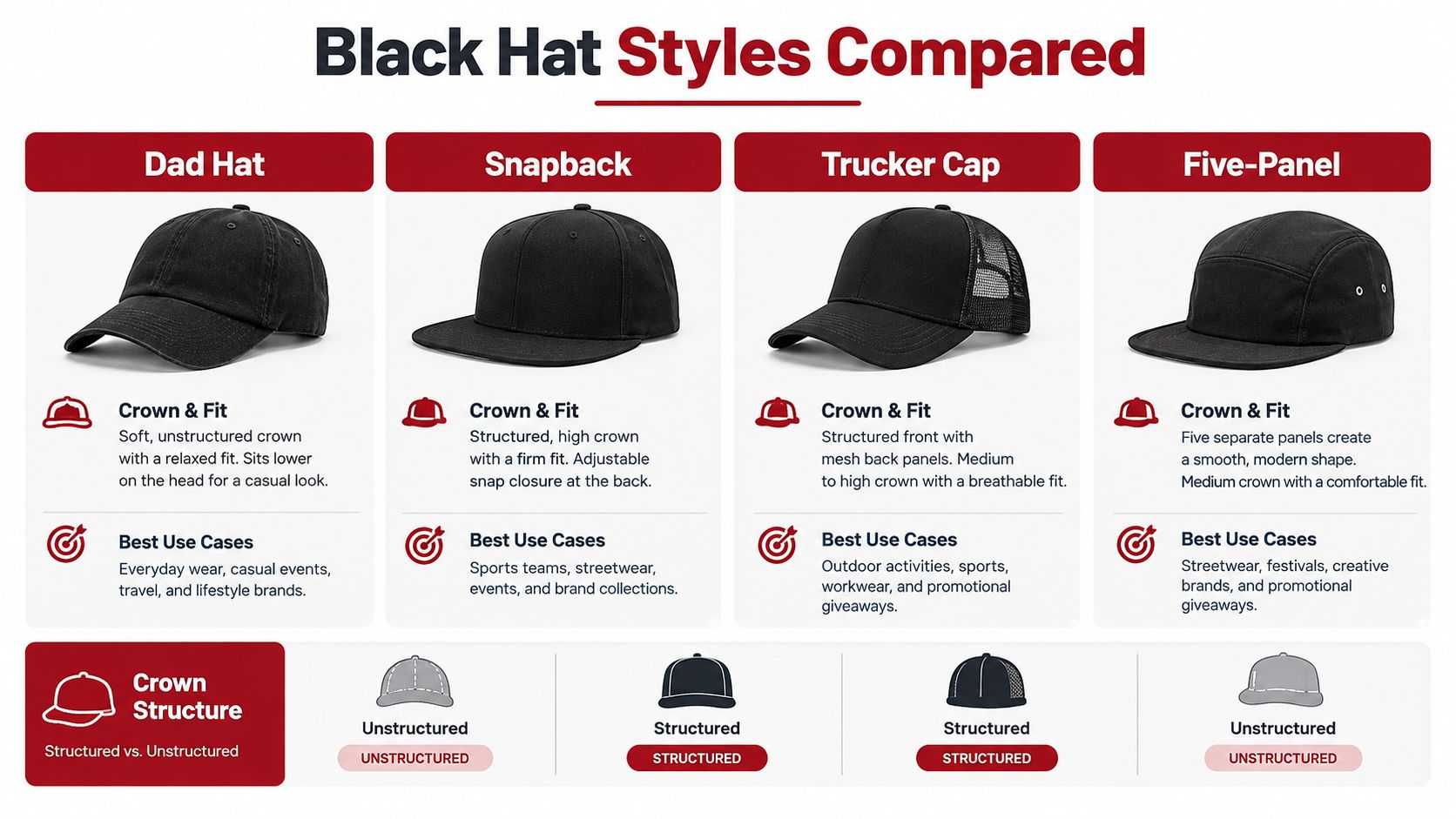
- Dad hats: Low profile, unstructured, curved brim. They suit casual uniforms, cafes, and broad adult audiences, and they pack easily for events. The soft front limits how crisp large embroidery looks.
- Snapbacks: Structured crown, flat or curved brim, adjustable plastic closure. They hold shape for bold front logos and suit teams and streetwear resale, but the higher profile doesn't flatter every wearer.
- Trucker caps: Foam or fabric front with mesh back panels. Airflow makes them practical for outdoor crews and summer events, and the front panel takes patches and printing well.
- Five panel caps: A single front panel without a center seam, which gives cleaner space for wide logos and printed graphics.
- Six panel caps: Traditional construction with a center seam. Structured versions support embroidery and hold a uniform silhouette across a staff.
- Beanies, bucket hats, and visors: Seasonal or role specific options. Beanies suit cold weather crews, bucket hats suit festivals and sun coverage, and visors suit tennis, golf, and service roles where a full crown feels hot.
- Ponytail and rope styles: Ponytail openings solve a real fit problem for long hair, while rope details add a retro accent for golf and lifestyle merch.
The visual below compares four common shapes side by side.
Structure, material, and heat
Structured crowns keep their shape with buckram behind the front panels, so logos sit flatter and the cap looks consistent across a group. Unstructured crowns feel softer and more casual, but they can wrinkle in cartons and pucker around dense stitching. Neither is better. Match structure to how formal the finished hat needs to look and how it'll be stored and shipped.
Material carries a real comfort trade off. Dark textiles absorb more visible and infrared radiation and convert that energy into heat. In controlled solar radiation testing, the temperature measured at the back of black fabrics was approximately 5 to 10°C higher than reflective or white control fabrics after sunlight exposure. That testing measured fabric, not finished hats, so treat it as an engineering indicator rather than a guaranteed on head temperature.
For hot weather programs, specify mesh trucker panels, lightweight cotton, polyester performance fabric, or ventilation eyelets, and judge the whole cap. Weave density, coating, lining, and moisture transport all affect how warm it feels. Cotton twill embroiders cleanly and suits indoor uniforms. Polyester performance fabric dries faster for athletics and delivery work. If you're narrowing options, the hat style guide for comparing crown shapes and closures helps you pair each construction with its decoration limits.
A simple selection method works. Shortlist two styles, decorate one sample of each, and have actual wearers test them in the intended setting, indoors and out. Keep the style that still looks right after a day of wear, not the one that looked best on a screen.
Build a Practical Black Hat Size Assortment
Sizing is where bulk orders waste money. A product labeled one size is a starting point, not a fit guarantee, because crown depth, panel shape, and closure range change how the same label performs. Two adjustable black caps can fit the same person completely differently.
Separate three different measurements
A product size is what the supplier prints in the catalog. A measured head circumference is what you get when wearers measure above the ears and across the forehead. A buyer defined size label is the simple system you use internally, such as youth, adult standard, and adult large. Confusing these three is how a team ends up with caps that are technically adjustable and practically unworn.
Closures matter as much as circumference. Snapbacks adjust in fixed steps and can leave a gap for smaller heads. Hook and loop straps adjust continuously but can catch hair. Metal buckle sliders look cleaner for staff uniforms and adjust smoothly. Fitted and stretch styles remove the closure entirely, which means your size assortment has to be more accurate because there's no adjustment to absorb a bad guess.
Estimate quantities from your actual population
- Staff programs: Count current employees, then add a replacement allowance for turnover, loss, and damage so new hires aren't waiting on a reorder.
- Teams: Use the roster, coaches, and a small reserve for late signups, and confirm youth versus adult sizing before decoration starts.
- Events: Base the count on expected attendance and how many attendees will realistically take and wear a hat, not total registrations.
- Resale: Weight the assortment toward the sizes your previous apparel sales moved fastest, and keep the first run narrow until you have sell through data.
One size fits most is a label, not a promise. A crown that's too shallow or a closure at its last snap tells you the assortment is wrong.
Request physical samples or exact measurements before committing. Have the smallest and largest headed people in your group try each style, since edge cases reveal problems averages hide. Record which closure settings they used. If several wearers max out the adjustment, you need a larger option in the mix. If the cap sits over ears on smaller wearers, add a youth or low profile style rather than forcing one blank to cover everyone.
Finish with a written size forecast you can hand to a supplier. List style, closure, size label, quantity per size, and reserve units separately. That document prevents the common bulk mistake of ordering a single quantity and hoping distribution sorts itself out. It also makes reorders cleaner, because you can compare what you forecast against what people took and adjust the next assortment with evidence instead of memory.
Set the Right MOQ and Total Order Budget
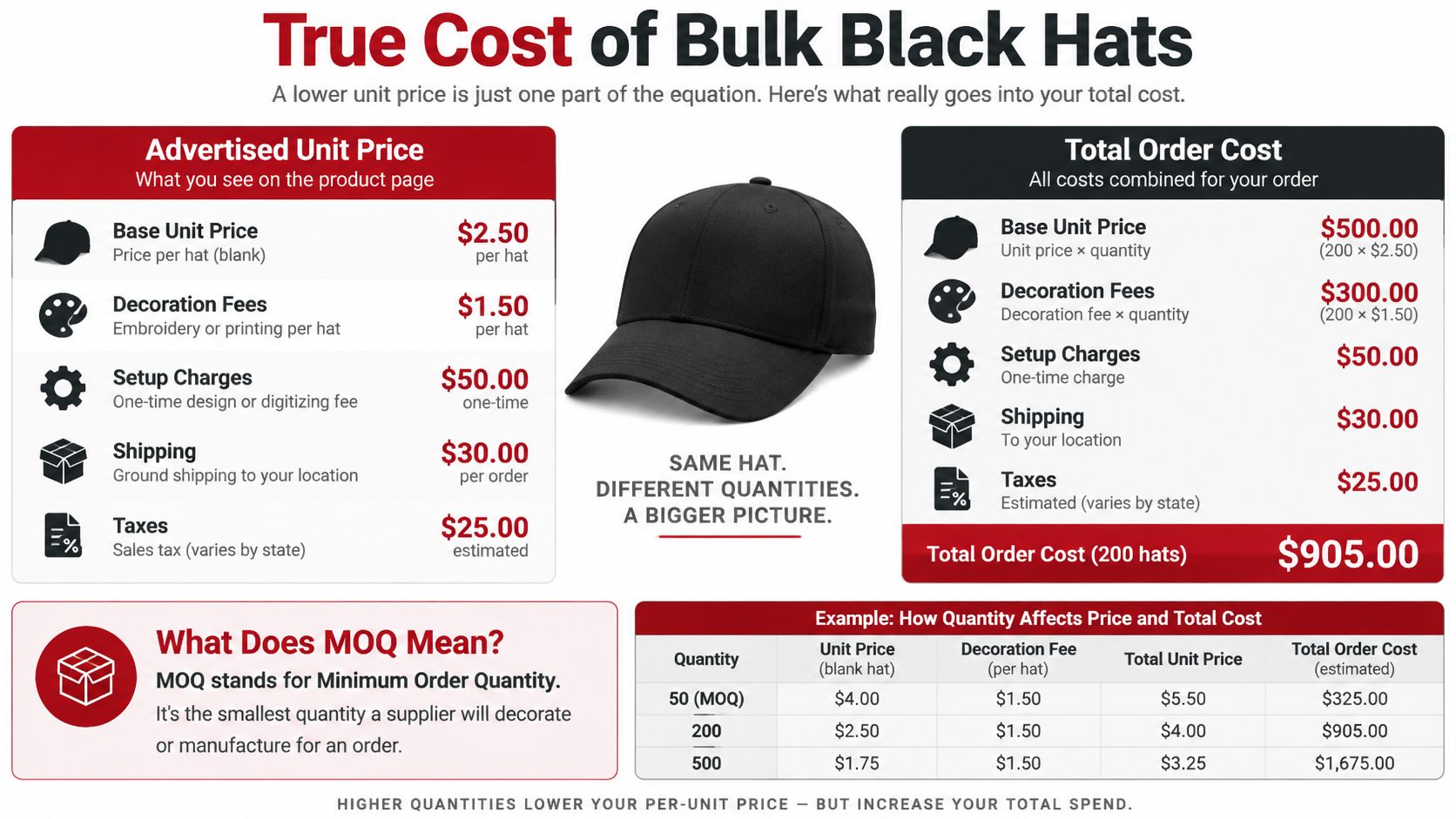
MOQ is the smallest quantity a supplier will decorate or manufacture under a specific run. Don't confuse a decoration minimum with blank stock availability. A supplier may sell you a small number of blank black caps while requiring a larger run per logo, per thread color change, or per size. Ask which minimum applies to your exact order before you budget.
Here's the cost picture most quotes leave out.
Build your quantity from demand, not price breaks
Start with confirmed need. Count staff, roster members, or committed buyers first. Add expected event takers, then a reserve for damaged, lost, or mismatched units. Subtract usable stock you already own. That total is your working quantity, and only then should you check whether a price break sits close enough to justify ordering up.
Most buyers aren't working with large, formal budgets. A 2025 industry survey found that the majority of promotional product buyers spend under $5,000 annually, while only 29.4% maintain a formal annual promotional products budget. For a small business or nonprofit, tying cash up in excess hats competes directly with other spending. A test run that sells through teaches you more than a bulk discount on unproven inventory.
| Decision Factor | Small Test Run | Larger Bulk Order |
|---|---|---|
| Unit price | Higher per hat | Lower per hat |
| Fit risk | Low, problems surface early | High if sizing is untested |
| Logo risk | Easy to revise artwork | Costly to redo at scale |
| Cash tied up | Limited | Significant |
| Best for | New brands, first events, unproven demand | Stable uniforms, predictable attendance, proven resale |
| Reorder need | Likely, so confirm stock continuity | Less urgent, but shade matching matters |
The short video below walks through how minimums and price breaks interact on a real order.
Price the delivered hat
Add the blank, decoration, setup or digitizing, thread or patch charges, shipping, and taxes, then divide by usable hats rather than ordered hats. A damaged or unwearable unit still cost money. If you're comparing suppliers, use the guide to minimum order requirements for custom hats to check how per logo minimums affect your math.
Ask direct questions before you pay. What's the per logo minimum, and does it reset per size or color? Are setup fees charged once or per design? Where are the price breaks, and what's the total spend at each one? Will this exact blank and black shade be available for a reorder, and how long does a reorder take? Set a reorder trigger based on remaining stock and lead time, so you reorder while you still have hats to hand out. A larger order makes sense when attendance is predictable, the design is final, and fit is proven. Until then, the lowest risk quantity is the one that covers confirmed demand plus a modest reserve.
Choose Embroidery Patches or Printing
Decoration is a branding and inventory choice, not just a finish. A simple logo on uniform caps calls for a different method than detailed artwork for a limited release. Match the decoration to the design, how the hat will be worn, and the amount of risk you can accept on the order.
Embroidery for logos that need texture and permanence
Embroidery stitches thread directly into the panel, giving logos and monograms a raised finish suited to company uniforms and team caps. Light and saturated thread colors stand out against black, while 3D puff adds height to bold, uncomplicated lettering. Fine lines, tiny text, and gradients are harder to reproduce. Dense stitching can also pucker an unstructured crown.
Before approving artwork, confirm stitch count, placement, and thread colors with the decorator. As one option, in-house embroidery with minimums starting at six pieces per logo is available from Dirt Cheap Headwear, along with 3D puff and fine-detail stitching. A small decorated run can test the logo and construction before you commit to a larger inventory.
Patches for flexibility across programs
Patches separate the branding from the blank. The same patch can go on trucker caps in summer and beanies in winter, or undecorated black hats can be held for different teams, sponsors, or events. Woven patches accommodate finer detail than stitched logos. Leather- or rubber-style patches offer a distinct retail look.
Account for attachment and fit. Sewn patches last, but add a production step. Heat-applied patches are faster, though bond quality depends on the fabric and care. Check the patch against the front panel: an oversized patch on a low-profile dad hat can curve awkwardly and lift at the corners.
Printing for large type and detailed graphics
Printing handles oversized text, numbers, and detailed or multicolor graphics that thread cannot reproduce. It suits event dates, roster numbers, and limited-edition artwork on five-panel fronts. On black fabric, ask how the printer handles underbase and ink opacity. Without enough coverage, colors can sink into the twill and look muted. For outdoor crews, check how the print holds up to repeated washing and sun.
Match method to artwork, not habit: Embroider a bold, simple logo. Use a patch for a detailed badge. Print a large graphic or fine type.
A local sports team with a simple two-letter mark may choose structured embroidered caps that can stand up to a season of washing. A landscaping company may use patches to carry one brand across caps and beanies. A reseller with detailed artwork may print it for a limited release, where the graphic is the product. Each choice carries different trade-offs in appearance, production steps, and wear. Approve a decorated sample before committing the full order.
Order Sample Inspect and Fulfill with Confidence
Approving a digital mockup isn't approving a hat. Screens hide thread sheen, panel shade differences, and how a logo curves across a crown. The sequence below keeps a bulk order controlled from sample to distribution.
Step through approval in order
- Order a physical sample: Get the exact blank in black, in the sizes you'll buy, and wear it before any decoration decisions.
- Approve a decorated preproduction sample: Check logo size, placement, thread or ink color against black, and spacing from seams and eyelets.
- Record written standards: Note acceptable shade, stitch density, thread tension, print registration, closure hardware, and brim shape, with photos of the approved sample.
- Confirm production details: Lock sizes, quantities per size, packing instructions, and delivery addresses before the run starts.
Black stock needs specific attention during inspection. Lint and light dust show immediately. Dye marks and shade variation between panels turn one cap into two tones under bright light. Crooked embroidery, puckering, damaged eyelets, warped brims, and wrong closure hardware all stand out more on a dark, uniform surface. Inspect samples under the lighting your wearers will be seen in, including daylight.
Inspect large orders statistically
Inspecting every unit isn't practical at scale, and pretending otherwise leaves you with no real standard. Agree on a sampling plan before production. ISO 2859-1 and related AQL systems use lot size, inspection level, sample size, and an acceptance number to determine whether a shipment passes, and they do not promise that a specific percentage of every shipment is defect free. In apparel examples, a lot of that scale can be checked through a defined sample with separate thresholds for major and minor defects, so define in advance which flaws reject a hat outright and which are acceptable.
Require random sampling across cartons, sizes, and production lots, not a hand picked top layer. The quality assurance guidance for checking decorated headwear orders is useful for building your receiving checklist. Compare pulled units against your approved sample photos for shade, embroidery registration, and brim shape. Count per size, not just per carton, since a correct total can still hide a wrong size split.
Pack and fulfill so distribution stays simple
Ask for cartons packed and labeled by size and style, with the size split printed on the outside. That saves hours when you're handing hats to a team or shipping resale orders. For multi location or worldwide delivery, confirm shipping terms, who handles customs paperwork, and whether cartons can ship directly to each site instead of through your office.
On arrival, do a receiving check the same day. Open cartons from different parts of the shipment, verify counts, try on edge sizes, and photograph any defects while the supplier can still respond quickly. Pull replacement stock aside before general distribution so a damaged or lost hat doesn't leave one staff member unmatched. Store black caps away from direct sunlight and dusty shelving, since fading and lint undo the clean look you bought them for. Keep the approved sample, your written standards, and the inspection notes with the reorder file. That record turns your second order into a repeat of a known result rather than a fresh negotiation.
Use This Black Hat Bulk Buying Checklist
Run through this list before you approve payment on black hats in bulk. Each item closes a decision that becomes expensive to reopen after production.
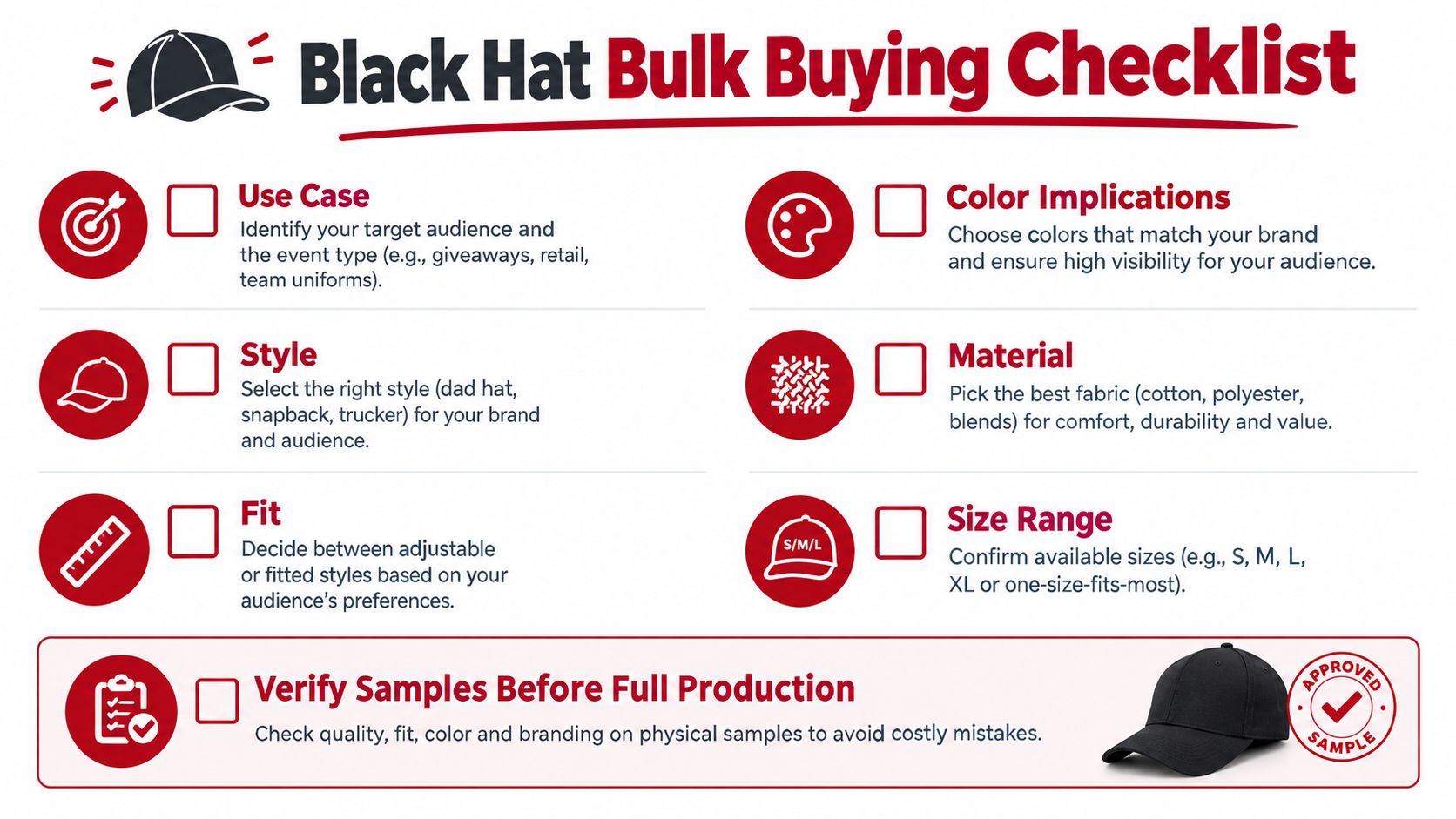
- Use case confirmed: Wearer, setting, and whether hats are uniforms, giveaways, or resale are written down.
- Color implications checked: Logo contrast, lint exposure, sun exposure, and unintended cultural signals reviewed on a real sample.
- Style and material matched: Crown structure, panel count, fabric, and ventilation fit the setting and decoration method.
- Fit and size assortment set: Closure type tested on smallest and largest wearers, quantities assigned per size with a reserve.
- MOQ and budget priced: Per logo minimums, setup, decoration, shipping, and taxes included in a delivered cost per usable hat.
- Decoration approved physically: Method chosen for the artwork, decorated sample inspected for placement, color, and finish.
- Inspection standard agreed: Acceptable shade, stitching, hardware, and brim shape documented with photos before production.
- Fulfillment and reorder planned: Cartons labeled by size, replacement stock reserved, reorder trigger set against lead time and stock continuity.
Test buyers should validate demand and fit first, even if the unit price stings a little. Established programs should focus on documented standards and confirming the same blank stays available. Both groups should think about end of life before ordering excess, because UN-Habitat reported in 2025 that global textile waste reaches about 92 million tonnes annually, with less than 15% of textiles recycled and more than 73% landfilled or incinerated. A durable hat people keep wearing, ordered in the right quantity, beats a larger run that gets discarded. Ask whether spare units can be redecorated, donated, or resold rather than stored indefinitely.
Compare the complete delivered outcome, not the lowest catalog price. The right order is the one your actual wearers put on, keep, and reorder without surprises.
Start with a small decorated test run, confirm fit and logo quality on real wearers, then scale your black hats in bulk order with documented standards and a clear reorder trigger. Dirt Cheap Headwear carries wholesale black blanks across dad hats, snapbacks, trucker caps, beanies, and more, with in house embroidery, custom patches, and printing to match your artwork. Visit Dirt Cheap Headwear to pick your styles, request samples, and build your first order around proven fit instead of guesswork.