
White Dad Hat Guide: Styles, Decoration, and Care
You've got a logo ready, an event or staff launch coming up, and a browser full of white caps that look almost identical. Then you notice different crowns, fabrics, closures, and decoration options. Picking a white dad hat isn't difficult once you stop shopping by the front photo and start checking how the cap will work.
Why the White Dad Hat Works for So Many Buyers
A small business owner spreading blank caps across a desk has a practical problem: the staff need to like wearing them, the logo needs to look right, and the finished order needs to make financial sense. A white dad hat is a sensible starting point, but the cheapest blank isn't automatically the right purchase.
Look at the cap itself before imagining your branding on it.

Buy for the person wearing it
My recommendation is to start with the wearer's routine. A café employee needs something comfortable through a shift. A fundraiser needs merchandise supporters would choose outside the event. A clothing brand needs a blank that feels deliberate rather than like leftover promotional stock.
Those are different jobs. Don't expect a logo to fix a cap that sits awkwardly or feels wrong.
For an additional fit reference, Blitz Surf Shop's sizing and style tips for caps can help you think beyond the product photograph. Compare the shape with a cap your intended wearer already enjoys, then request a physical sample before committing.
Decide what matters before comparing prices
Use these priorities to narrow the selection:
- Wearability: Try the cap on, adjust it, and check for pressure around the forehead and ears.
- Decoration space: Compare your artwork with the actual usable crown area, not the whole front of the hat.
- Maintenance: Decide whether the wearer can follow a gentle care routine or needs a more forgiving option.
- Repeat availability: Ask whether you can reorder the same blank rather than finding a replacement after launch.
A good purchase balances those needs. For a working uniform, I'd favor easy care over elaborate decoration. For retail merchandise, I'd spend more attention on fit and finish than on adding another logo placement.
What Makes a Dad Hat a Dad Hat
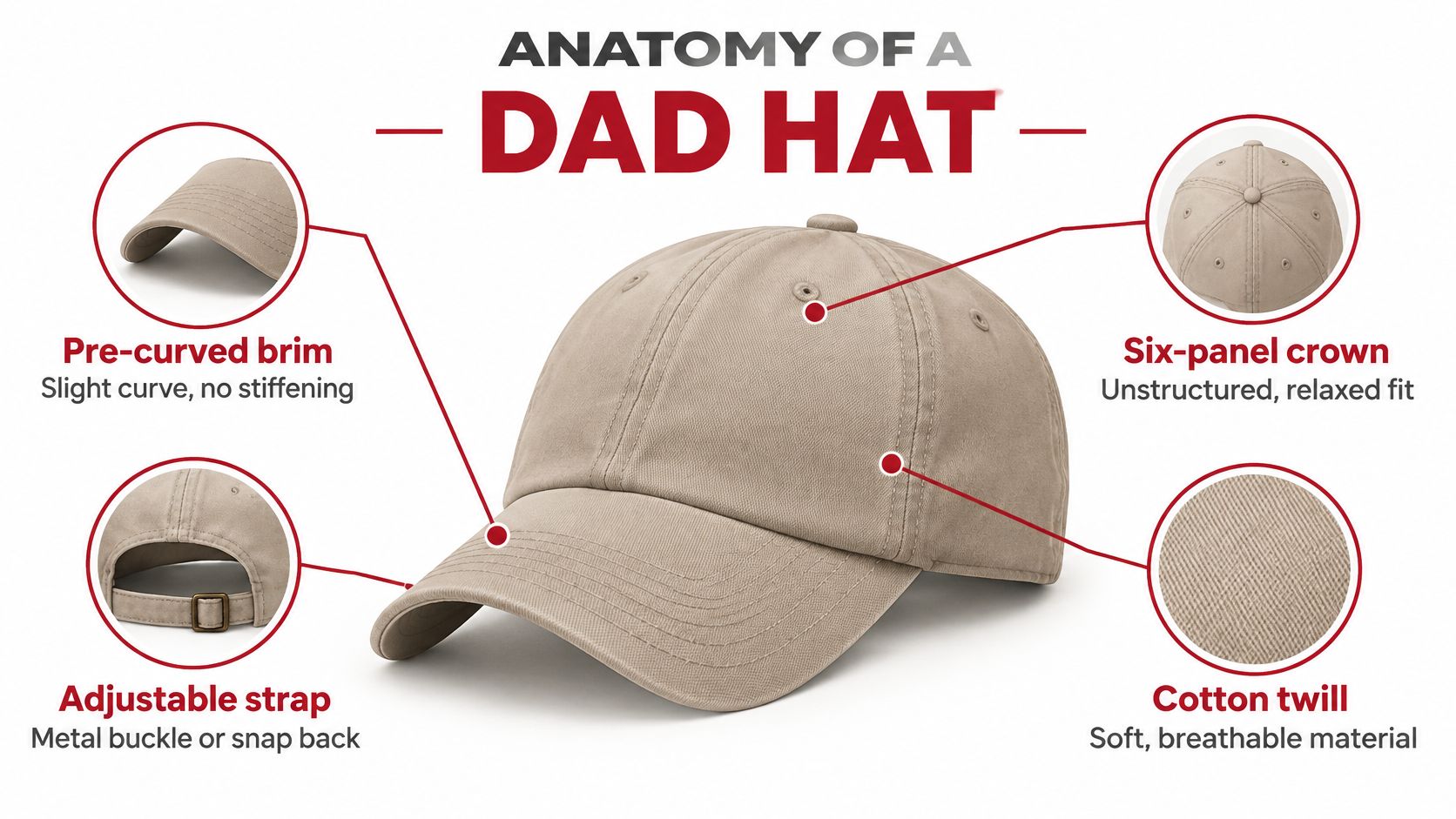
A dad hat is a relaxed baseball cap, not a separate invention. Its history runs through baseball headwear, including the Brooklyn Excelsiors' early cap design and later casual styles; ’47 introduced the low-crown, curved-bill Clean Up in 1998, according to this history of the baseball cap.
For buying purposes, concentrate on crown softness, profile, brim shape, and adjustment. Don't accept the category label as a complete specification.
Use the diagram to locate those parts, then check the listing and sample for the exact construction.
Check the crown and brim separately
For the relaxed look, I recommend an unstructured crown that yields when you press it rather than holding a rigid front. If you're uncertain about that distinction, compare structured and unstructured hats before choosing your blank.
Don't mistake a soft crown for a completely soft hat. Check the brim separately and ask about its insert, particularly if washability matters. The illustration's reference to “no stiffening” shouldn't replace the manufacturer's specification.
On the sample, inspect these details:
- Profile: Check how high the crown sits and whether it touches the tops of your ears.
- Panel seams: Identify any seam crossing the intended decoration area.
- Closure: Open, adjust, and close it yourself. Look for a comfortable way to manage the loose strap.
- Interior: Feel the sweatband and inspect the backing behind any decorated area.
- Eyelets: Check their placement without assuming visible ventilation alone guarantees comfort.
Choose fabric by touch and intended care
Ask for samples of washed cotton twill, brushed cotton, and any performance fabric you're considering. Compare surface texture, crown body, and the care label rather than assuming that “performance” means better for every wearer.
For an everyday merchandise cap, my starting choice would be a cotton blank with a finish I've handled. For active uniforms, I'd compare that sample against a washable performance option and have the intended users try both.
If you're still comparing how different silhouettes work with everyday clothing, Cedar & Lily Clothier's hat picks offer another style reference. Make the final decision on the sample, though, not on how the cap looks on somebody else.
The Market and Why White Keeps Winning
White is a useful branding color. That doesn't mean anyone can credibly tell you its worldwide share of dad-hat sales.
One estimate valued the global baseball-cap market at approximately USD 17.98 billion in 2021, with a projection of USD 25.64 billion by 2029, according to baseball-cap market estimates. Those are category figures, not measurements of white dad hats specifically.
Separate useful context from unsupported numbers
The graphic below contains color-share, wholesale-price, and growth figures that aren't supported by the market evidence cited above. Don't use its figures for purchasing, pricing, or sales forecasts. There's no verified global white-dad-hat share established here.
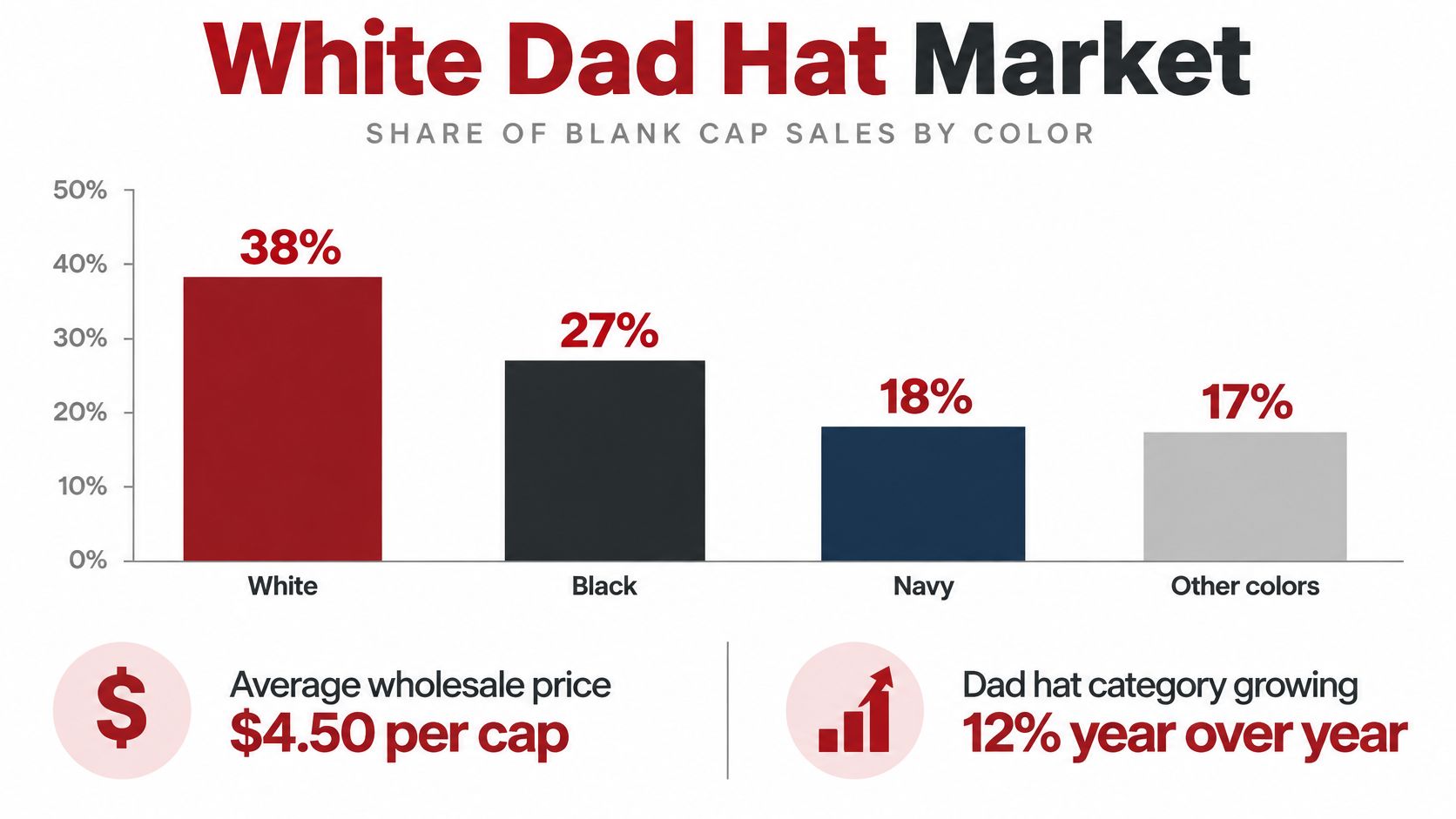
The stronger commercial argument is visual and practical. White gives buyers a neutral background for different brand palettes and a clear contrast for colored decoration. For a business ordering across departments or campaigns, that flexibility can matter more than following a supposed color trend.
Buying rule: Use market reports to understand the category. Use your own samples, sales, and reorder history to decide which color deserves inventory.
Judge the finished product, not the blank color
I'd compare a white sample against your actual shirts, packaging, and logo thread before approving it. Check it indoors and outdoors, and photograph the finished sample against the backgrounds you normally use.
- For bold branding: Test the actual thread or print color against the white fabric.
- For tonal decoration: Check whether customers can read the design without ideal lighting.
- For retail: Show the decorated sample to intended buyers before committing to stock.
White won't make an ordinary blank feel premium by itself. My recommendation is to prioritize a clean finish, a comfortable fit, and restrained decoration. Those are details you can inspect directly, unlike an unsupported claim that a particular color dominates the market.
Decorating a White Dad Hat Without Ruining It
Choose the decoration method after the blank and artwork are together. A logo that looks excellent on a screen still needs to work across a curved, flexible surface. Ask the decorator to identify compromises before you pay for production.
For a first order, my default recommendation is flat embroidery with simplified artwork. Treat puff, patches, and printing as deliberate alternatives, not automatic upgrades.
Match the method to the artwork
Flat embroidery is where I'd start for a compact name or uncomplicated symbol. Ask to see the smallest lettering, the edges, and the interior backing on a physical sample. Don't approve it solely from a digital rendering.
For puff embroidery, ask the decorator which elements need changing. I'd reserve it for bold artwork and approve the actual result on the selected blank rather than assuming a design from a structured cap will transfer unchanged.
Patches deserve a separate attachment decision. Ask whether the proposed patch is sewn on, heat-applied, or removable, and request care instructions for that exact combination. For heat application, get confirmation that the blank and attachment process are compatible.
For printing, distinguish screen printing from a transfer method such as DTF. Request an example on comparable fabric, then inspect its feel, flexibility, and edge finish. Don't choose printing purely because the artwork contains details you haven't tried simplifying.
Matching Decoration Methods to Common Logo Types
| Logo type | Best method | Watch out for |
|---|---|---|
| Simple wordmark | Flat embroidery as the starting option | Tiny lettering and placement across seams |
| Bold initials | Puff embroidery, subject to sampling | Whether the design suits the process |
| Badge-shaped artwork | Custom patch | Attachment method and patch stiffness |
| Detailed multicolor illustration | Printing, after sample approval | Surface feel and fabric compatibility |
| Branding intended to change | Removable patch system | The appearance of the attachment base |
Use this comparison of different branding styles to prepare questions for your decorator, not as a substitute for testing your own design.
Quote the whole job
Ask the shop to itemize setup, artwork preparation, decoration, placement, and any sample charge. Get minimums and turnaround expectations for each proposed method rather than assuming embroidery, patches, and printing share the same ordering rules.
- Front center: Have the decorator mark the usable area on your chosen blank.
- Side or back: Check clearance from seams, adjustment hardware, and the opening.
- Under-brim: Request a separate feasibility check before including it in the design.
Approve the cap from the inside as well as the outside. The wearer has to live with the decoration, not just look at it.
Finally, request washing guidance for the finished hat. The blank's care label alone doesn't settle how an added patch, transfer, or embroidered design should be maintained.
Where a White Dad Hat Actually Fits In
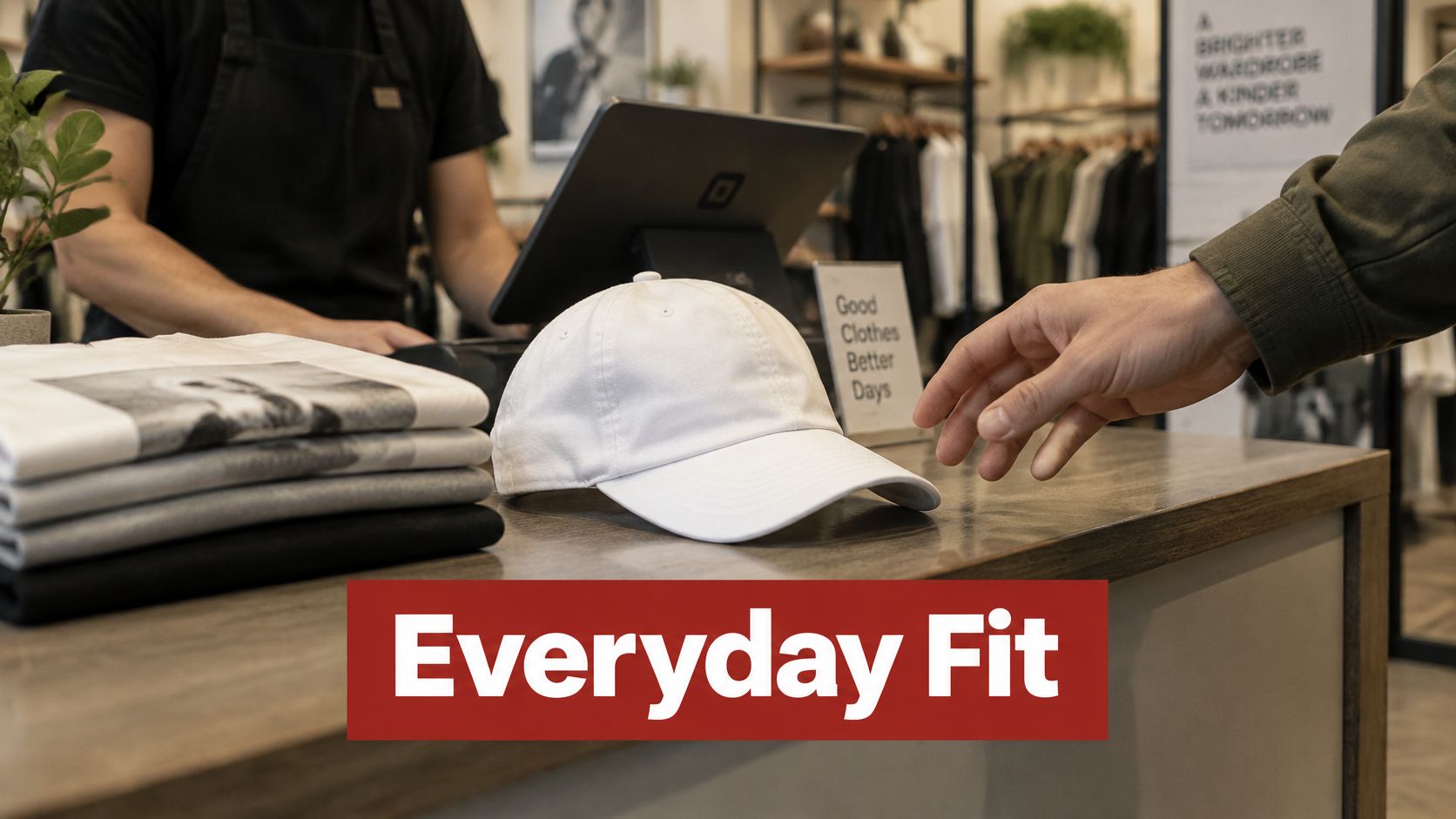
A white cap on a shop counter needs to make sense beside the rest of the merchandise. I'd place the sample next to the shirts or uniforms it's meant to accompany before deciding whether the finished design belongs.
This is the kind of simple display that lets you judge the whole combination.
Match the hat to the job
For a café or shop uniform, I'd pair a restrained front logo with a plain apron or work shirt. Have employees try the finished sample during their usual tasks, then collect feedback about fit and care before expanding the order.
For a team or coaching program, compare the hat with the existing kit. Give wearers a clear adjustment demonstration, and keep the approved blank's identification with your uniform records so replacements don't become guesswork.
For a nonprofit fundraiser, I'd favor a design supporters can wear after the campaign. Consider whether the organization's mark is enough without adding a date, venue, sponsor list, and slogan to the same crown.
For creator merchandise, make the hat something you'd willingly wear without the launch announcement. Test it with an ordinary T-shirt, denim, or whatever clothing already represents the brand.
Use video as another viewing angle, then make the decision from a physical sample.
Outdoor use needs a separate check
Don't confuse a light color with certified protection. Testing of white cotton reported 67.62% solar reflectance, but also 27.08% solar transmission, showing why fabric construction matters alongside color in this research on white-cotton thermal behavior.
That supports considering white for sunny conditions, not promising that every white cap will keep the wearer cool. Request fabric information and have users assess comfort in the conditions where they'll work.
For UV exposure, ask for the specific blank's tested protection rating. Research on fabric construction and ultraviolet protection makes clear that white cotton shouldn't be treated as reliable sun protection without suitable construction and testing.
For outdoor staff or events, describe an untested cap as shade support, not a replacement for sunscreen or other protective measures.
Cleaning a White Dad Hat the Right Way
Read the finished hat's care instructions before reaching for stain remover. You're cleaning fabric, a brim, a closure, and decoration together. The most restrictive component should guide your approach.
Aggressive whitening isn't a reliable rescue plan. A survey found that 32% of Hispanic consumers who used bleach on white clothing had experienced yellowing or dinginess, according to this report on white-clothing stain-removal difficulties. That's a clothing survey, not a hat-specific result, but it's a good reason not to improvise with bleach.
Start with the fabric and a hidden test
For cotton, begin conservatively with label-approved cold-water spot treatment. Don't assume a washable cotton crown means the entire cap can be soaked.
For polyester or performance fabric, follow the instructions for the actual product rather than borrowing a cotton-whitening routine. For wool blends or an unidentified fabric, get manufacturer guidance before attempting a full wet clean.
Test any permitted cleaner in a discreet area, including on colored decoration where practical.
| Stain or problem | Recommended starting approach | Avoid |
|---|---|---|
| Sweat or makeup | Gently spot-treat the affected area with a label-approved product | Scrubbing across the logo |
| Food or drink | Blot residue and use cold-water spot treatment where permitted | Aggressive rubbing |
| Grass or dirt | Remove loose debris gently before treating the remaining mark | Grinding debris into the fabric |
| Yellowing | Check whether oxygen-based whitening is permitted | Escalating straight to chlorine bleach |
Preserve the crown and decoration
Use oxygen-based whitening only where the care instructions permit it. Don't use chlorine bleach unless it's explicitly approved for the complete hat, including its decoration. Strong whitening can leave uneven results around dense embroidery.
Avoid repeated soaking as your routine for an unstructured crown. Work locally where possible, use low friction, and rinse permitted cleaning products out carefully.
Care priority: An evenly maintained hat with intact branding is more useful than a aggressively whitened cap with damaged decoration.
After a permitted wash, gently reshape the crown and let it air-dry on a clean support without forcing it into a new shape. Don't wring it or add heat unless the manufacturer specifically allows it.
Store the dry cap without crushing the crown beneath heavier items. For a uniform program, give wearers the same written instructions; these hat-cleaning tips provide a useful starting point for building that care sheet.
Designing for What Happens After the First Wear
A launch photograph isn't the end of the product's job. Before approving a permanent design, ask whether you'd still want the hat after the campaign, season, or ownership changes.
The broader resale context makes that question worth asking. The 2025 ThredUp Resale Report projects the global secondhand apparel market will reach $367 billion by 2029 and reports that 41% of younger consumers are less likely to buy apparel without good resale value. Those findings concern apparel broadly; they don't establish resale demand or a resale premium for used hats.
Keep future use possible
My recommendation is to separate lasting identity from temporary information. Put the brand or organization on the hat if that identity will remain relevant. Think harder before permanently adding campaign details that nobody will want later.
- For changing campaigns: Consider a removable patch system and inspect how the cap looks when the patch is off.
- For permanent branding: Choose a placement that leaves room for future personalization.
- For future owners: Include fabric and care information rather than relying on the original buyer to remember it.
Thread color deserves a realistic sample check, too. Compare how the decoration looks against both a fresh blank and a worn sample, if you have one available. Don't promise that a particular thread will conceal yellowing or restore condition.
Be honest about white
White offers styling flexibility, but visible sweat, makeup, and dirt can hurt perceived condition. Removable decoration doesn't undo wear, and permanent embroidery shouldn't be sold as easily reversible.
For resale or donation, describe the actual condition and disclose remaining attachment areas or marks. For reuse within your own organization, keep clean, serviceable caps available for people who actively want them rather than treating every returned hat as suitable for reassignment.
Design for another useful wear, not an assumed resale payout.
Ordering White Dad Hats in Bulk Without Surprises
Approve a finished physical sample, not just a logo proof. Keep that sample as your reference for the delivered order and any future reorder.
Put the specifications in writing
- Blank identity: Record the manufacturer, style, fabric, white color designation, crown construction, and closure.
- Fit: Confirm the adjustment range and arrange wearer testing where practical.
- Decoration: Approve placement, dimensions, thread colors, backing, and patch attachment where applicable.
- Order terms: Request minimums, setup charges, sample costs, and the complete delivered quote.
- Timing: Separate proof approval, production, dispatch, and expected delivery in the written schedule.
- Problem handling: Ask how to report damaged stock, decoration errors, substitutions, and shortages.
Plan the reorder before launch
Ask whether later batches may vary in white shade or fabric finish. Find out how stock notifications work and whether the supplier will contact you before substituting a blank.
Keep the approved artwork, order specification, care instructions, and sample together. When stock arrives, compare it with that reference before distributing or decorating the entire delivery. If something doesn't match, document it and contact the supplier while the order is still intact.
Dirt Cheap Headwear offers wholesale blanks and custom-decorated headwear, including embroidery, patches, and printing. Visit with your logo, intended use, and preferred white dad-hat construction, then ask about a suitable blank, a finished sample, and the requirements for your order.