
Black Flat Cap Guide: History, Fit, and Customization
You've got a staff event, a team launch, or a small apparel run coming up. The black flat cap looks like the safe choice, so it's tempting to order the first attractive blank you find and send over the logo. That's how buyers end up with limp crowns, tight bands, faded black fabric, and embroidery that looks oversized before the first shipment leaves the supplier.
The biggest buying mistake is choosing the cap before defining who will wear it and where. A successful order starts with four decisions: the silhouette, the fabric, the fit, and the decoration method. Get those right, and black becomes an exceptionally practical blank canvas for uniforms, teams, brands, events, and retail collections.
Why the Black Flat Cap Keeps Winning Orders
Black works because it gives a group visual consistency without forcing everyone into the same outfit. It pairs with tailoring, denim, outerwear, sportswear, and work clothing, while its dark surface usually photographs cleanly in staff portraits and event shots. That versatility makes it a lower-risk color than a seasonal shade, but it doesn't make every black flat cap interchangeable.
Start with the audience. A corporate hospitality team may need a structured wool blend with restrained embroidery. An outdoor crew needs ventilation, sweat management, and resistance to repeated exposure. A fashion label may care more about crown profile, hand feel, and whether the blank looks intentional before any logo is added.
Four decisions before you order
- Shape: Choose a classic flat cap, ivy cap, or newsboy silhouette according to the wearer's face, hair, and clothing.
- Fabric: Match shell weight and construction to temperature, humidity, movement, and laundering.
- Fit: Measure head circumference, then test pressure points, crown space, and brim position on real people.
- Decoration: Select embroidery, a patch, or printing based on the front panel, logo detail, order size, and intended finish.
Black can look refined or severe. Texture decides much of that difference. A soft cotton cap feels relaxed, while dense wool or tweed gives the same color more authority. A glossy synthetic surface can look promotional if the silhouette and logo aren't carefully controlled.
Practical rule: Approve the blank cap before approving the logo. A decoration method can't rescue a poor crown or uncomfortable fit.
For fashion businesses, the cap also has to fit the wider selling experience. If you're deciding which platform suits fashion brands, treat the product specification and the online merchandising setup as one decision. Customers need clear views of the silhouette, fabric texture, sizing, and decoration, not just a black product photo.
Where the Black Flat Cap Actually Comes From
The black flat cap wasn't invented as a modern styling shortcut. Its roots sit inside a much older northern English flat-cap tradition, where the style was often called a “bonnet.” In 1571, England's Parliament enacted the Statute of Caps, requiring males older than six, apart from nobles and certain exempt groups, to wear woollen caps on Sundays and holidays. Anyone who ignored the requirement faced a fine of three farthings per day. The policy supported domestic wool consumption and trade, but it also attached the cap to ordinary working life rather than aristocratic dress.
The law was repealed in 1597, after approximately 26 years, but the garment had already settled into everyday use among tradesmen, apprentices, laborers, and other commoners. In England, “cap” gradually replaced “bonnet” before about 1700, while Scotland retained “bunnet” in Scots usage. Those terminology changes matter because they show how the style developed through local work, language, and class identity, not through one short-lived fashion cycle.
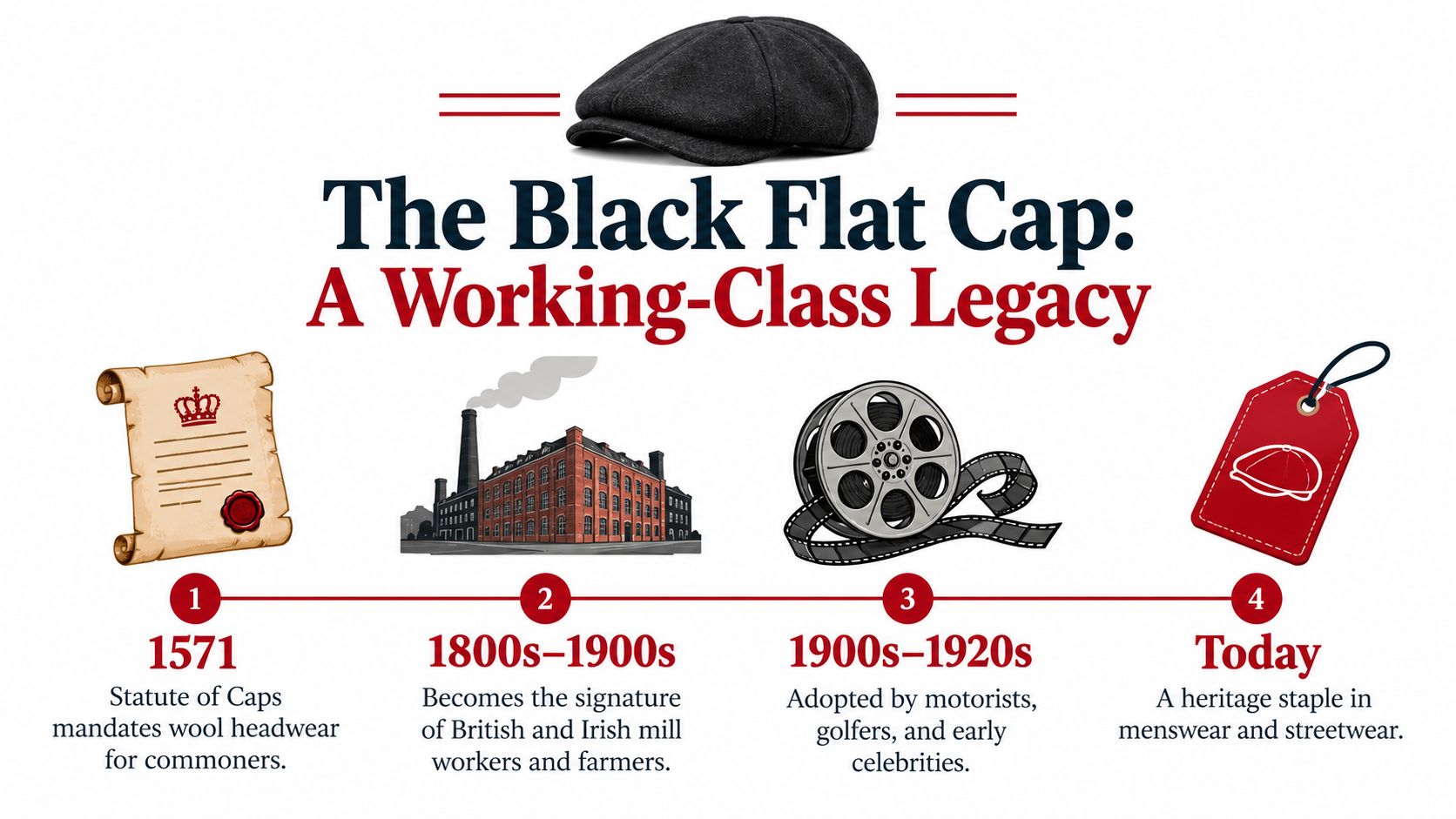
By the 19th and early 20th centuries, flat caps were common throughout Britain and Ireland, especially among working men in industrial and agricultural communities. That background explains why the shape still reads as practical and understated when it's made in plain black. It carries heritage, but not the formal signals associated with top hats, fedoras, or ceremonial headwear.
The style's history also gives buyers a useful advantage. A black flat cap can appear in a staff photo, product collection, or team uniform without being tied too tightly to one short trend. For a broader overview of how headwear styles developed, the history of headwear offers useful context.
Choose a clean crown and restrained decoration, and the cap feels established rather than theatrical. Choose excessive volume, shiny fabric, or a large front logo, and the same historical reference can become costume-like.
Classic, Ivy, and Newsboy Compared
The words “flat cap,” “ivy cap,” and “newsboy” often get used interchangeably, but they don't produce the same result on the head. Buyers should compare panel construction, crown volume, and brim length before they compare colors or logos.
| Silhouette | Panel Count | Crown Volume | Best For |
|---|---|---|---|
| Classic flat cap | Usually a low, integrated crown with a compact panel structure | Low | Corporate uniforms, minimalist outfits, polished everyday wear |
| Ivy cap | Commonly a streamlined multi-panel crown with a defined front | Low to medium | Sport-inspired uniforms, active casual clothing, travel |
| Newsboy | Often a fuller multi-panel crown with a buttoned top | Medium to high | Heritage styling, fashion collections, vintage-led events |
The classic flat cap is the safest choice for a broad audience. Its low profile sits close to the head, so it works with fitted coats, simple jackets, and clean uniforms. Choose it when your logo must remain secondary to the overall appearance.
The ivy cap has a sportier attitude. It usually gives the wearer slightly more crown presence without the round fullness of a newsboy. That makes it a strong option for golf-related apparel, active casual teams, and brands that want movement without looking like they've borrowed a period costume.
The newsboy is the statement shape. Its extra crown volume can complement a long face or thick hair, but it may overwhelm a smaller face or a wearer with a narrow frame. Don't choose it as a default uniform cap unless the visual identity deliberately leans vintage.
Fast fit rules by face and hair
- Rounder faces: A lower, cleaner crown and modest brim can create a sharper outline.
- Longer faces: A little extra crown volume can balance vertical proportions, making an ivy or restrained newsboy worth testing.
- Thick hair: Leave room in the crown. A compressed low-profile cap can flatten volume and look undersized.
- Curly hair: Test the cap after styling, not only on freshly brushed hair. Hair compression changes the fit quickly.
- Minimalist or corporate clothing: Choose the classic flat cap in a matte fabric.
- Relaxed or heritage clothing: Consider an ivy or newsboy, but keep the logo small and the texture natural.
For most first orders, I recommend the classic flat cap unless the collection already has a clear vintage or sports direction. It has the widest use range and gives decoration fewer opportunities to look forced.
Picking Fabric That Will Not Disappoint
A black flat cap for outdoor staff, event teams, or retail branding can look sharp at approval and fail after repeated wear. Fabric weight controls whether the crown stays crisp, collapses around the head, or feels uncomfortable in warm weather. Specify the shell composition, fabric weight, lining, sweatband, and colorfastness information before approving decoration. For broader shell-composition and weight comparisons, use this materials guide for hats.
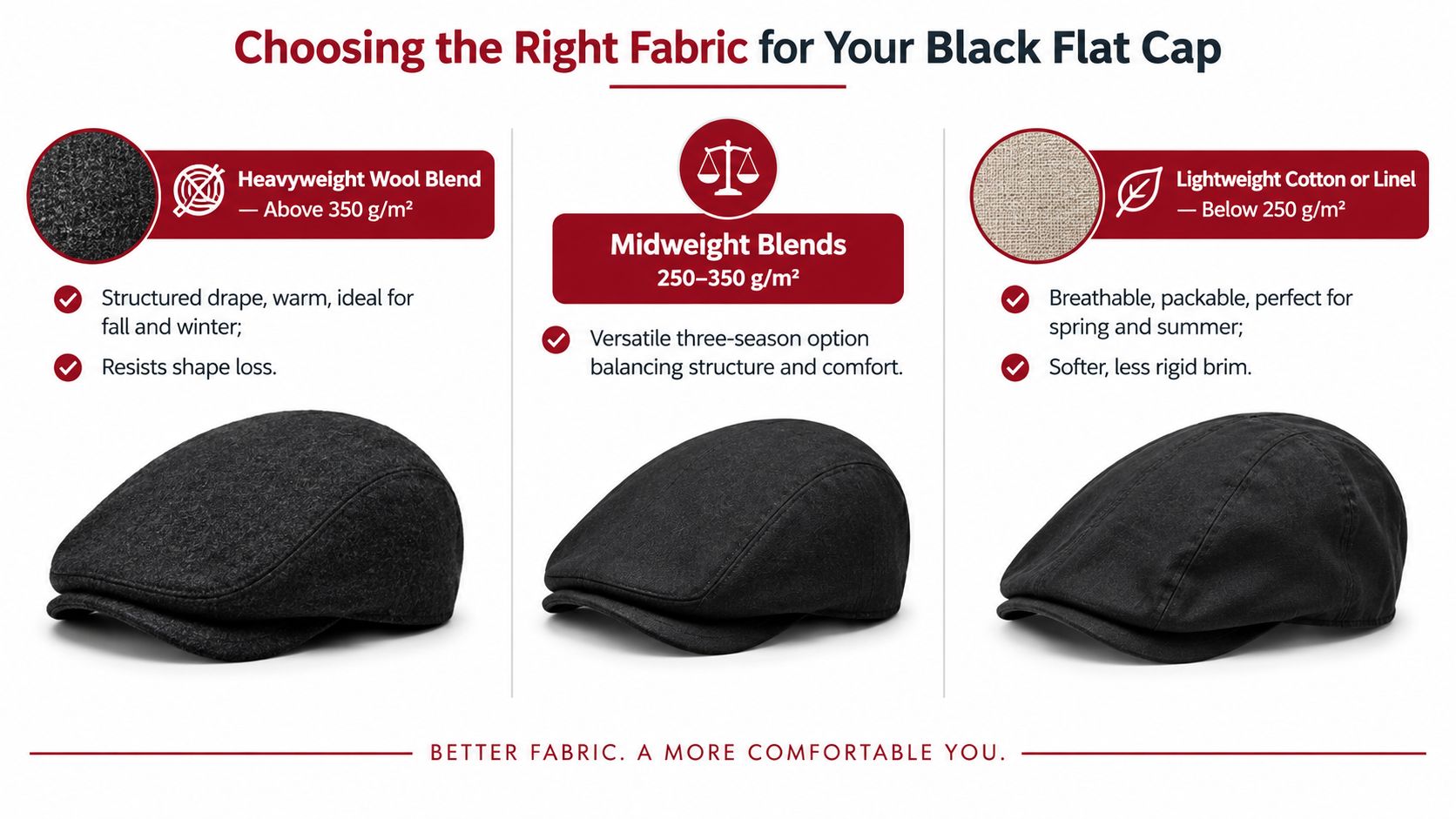
For fall and winter uniforms, request wool or a wool blend above roughly 350 g/m². The heavier shell gives the crown more structure, resists sagging, and holds its shape better in damp conditions. For warm-weather promotions, cotton, linen, or wool blends below approximately 250 g/m² offer more ventilation and a softer drape. These thresholds and their practical trade-offs are also outlined in this flat-cap fabric guide.
Match the shell to the assignment
- Cold-weather staff: Choose a structured wool or wool blend. It supports a polished silhouette and adds insulation.
- Summer promotions: Select breathable cotton or linen. Keep the lining light, especially for outdoor queues and long event shifts.
- Travel and outdoor work: Consider a technical or recycled synthetic with moisture management and better resistance to rain and repeated handling.
- Three-season retail stock: Use a midweight blend when one product must serve different climates. It balances structure with comfort.
Black requires strict quality control. Fading, crocking, and staining stand out on a dark surface, particularly when caps are worn outdoors or rub against pale clothing. Before placing a branded order, request supplier results or production samples covering light exposure, washing, and rubbing. The textile colorfastness standard from Kaken references light-fastness testing under JIS L 0842 and staining results of class 4 or higher for assorted dark and pale products.
Give the sweatband equal attention. A smooth cotton or satin band reduces friction and improves moisture management during extended wear. For staff headwear, that interior choice can matter more than a decorative lining hidden from view.
Test before approving bulk decoration
Wash and abrade a preproduction sample according to the intended care process. Inspect the black surface, brim edge, crown recovery, and any dye transfer onto a light garment. If embroidery is planned, test the decorated sample as well. Needlework adds friction and can expose weak fabric or unstable dye.
Supplier instruction: Ask for the exact shell composition, weight, care label, colorfastness documentation, and a physical sample before you approve a large branded run.
Getting the Size and Position Right
A black flat cap can look excellent in a product photo and still fail on the wearer. The first fitting problem usually appears above the ears, where a narrow band creates pressure that shoppers mistake for a sizing issue everywhere else.
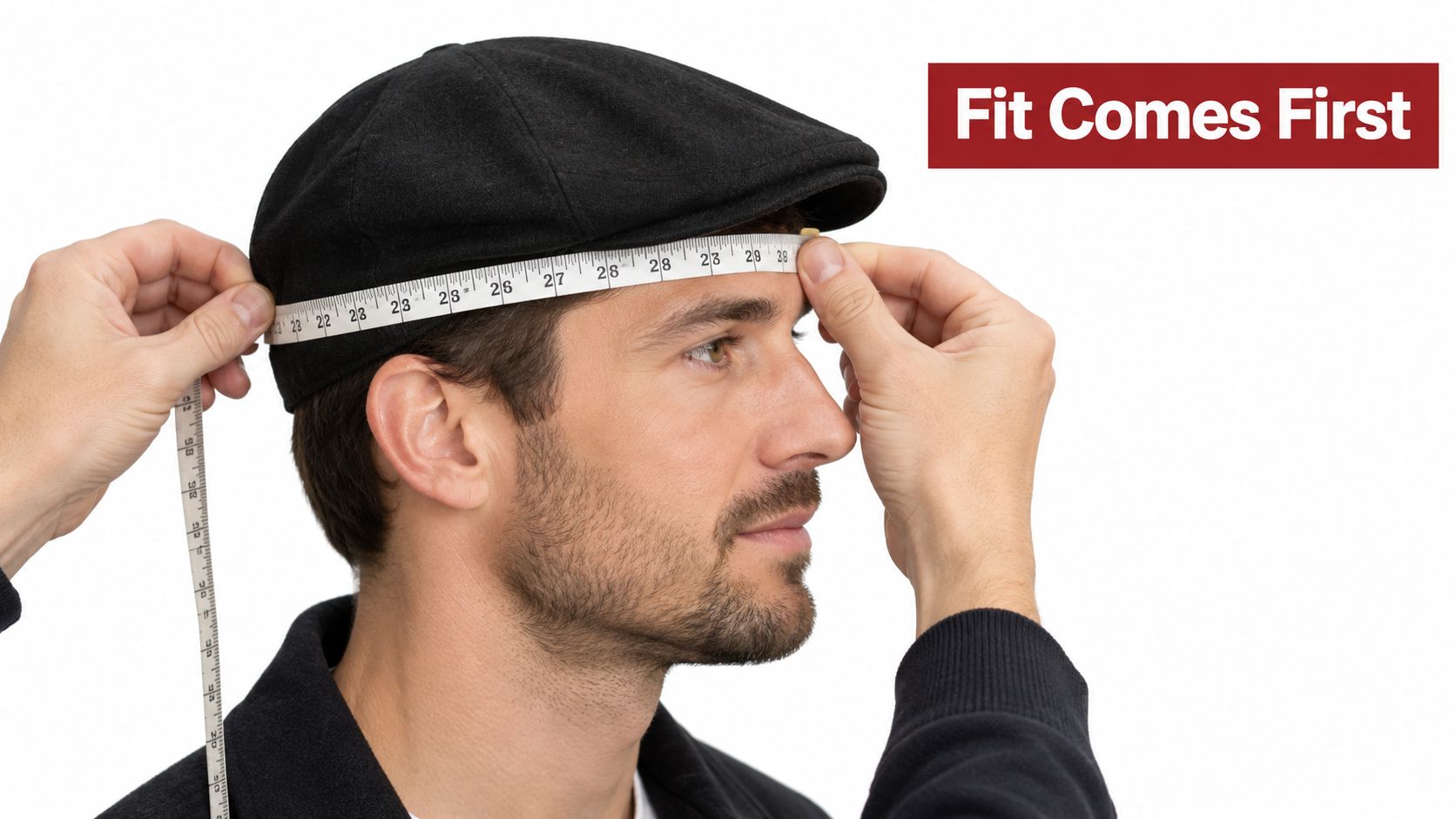
Measure around the head with a soft tape, passing it above the eyebrows and around the fullest part of the back of the skull. Keep the tape level and relaxed. Record the measurement without pulling tight, then compare it with the supplier's sizing chart. Head circumference is the starting point, not the complete fit decision.
An adjustable back strap helps a mixed group, but it doesn't fix a poorly shaped crown. A uniform program should test the smallest and largest expected wearers, while a first-time retail run should favor forgiving sizing over an aggressively close fit.
Run these checks in a fitting session
- Pressure: The band should stay secure without pinching above the ears or leaving a sharp pressure line.
- Crown space: Hair should fit without being crushed into an obvious ridge.
- Brim clearance: The wearer should be able to look down, turn the head, and sit in a vehicle without the brim interfering.
- Position: Place the brim roughly a finger's width above the eyebrows for a clean, controlled silhouette.
- Movement: Walk, bend, and turn the head. A cap that shifts immediately is too loose or poorly balanced.
- Photographs: Check front, side, and three-quarter views. Black makes uneven positioning easy to spot.
A sports team usually needs a more secure fit than a hospitality team standing indoors. A promotional audience may prefer adjustment because the group includes more varied head shapes. Don't rely on one model with one hairstyle. Include straight, thick, and curly hair in the fitting sample.
Watch the brim when people drive or work at a counter. A brim that projects too far can become distracting, while a crown that sits too low can make the wearer look stern. The best position feels stable but doesn't demand constant adjustment.
Approve the size range only after the test group has worn the cap for a meaningful period. A quick mirror check catches appearance problems, but pressure and heat become clear after longer use.
Styling the Cap for Every Audience
Styling isn't one universal formula. It's audience segmentation expressed through fabric, shape, texture, and logo restraint. The same black flat cap can look polished on a corporate team, relaxed on a streetwear customer, technical on an outdoor crew, or theatrical at a heritage event.
Corporate teams
Use a classic low-profile silhouette in structured wool or a matte wool blend. Pair it with a dark coat, fitted overshirt, knitwear, or a clean uniform jacket. Keep the branding small and tonal or use one restrained contrast color. A large bright logo turns a refined cap into promotional merchandise immediately.
Casual and streetwear customers
Choose soft cotton, washed twill, or another fabric with visible but controlled texture. Denim, chore jackets, overshirts, and simple outerwear make a black cap feel lived-in rather than formal. The common mistake is letting the softness become sloppiness, so the crown still needs enough recovery to hold its intended profile.
Sports and outdoor teams
Prioritize technical or recycled synthetics when sweat, rain, travel, or frequent handling matter. Pair the cap with performance layers rather than heritage tailoring. Keep the silhouette clean and the decoration durable, because a vintage-looking wool cap paired with technical kit can read as costume instead of teamwear.
Heritage events and fashion collections
Use tweed or a wool blend when the event needs texture and historical reference. Layer with a structured coat, knitwear, waistcoat, or other garments that support the cap's visual language. The failure mode here is overloading every item with vintage cues. Let the cap be the heritage accent, then keep at least one part of the outfit modern.
Before finalizing the look, review real-world references from fashion influencer blog posts. Don't copy an outfit blindly. Use those references to judge whether your chosen fabric, crown volume, and logo placement look natural in the context where customers will see them.
Black is most effective when the texture matches the audience. Matte cotton relaxes the product. Dense wool sharpens it. Technical fabric makes it functional. The color stays constant, but the material tells people how to read the cap.
Branding and Small-Batch Customization the Smart Way
A logo doesn't need to dominate a black flat cap to be recognizable. In fact, oversized decoration is one of the fastest ways to make a refined silhouette look cheap. Start with the front panel dimensions, then scale the artwork to the available surface rather than forcing a standard hat logo onto a smaller crown.
Choose the decoration method by the job
Embroidery is the default for a durable, premium finish. It suits simple logos, short wordmarks, and compact symbols, especially when the front panel can support the stitch density without puckering. Use high-contrast thread when visibility matters, but test the color against the exact black fabric.
Custom patches work well for limited editions, clubs, event drops, and designs that may change between runs. A patch can also protect a delicate shell from dense direct embroidery. Confirm its backing, edge finish, attachment method, and size before approval.
Printing makes sense for bold, full-color graphics on suitable cotton caps. It can support small runs and artwork with gradients or detail that thread can't reproduce cleanly, but the print surface must match the fabric and care process.
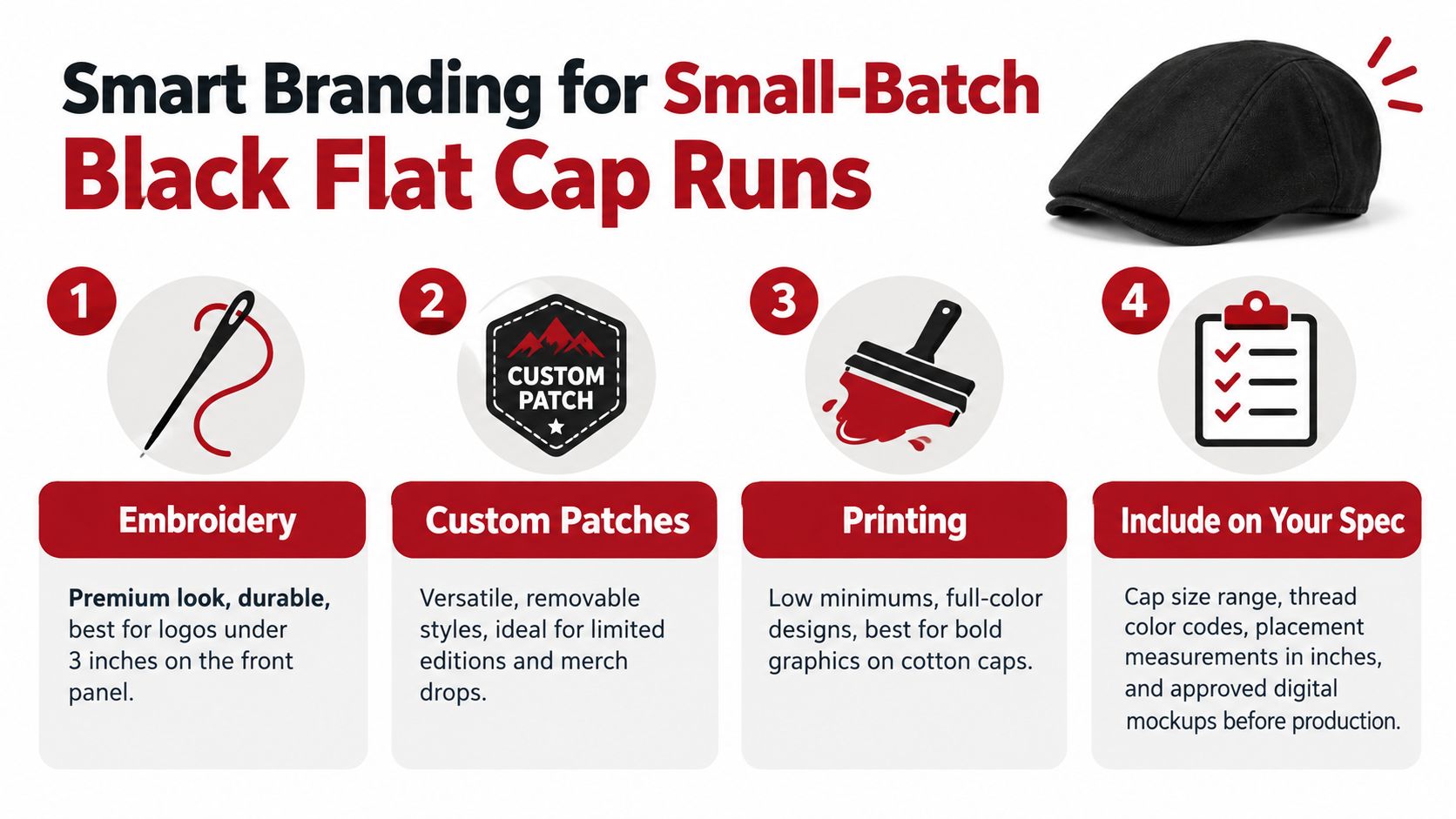
A reliable proof should show the cap from the front and side, identify the decoration method, specify thread or ink colors, and mark placement measurements. Approve the actual size, not only a digital logo file. A design that looks balanced on a large cap may crowd the front panel of a compact classic shape.
Use a production sample as a quality gate
Request a decorated sample before the full run. Launder it, rub the decorated area, inspect the reverse, and check whether the black dye transfers onto a light garment. For outdoor use, expose the sample to the conditions the finished product will face and examine the logo edge, fabric fading, and crown recovery.
Your decorator brief should include:
- Cap specification: Silhouette, shell composition, fabric weight, lining, and size range.
- Artwork: Approved vector file, color references, and any fine-detail limits.
- Placement: Front or side location, measured dimensions, and distance from seams.
- Decoration: Embroidery, patch, or print method, including backing and finish.
- Approval: Digital proof and physical preproduction sample.
- Supply plan: Stock confirmation, production timing, shipping destination, and communication contact.
If you're comparing small-run options, review this guide to small-batch embroidered hats before sending artwork. The right supplier should answer practical questions quickly, flag stock risks early, and tell you when a logo is too detailed for the chosen panel.
Proof rule: Never approve a bulk black-cap order from a logo mockup alone. Approve the decorated physical sample after washing and rubbing.
Your Black Flat Cap Buying Checklist
The best order brief answers one question before it mentions a logo: who is wearing this and where? A black flat cap for indoor hosts is not the same product as one for cyclists, festival staff, retail customers, or a winter fashion collection.
Use this buying flow before you request pricing.
Start with the environment
Write down the climate, season, activity level, exposure to rain and sun, and expected care routine. Warm conditions favor breathable lightweight natural fibers. Cold or damp conditions favor a denser structured shell. Travel and outdoor work may justify a technical or recycled synthetic.
Select the silhouette
Choose the classic flat cap for the widest audience and the cleanest uniform result. Select an ivy cap when the project needs a sportier profile. Reserve the fuller newsboy shape for a deliberate heritage or fashion direction, especially when the wearer's face and hairstyle can support additional crown volume.
Confirm fit with people, not assumptions
Measure head circumference, compare the supplier's chart, and test the largest and smallest likely wearers. Check pressure above the ears, crown space, brim clearance, stability during movement, and appearance from several angles. Include different hair textures in the sample group.
Specify the fabric and finish
Record shell composition, fabric weight, lining, sweatband, care label, and colorfastness requirements. Request a production sample and inspect it after laundering and abrasion. If the cap will be worn outdoors, treat fading and dye transfer as approval criteria, not afterthoughts.
Build the decoration brief
Decide whether embroidery, a patch, or printing best suits the artwork and panel. Provide measured placement, approved colors, a digital proof, and a physical sample requirement. Confirm stock, timing, shipping, and the supplier's process for handling changes before production begins.
A buyer who follows this sequence doesn't need to guess from a product photo. The black flat cap becomes a specified product with a defined audience, controlled construction, tested fit, and decoration that belongs on the silhouette.
Dirt Cheap Headwear supplies blank caps and custom-decorated headwear for teams, businesses, brands, and events, with low-minimum embroidery, patches, printing, and worldwide shipping options. Visit Dirt Cheap Headwear to choose a black flat cap, request a proof, and test the right blank before committing to your full run.