
Bucket Hat vs. Baseball Cap: Which Is Best for Your Team?
You're probably looking at a bulk order page with two tabs open. One says bucket hats. The other says baseball caps. Your team needs something branded, wearable, and worth reordering later. The problem is that this choice affects more than style.
A hat order touches logo size, decoration method, comfort in the field, how the product ships, and whether people will keep wearing it after the event ends. That's why the bucket hat vs baseball cap decision matters more than most buyers expect.
I've seen this question come up from groundskeepers, breweries, tournament organizers, school programs, and startup brands. They all ask the same thing in different words. Which one gives me the best value once I add my logo and buy in quantity?
If you're outfitting players, coaches, or fans, it also helps to look at what people already wear comfortably in active settings. Signature Lacrosse has a useful view of essential headwear for players, and it's a good reminder that the “right” hat depends heavily on who will wear it and when. If you're still narrowing your options at the category level, this wholesale blank hats buying guide is a practical place to compare styles before you commit to decoration.
The Ultimate Headwear Decision for Your Business
A restaurant group ordering hats for patio staff doesn't need the same thing as a streetwear brand planning a summer drop. A roofing crew cares about coverage and daily comfort. A fundraiser committee cares about broad appeal and easy sizing. A merch brand cares about silhouette and perceived value.
That's where buyers get stuck. A baseball cap feels safe because everyone recognizes it. A bucket hat feels interesting because it stands out and covers more. Neither is automatically the better buy.
Here's the practical reality from the shop side. The best hat in bulk is the one that fits your logo, your audience, and your use case at the same time. If one of those three is off, you'll feel it fast. The logo looks cramped. The staff doesn't wear it. The event leftovers sit in boxes.
A quick comparison helps before you dive into specs.
| Factor | Bucket Hat | Baseball Cap |
|---|---|---|
| Overall look | Casual, fashion-forward, utility-inspired | Classic, sport-driven, familiar |
| Sun coverage | Broader all-around coverage | Front-focused shade |
| Front logo area | Smaller and softer | Larger and more stable |
| Packability | Easy to fold and pack | Holds shape, less compressible |
| Best decoration style | Flat embroidery, woven patch, simple art | Flat embroidery, patch, 3D puff on structured styles |
| Best for | Outdoor crews, festivals, trend-driven merch | Teams, uniforms, promotions, everyday brand wear |
Most buyers don't need a fashion lecture. They need fewer surprises after the order lands. That means looking at silhouette, construction, branding surface, and wearer behavior as one decision, not four separate ones.
Core Differences A Tale of Two Silhouettes
The simplest way to understand the bucket hat vs baseball cap debate is to ignore trend talk and focus on geometry.
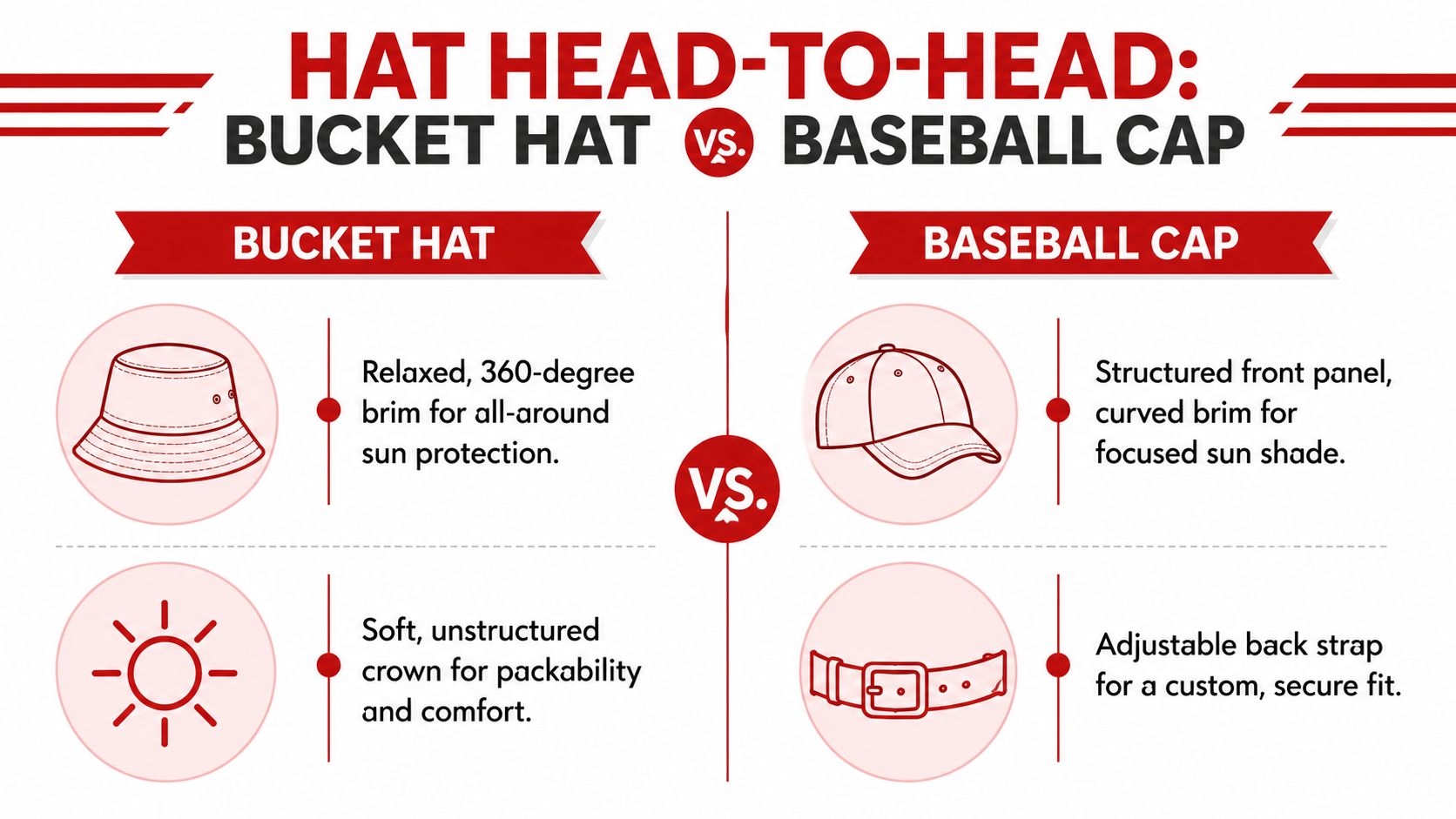
A baseball cap is built around a forward-facing visor. A bucket hat is built around a 360-degree downward-sloping brim. That one difference changes how each style performs, how it wears, and how it handles branding.
What each silhouette was built to do
The bucket hat has roots in utility. It originated in the early 1900s, when Irish farmers and fishermen wore it for rain protection. In modern use, it's defined by that all-around brim that protects the face, neck, and ears. The baseball cap, by contrast, uses a forward visor that mainly shields the face and eyes. That split is documented in Eric Javits' overview of bucket hat and sun hat design history.
That background still shows up in modern buying decisions. Bucket hats feel like general coverage gear first, style piece second. Baseball caps feel like focused performance wear first, logo platform second.
Why this matters in a bulk order
If your team works outdoors, the shape of the hat changes the practical value of the order. If your hats are mainly for retail, giveaways, or fan wear, silhouette changes how visible and familiar the product feels.
A cap usually wins when you want a clean front-facing logo. A bucket hat usually wins when the wearer cares more about all-around comfort and shade.
That's why these two styles are not interchangeable, even when they use similar fabrics or colors. A buyer choosing between them is really choosing between targeted frontal shade and all-around casual coverage.
Here's the commercial shorthand I use:
- Choose the cap silhouette when your brand needs instant recognition, a classic team look, or a shape people already know how to wear.
- Choose the bucket silhouette when you want broader utility, packability, or a more current merch feel.
- Avoid forcing either one into the wrong role. A construction crew sun hat order and a sponsor giveaway for a sports event should not be treated the same way.
A lot of ordering mistakes happen because buyers compare them as fashion accessories. They're better understood as two different tools that happen to live in the same category.
A Deep Dive into Materials and Construction
Construction decides how a hat behaves long after the sample photo looks good. Its quality helps buyers separate a smart order from a frustrating one.
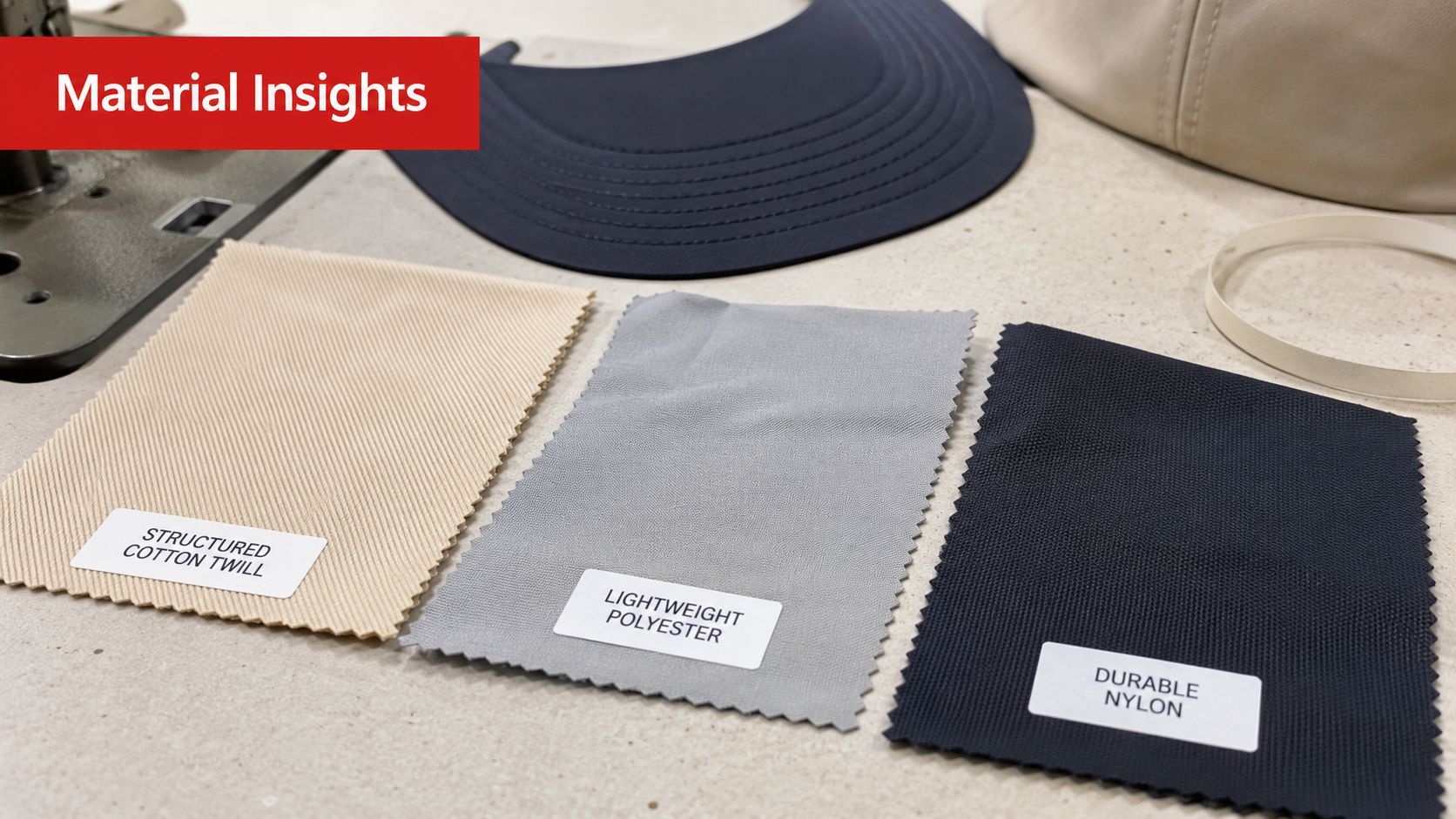
Bucket hats and baseball caps differ in a very specific way at the build level. Baseball caps use a rigid, structured crown and a visor designed to hold its curve. Bucket hats use a soft, unstructured crown with a flexible brim, often in breathable cotton or canvas. That difference also affects packability, since bucket hats compress more easily while rigid caps are more prone to creasing if squeezed in transit or stuffed into event boxes, as noted in Hat Heaven's breakdown of materials and construction differences.
How to read a cap spec sheet
Not all baseball caps behave the same. In bulk buying, a few details matter right away.
- Structured vs unstructured: A structured cap holds its front shape better and supports bolder logo work. An unstructured dad hat has a softer, more relaxed look.
- 5-panel vs 6-panel: A 5-panel cap gives you a cleaner front decoration area. A 6-panel cap has a center seam that can affect how certain logos sit.
- Closure type: Snapbacks feel casual and adjustable. Strapbacks lean lifestyle. Stretch-fit options reduce adjustment hassle but can complicate size planning.
- Mesh back vs solid back: Trucker styles breathe better. Full-fabric caps often feel more uniform and corporate.
If you want a practical primer on crown shape before choosing decoration, this guide on structured vs unstructured hats helps clarify what changes visually and technically.
What matters on bucket hats
Bucket hats are simpler on paper, but the material still matters. Cotton twill gives you a familiar hand feel and solid everyday wear. Canvas feels sturdier. Ripstop-style builds usually make sense when the hat needs to fold, travel, and recover shape.
Because the crown is soft, the whole hat moves more with the wearer. That's great for comfort and storage. It also means decoration has to work with a surface that isn't trying to stay perfectly flat.
Practical rule: If the hats will be tossed into backpacks, event bins, or glove compartments, bucket hats usually handle that abuse better than rigid caps.
This visual walkthrough is useful if you're comparing how shape and fabric affect wear in everyday use.
Durability isn't just fabric weight
Buyers often ask which style “lasts longer.” The better question is what kind of wear the hat will see.
A baseball cap keeps its look well when people wear it normally and store it properly. It's a good choice for teams, front-of-house staff, and retail merch. But once people crush it into a duffel bag, that structured shape can show damage.
A bucket hat usually tolerates casual abuse better. It can be folded, packed, and worn hard without asking the crown to keep a showroom shape. For event logistics, travel kits, and outdoor crews, that matters more than people think.
Customization and Embroidery A Decorator's Guide
Many bulk orders are won or lost at the point of logo application. A hat can fit your budget and audience, then fail the moment your logo hits the wrong surface.
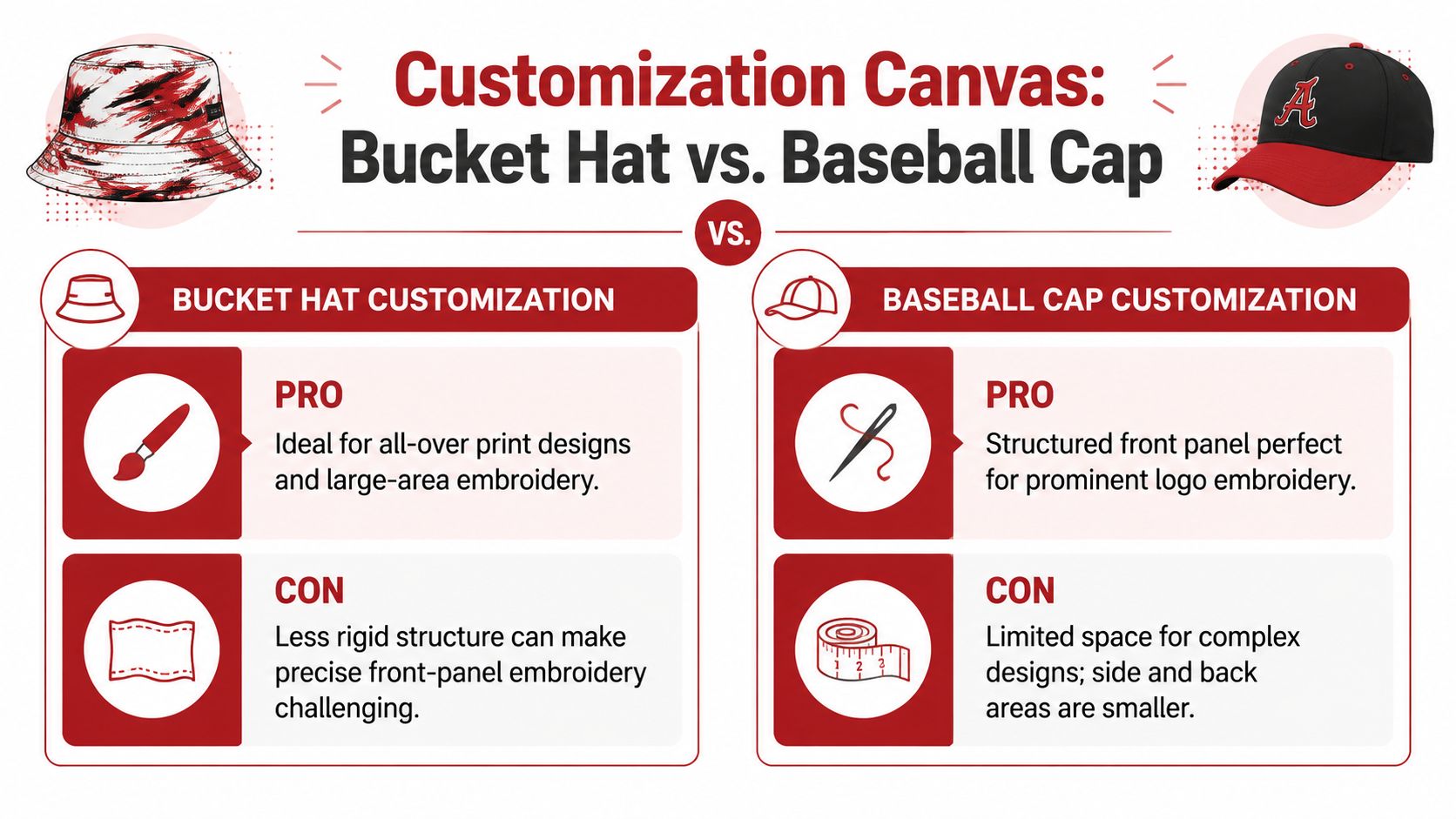
Baseball caps usually offer the easier decoration canvas. Bucket hats can look fantastic, but they reward restraint and smart placement.
Where baseball caps shine
A structured baseball cap gives your decorator something stable to work with. That matters for bold front logos, clean outlines, and raised treatments.
If your logo has thick lettering, badge-style art, or a design that needs to read from across a field or trade show floor, caps are the safer bet. Structured fronts also handle 3D puff embroidery better because the crown supports the extra height.
There's another practical wrinkle. A 5-panel cap gives you one uninterrupted front panel. That's ideal when your logo is wide or centered. A 6-panel cap splits the front with a seam, which isn't a dealbreaker, but it can complicate fine detail or tight text.
Where bucket hats work best
Bucket hats ask for a different mindset. The front area is softer and usually smaller. Fine detail can still work, but the best results tend to come from simple flat embroidery, a clean woven patch, or a compact logo mark rather than a busy full lockup.
The side of a bucket hat can also be a smart decoration zone, especially for lifestyle brands or event merch. That placement feels intentional on this silhouette in a way that side branding on a cap sometimes doesn't.
Keep the logo concise on bucket hats. Let the silhouette do some of the branding work.
If you're comparing decoration methods before placing art, this overview of printing and embroidery options is useful for matching technique to fabric and hat shape.
Matching logo type to hat style
Use this as a working cheat sheet:
- Big wordmark or sports logo: Baseball cap.
- Minimal brand mark or patch concept: Bucket hat or cap.
- Raised puff embroidery: Structured baseball cap.
- Soft vintage-style branding: Unstructured cap or bucket hat.
- Complicated small text: Usually neither is ideal unless you simplify the art first.
One practical note from the shop floor. Buyers often send the exact same logo file for both styles and expect the same result. That rarely works. Good decoration adjusts for the canvas.
For example, Dirt Cheap Headwear handles in-house embroidery on multiple hat types, including low-minimum custom orders. That kind of setup can help when you need to test a logo on more than one silhouette before scaling the full run. The important part isn't who decorates it. It's whether they'll tell you when the art needs to be simplified, resized, or moved.
Decorator's note: The best-looking hat isn't always the one with the biggest logo. It's the one where the logo fits the structure.
Choosing the Right Hat for Your Audience and Use Case
A good bulk order starts with the wearer, not the warehouse shelf. Once you know who's getting the hat and what they'll do in it, the bucket hat vs baseball cap decision gets much easier.
Outdoor crews and high-sun work
If your staff spends long hours outside, bucket hats have the stronger practical argument. They're repeatedly described in outdoor guidance as offering 360° protection, while caps focus shade forward only. That's one reason bucket hats are often recommended for hiking, fishing, and paddling, and why they sit in the middle ground between a cap and a larger sun hat for users who want more ear and neck coverage without going fully wide brim.
That doesn't mean every work crew should wear bucket hats. It means sun exposure should be part of the purchasing conversation, not an afterthought.
Teams, schools, and classic uniforms
Baseball caps still dominate here for a reason. They look familiar, they frame a front logo well, and they fit almost any age group without much explanation.
For coaches, booster clubs, school stores, rec leagues, and company uniforms, the cap usually feels like the safer order. It's easier to picture on a group. It also tends to align better with sponsor logos, mascots, and straightforward embroidered branding.

Events, merch drops, and trend-driven branding
Bucket hats can outperform expectations. For music events, summer launches, brewery merch, travel promotions, and fashion-leaning brand drops, they often feel more intentional than a standard cap.
They also solve a common event problem. People can fold them, stuff them in a tote, and put them back on later without worrying much about shape. That kind of easy wear helps a giveaway keep getting used.
A simple winner-by-scenario list
- Landscaping crew or outdoor vendor booth: Bucket hat.
- Little league fundraiser or school spirit store: Baseball cap.
- Festival merch table: Bucket hat.
- Corporate golf outing or sponsor giveaway: Baseball cap.
- Lifestyle apparel brand with minimal graphics: Either can work, but the logo approach should decide it.
The right answer usually shows up when you ask one question. Do you need the hat to act more like a uniform, or more like a piece of merch?
If it's a uniform, the baseball cap often wins. If it's merch or outdoor utility, the bucket hat gets much more compelling.
Final Verdict and Smart Ordering Tips
If you want the shortest possible answer, here it is.
Choose a baseball cap if your priority is logo visibility, a classic team look, and an easy-to-recognize fit for a broad audience. Caps are usually the easiest sell for uniforms, sports programs, company merch, and promotional events where familiarity matters.
Choose a bucket hat if your priority is broader coverage, packability, and a more casual or trend-forward look. Expert analysis describes the bucket hat's brim as providing 360° coverage for the face, ears, and neck, while a baseball cap protects mainly the face and eyes. For high-exposure work environments, that difference becomes a meaningful performance gap for occupational sun safety.
A clean order process matters just as much as the style choice. Before you place the full run, do a few things that save headaches later.
Ordering habits that prevent expensive mistakes
- Ask for a physical sample if the logo is complex: Especially if you're comparing a patch on a bucket hat versus embroidery on a structured cap.
- Send usable artwork: Vector files are easier to size and clean up than low-resolution screenshots.
- Match decoration to structure: Puff belongs on the right cap. Fine detail needs enough surface stability. Simple marks usually travel best across multiple styles.
- Think about storage and distribution: If hats are being packed into swag bags or shipped in volume, shape retention matters.
- Don't overbuild the design: A smaller, cleaner front hit usually beats cramped artwork with tiny text.
What works in practice
If you're unsure, the safest split is simple. Put your main logo on a baseball cap for the broadest appeal. Use a bucket hat when the audience, season, or use case gives that silhouette a clear advantage.
That's usually the difference between a hat that gets worn once and a hat that becomes part of someone's regular rotation.
If you're ready to compare styles, test embroidery placement, or price out a bulk run, Dirt Cheap Headwear offers wholesale blanks and custom decoration for both bucket hats and baseball caps. Start with your audience, your logo file, and your quantity range, then narrow the style from there.
Pingback: Custom Bucket Hats for Men: The Ultimate 2026 Guide | Dirt Cheap Headwear
Pingback: Custom Bucket Hats with String: Your 2026 Ordering Guide | Dirt Cheap Headwear