If you're shopping for wholesale blank snapback hats right now, you're probably stuck between two bad options. One looks cheap in photos and will almost certainly stitch poorly. The other looks premium, but the pricing, minimums, and brand choices make it hard to tell whether you're buying a smart seller or an expensive mistake.
That confusion is normal. Snapbacks look simple until you have to buy them for a brand, a team, a merch table, or a promo campaign. Then every small choice starts affecting something bigger. Crown height affects logo placement. Fabric affects embroidery quality. Minimums affect cash flow. Even the panel count changes how your front logo reads from a few feet away.
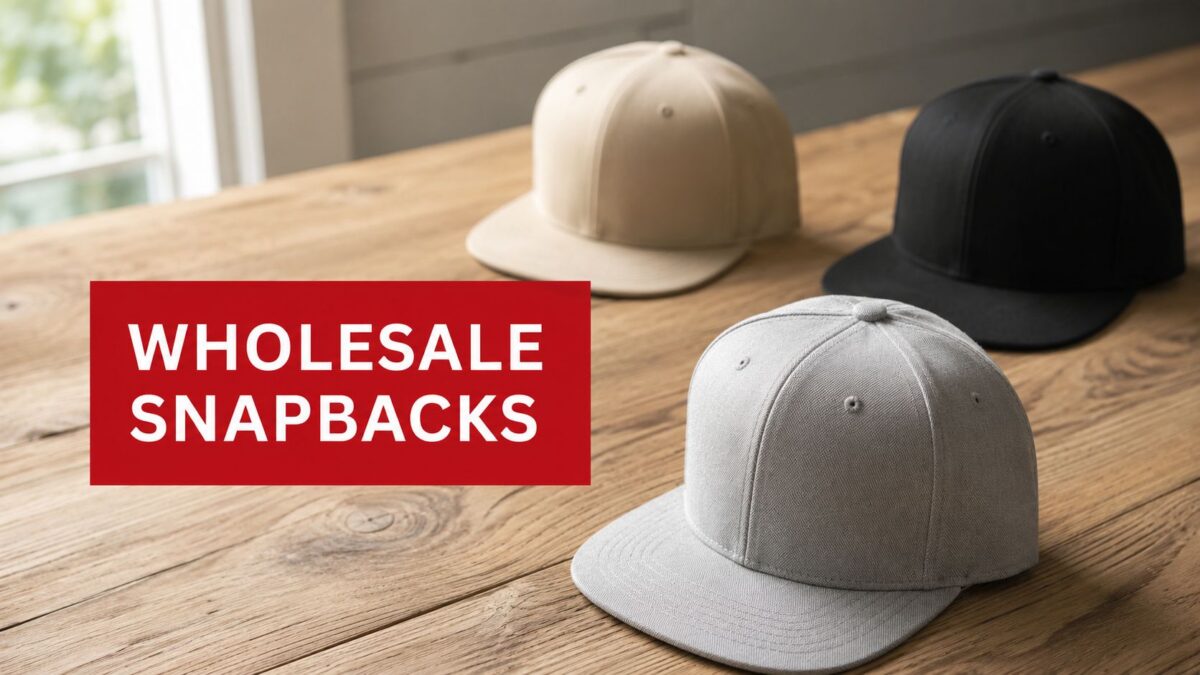
The good news is that wholesale blank snapback hats are a mature category, not a niche gamble. Large distributors still treat snapbacks as a core item for clothing brands, embroidery shops, promotional events, and custom merch businesses. One supplier says it has served over 100,000 customers and lists wholesale snapback hats for as low as $3.99, with many styles available with no minimum order requirement on its blank snapback hats page. That tells you something important. You can enter this category without betting your whole budget on one style.
Starting Your Search for the Perfect Snapback
Most new buyers start the same way. They search a few wholesale sites, open a dozen tabs, compare photos, and assume the cheapest hat with the cleanest mockup will do the job. That's where problems start. A snapback that looks fine on screen can arrive with the wrong crown shape for your logo, the wrong hand-feel for your audience, or the wrong structure for the decoration method you planned.
The better approach is to buy backward from the outcome. Ask what the hat needs to do before you ask what it costs. Is it supposed to feel like retail merch? Survive repeated wear for a work crew? Function as a low-risk event giveaway? Those are different jobs, and they shouldn't all point to the same blank.
A simple starting point helps. If you need a broader view of bulk buying basics before narrowing into snapbacks, this guide on how to buy blank hats in bulk is a useful primer.
Start with the use case, not the catalog
Here are the questions that matter early:
- Who will wear it: A streetwear customer usually wants a different silhouette than a school booster club or service company.
- How will you decorate it: Embroidery, puff embroidery, and patches don't behave the same on every crown.
- How risky can the buy be: If you're testing a new logo or colorway, low minimums matter more than squeezing every last cent out of unit cost.
- What needs to look premium: Sometimes it's the fabric. Sometimes it's the shape. Sometimes it's just clean front decoration on the right panel setup.
Practical rule: Never approve a blank because the stock photo looks good. Approve it because the structure, fabric, and decoration method match the job.
What usually goes wrong
New buyers often over-focus on color and under-focus on shape. They also assume "snapback" is one thing. It isn't. Two hats can both be snapbacks and still wear completely differently.
What works is narrowing your search in this order: silhouette, crown structure, fabric, decoration method, then pricing. That order saves money because it cuts out styles that were never going to perform well for your brand in the first place.
Anatomy of a Snapback A Buyers Guide
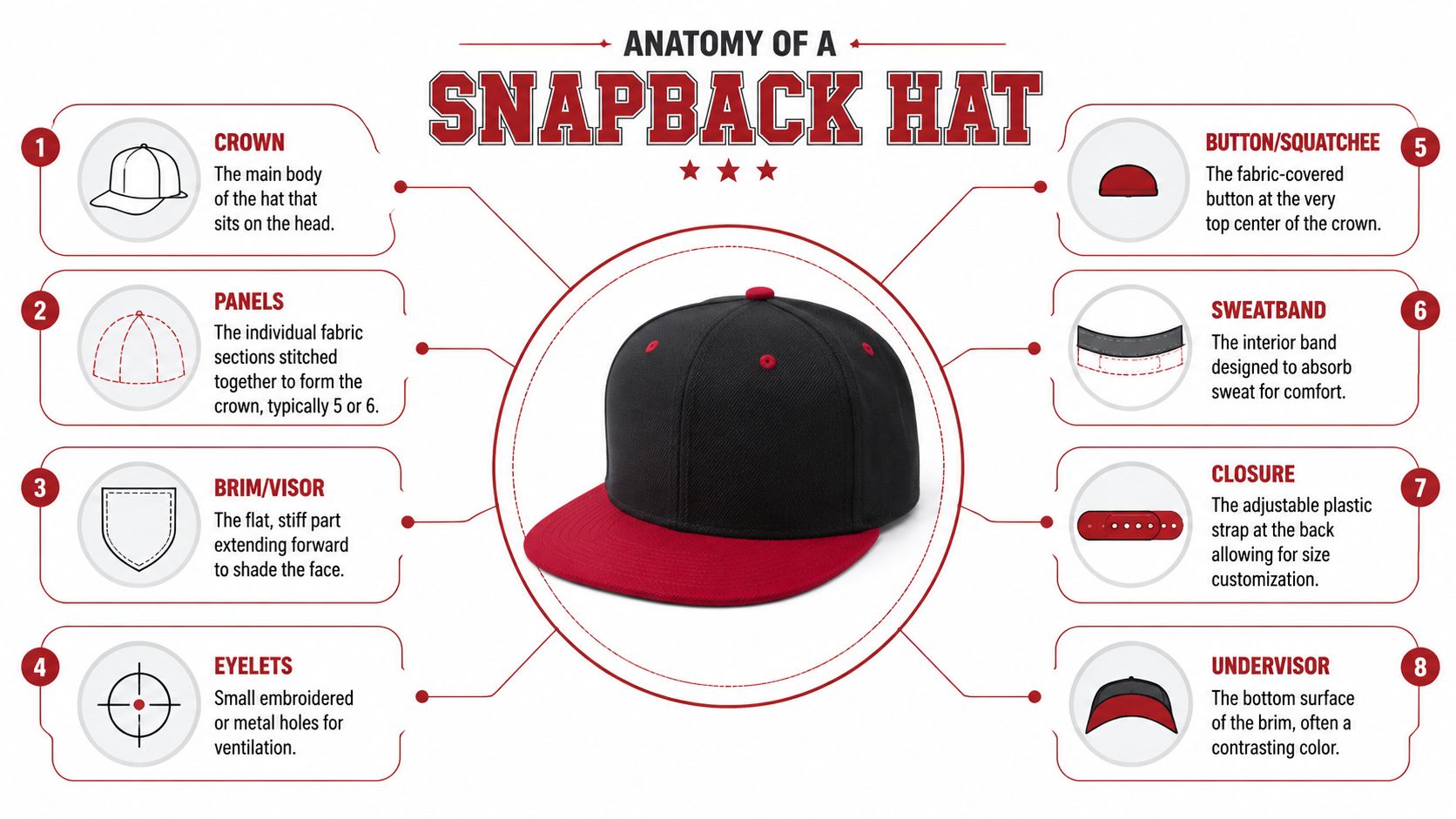
You don't need to memorize factory jargon, but you do need to understand what you're buying. The anatomy of a snapback is what determines fit, decoration quality, and how "retail" the finished piece feels in someone's hand.
If you need a basic style definition first, this overview of what a snapback cap is gives the quick version. For buying decisions, though, the details below matter more.
Crown and profile
The crown is the body of the hat. The profile is how tall that crown sits. Think of the crown like a car's chassis. If the structure is wrong, everything mounted on top of it looks off.
A high-profile snapback gives you a taller front face. That's useful when you want a bold logo, a larger patch, or a more fashion-forward silhouette. A low-profile snapback sits closer to the head and usually feels more understated. That can work for minimalist branding, but it gives you less front real estate.
For decoration, structured crowns are usually the safer choice. They hold shape during embroidery and keep front graphics from collapsing once the hat is worn.
Panels and front layout
Snapbacks are usually built as 5-panel or 6-panel caps.
- 5-panel hats have one uninterrupted front panel. That's great for larger patches or clean front prints because there's no center seam cutting through the artwork.
- 6-panel hats have a center seam down the front. They are common, familiar, and often easier to fit into broad commercial programs, but that seam can affect logo placement.
If your logo is wide, geometric, or text-heavy, panel layout matters more than many first-time buyers expect.
A bad blank doesn't always look bad by itself. It starts looking bad after your logo is added.
Fabric and why it affects decoration
The most important technical variable in wholesale blank snapback hats is the crown and fabric system. According to this blank hats fabric guide, poly-cotton blends commonly used in caps are typically 80/20 or 65/35, with at least 50% cotton in the blend. That balance improves hand-feel and structure compared with fully synthetic fabric, while still keeping enough polyester for durability and shape retention.
That isn't just a comfort story. It's a decoration story.
Firmer, structured crowns generally tolerate embroidery and patch application better than soft fabrics that can distort under needle tension or heat. If you're planning front embroidery, especially anything dense or raised, blend and structure matter because they help the logo stay clean instead of puckering.
A simple way to look at it:
| Part of the spec | Why you should care |
|---|---|
| Structured crown | Better support for embroidery and patches |
| Softer fabric | More casual feel, but more risk of distortion |
| Poly-cotton blend | Balance of comfort, durability, and shape |
| Flat visor | More streetwear-leaning look |
| Plastic snap closure | Easy sizing across mixed wearers |
Small parts that affect wearability
The sweatband matters for comfort. The snap closure matters for broad fit across staff, event attendees, or customers. The undervisor can subtly change the look of the finished hat, especially on premium or throwback styles.
These sound like minor details until someone wears the hat. Then they become the difference between merch that sits on a shelf and merch that gets repeated use.
Finding the Best Brands for Wholesale Snapbacks
A new brand orders a popular snapback because the name feels safe. The sample arrives, the front panel is softer than expected, the embroidery sinks, and the finished hat looks cheaper than the logo file. That mistake happens all the time. Brand selection affects decoration quality, sell-through, and return rates, not just supplier comfort.
The better question is simple. Who is going to wear this hat, and what do they expect it to feel like?
YP Classics and Flexfit for broad commercial use
YP Classics and Flexfit usually fit buyers who need range, stable inventory, and silhouettes that work across different customer groups. That matters if you're testing retail merch, event product, and uniform use at the same time.
From a decoration standpoint, these brands are often a safe starting point because many of their snapback styles are built for repeat embroidery programs. Structured fronts usually hold logos cleaner, especially for standard front embroidery and patch placement. If your design has small lettering or a dense fill, that support helps control puckering and keeps the logo readable.
The trade-off is style identity. A broad line gives you options, but it also makes it easier to choose a hat that is fine on paper and forgettable in hand. Buyers still need to sort by crown shape, fabric, and profile instead of assuming every style under the brand will perform the same way.
These brands usually fit:
- Apparel startups that need room to test shapes before committing to a winner
- Promotional product buyers that need dependable blanks across different budgets
- Decorators running repeat orders where consistency matters more than novelty
Richardson for practical wear and team use
Richardson works well for customers who want a cap that feels familiar the first time they put it on. That audience includes team programs, outdoor brands, jobsite crews, and event staff.
The reason is less about hype and more about predictability. Richardson styles often land in a practical middle ground. They have enough structure for clean decoration, enough durability for repeated wear, and a shape that does not require much fashion education to sell. For a business owner, that lowers friction at the point of sale.
There is a trade-off. If your brand depends on a more fashion-forward silhouette or a sharper streetwear look, some Richardson styles can read too functional. That does not make them worse. It makes them right for a different buyer.
New Era for stronger retail perception
New Era makes more sense when the blank itself adds perceived value. Some customers notice the label, associate it with licensed product and sports culture, and will pay more because of that connection.
That can help a premium merch program. It can also hurt margin if the audience does not care about the logo inside the hat. For giveaways, volunteer kits, or cost-sensitive promotions, the higher blank cost may not improve wear rates or brand recall enough to justify it.
Decoration planning matters here too. If you are paying more for the cap, the artwork has to match. A weak one-color left chest logo adapted onto a premium snapback rarely carries the product. Buyers get better results when the decoration feels intentional, whether that means raised embroidery, a clean woven patch, or a retail-style front hit sized for the crown properly.
Pick the blank your customer will wear twice a week, not the one that sounds impressive in a sourcing call.
A practical brand filter
Use brand choice to solve a business problem, not to win a brand-name debate.
| Brand lane | Usually fits buyers who need |
|---|---|
| YP Classics / Flexfit | Wide style coverage, dependable decoration platforms, flexible testing across audiences |
| Richardson | Teamwear, workwear, outdoor use, and easy-to-sell everyday shapes |
| New Era | Stronger retail signaling, higher perceived value, and customers who care about the label |
The right brand is the one that supports your selling price, your decoration method, and your customer's expectations at the same time. If one of those three is off, the hat gets harder to sell.
Understanding Wholesale Pricing and Minimums
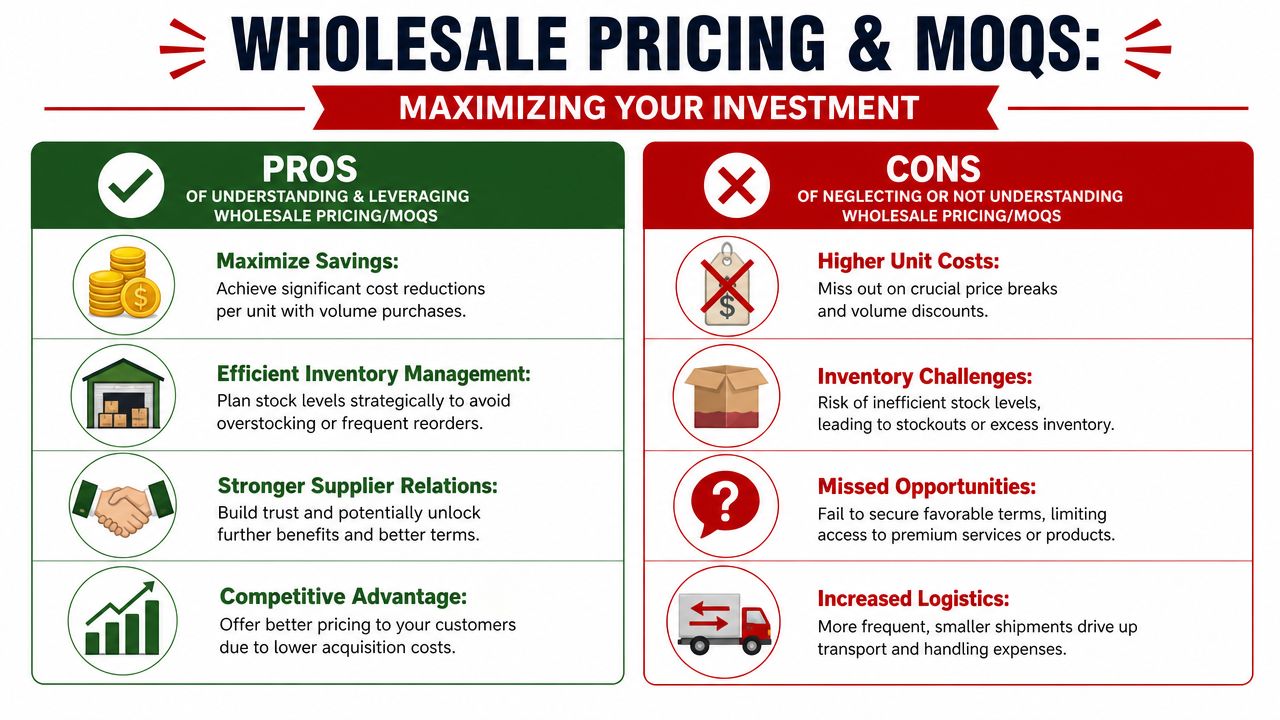
A new buyer usually asks for the lowest unit cost first. That sounds disciplined, but it often leads to the wrong purchase. Wholesale snapback buying is really a cash-flow decision, a decoration decision, and an inventory decision at the same time.
Minimums shape all three. They determine how much money goes out before you know the hat will sell, how many colors or styles you can test, and how painful a bad pick becomes.
Why low minimums matter more than people think
Low minimums buy information.
That matters more than a small price break on paper. If you can test one structured snapback against one softer-profile option, you learn how your logo stitches, how the fit lands on actual customers, and whether the shape matches your audience. That is a better use of early cash than forcing a larger order just to shave a little off the blank cost.
For small runs, I would rather see a buyer test fewer units across smarter options than overcommit to one style too early. A practical starting point is to review a supplier's plain snapback cap styles for small-batch testing and narrow the field based on crown shape, fabric, and reorder availability before decoration starts.
How to judge price the right way
Unit cost matters. Failure cost matters more.
Ask these questions before you approve a PO:
- What happens if this style stalls after the first drop?
- Can you reorder the same blank in the same color six weeks from now?
- Will your decorator get consistent results on this crown and fabric?
- Does the savings on the blank disappear after spoilage, setup, or second-round sampling?
Many new programs lose margin when a cheaper snapback can become the expensive option if the front panel is too soft for clean embroidery, if the fabric shows hoop burn, or if the shape looks off once customers try it on. A blank that costs a bit more but runs clean in production usually protects profit better than the lowest quote.
Sampling mode and scaling mode are priced differently
Early orders are for learning. Later orders are for repeatability.
In sampling mode, low minimums and broad style access matter most. You are testing fit, decoration, and customer response. In scaling mode, the priority shifts to steady inventory, color continuity, and fewer production surprises. That is also the point where forecasting starts affecting purchasing discipline. Teams that optimize your warehouse demand planning usually make better reorder decisions because they are buying against demand patterns instead of gut feel.
Bottom line: Inventory that does not move is more expensive than a higher-quality blank that sells through.
A practical buying checklist
Before placing a wholesale snapback order, verify these four things:
Minimum threshold
Buy at the level your business can absorb. A startup testing one logo should not buy like a school program ordering for a full season.Style depth
A supplier with multiple snapback silhouettes gives you room to match product to audience instead of forcing one shape into every use case.Reorder confidence
Confirm whether the hat is a steady core item or a style that may disappear after one cycle. That affects how safely you can build a repeatable merch program around it.Decoration fit
Match the blank to the artwork you plan to run. Structured fronts usually handle front embroidery better. Softer builds can work, but they leave less room for error.
Good wholesale pricing is not about finding the lowest number. It is about buying the right amount of the right hat at the stage your business is in.
Customization Options for Your Blank Hats
The blank hat is only half the decision. Decoration is where buyers either create something retail-ready or ruin a decent blank with the wrong technique.
The biggest mistake I see is trying to force one decoration method onto every logo. That usually leads to small text filling in, puff embroidery collapsing, patches lifting, or print methods fighting the surface of the hat. Good customization starts with the logo, but it finishes with the right match between artwork and hat structure.
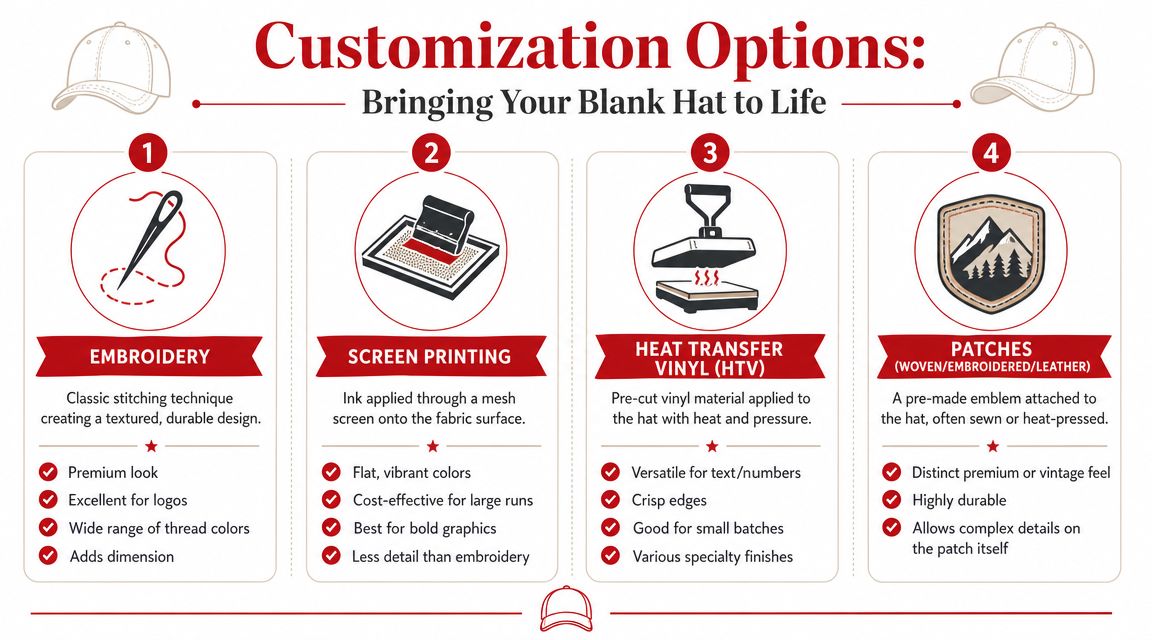
Embroidery for the classic retail look
Flat embroidery is the safest all-around option for snapbacks. It gives texture, holds up well, and looks familiar to customers across streetwear, teamwear, and promo use. It works best when the logo has clean shapes and enough spacing between small details.
3D puff embroidery creates raised dimension, but it needs the right platform. A firm, structured front crown usually handles puff better than a soft cap. If the crown doesn't have enough support, the raised areas can look uneven and the front panel can ripple.
That ties back to fabric and structure. Firmer crowns and stable blends generally give decorators a better base for needle tension and cleaner logo shape.
Patches for detail and brand character
Patches solve problems that embroidery can't always solve cleanly.
- Woven patches are useful when artwork has finer detail.
- Leather-style patches create a more rugged or premium look.
- Embroidered patches keep a traditional texture while giving more flexibility in edge shape.
- PVC or rubber-style patches push the look into a more technical or modern lane.
Patches also help when the front panel seam gets in the way. On some builds, a properly sized patch handles the front area better than dense direct embroidery.
A short production demo helps if you're comparing methods visually:
Printing and transfers for specific jobs
Printing on snapbacks can work, but it's not always the first choice for structured caps. Flat decoration methods usually prefer flatter, more cooperative surfaces. That means they often make more sense on selected panels, lighter branding programs, or short-run needs where embroidery setup isn't the right fit.
Heat transfer vinyl can be useful for names, numbers, and short-run personalization. Screen printing can work for bold graphics if the hat construction allows clean application. But if the goal is durable, premium front branding on a structured snapback, embroidery or patches usually win.
Match the logo to the method
Use this quick logic:
| Logo type | Usually the better route |
|---|---|
| Simple bold logo | Flat embroidery |
| Big chunky mark | 3D puff embroidery |
| Fine detail or vintage badge look | Woven or embroidered patch |
| Short-run personalization | Heat transfer |
| Large flat graphic | Screen print, when the surface allows it |
For businesses carrying multiple decorated SKUs, inventory planning matters as much as design planning. If you're trying to balance test runs, reorders, and seasonal color changes, it helps to optimize your warehouse demand planning before you expand too many variations at once.
If you need a ready source for plain hats before decoration, plain snapback caps are one straightforward option to compare alongside other wholesale programs. The key is keeping the blank and the decoration method aligned from the start.
The Wholesale Ordering Process from Proof to Delivery
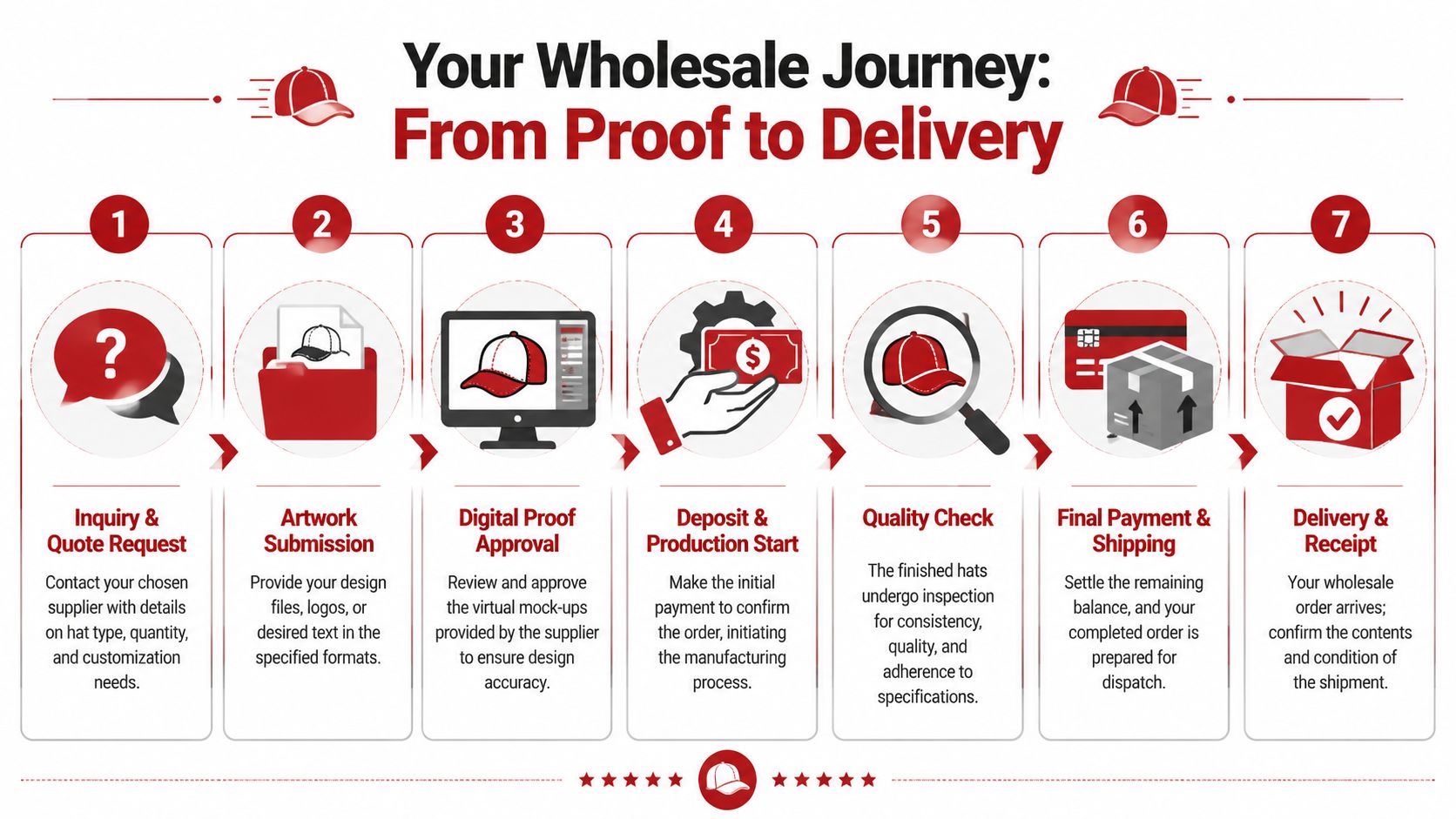
The ordering process feels intimidating until you realize it's mostly a sequence of approvals. Problems happen when buyers rush the approval stages, especially artwork and proofing.
A clean wholesale order starts before anyone decorates a hat. You need the right blank, a usable logo file, and a clear idea of placement. If any of those are fuzzy, delays show up later as revisions, production holds, or disappointing finished goods.
Step one is spec clarity
Your quote request should identify the blank, color, quantity, and decoration method. If you're undecided on one of those, say so early. Suppliers can usually guide options better when they know whether you're aiming for merch, uniforms, giveaways, or resale.
This category is accessible partly because wholesale snapbacks are now widely available to small buyers. As noted earlier in the article, one supplier says it has served over 100,000 customers and offers some snapback styles at entry-level pricing with many no-minimum options, which is why first-time buyers can often test without a huge commitment.
Proofing is where quality control starts
For embroidery, your file usually needs digitizing. That means converting artwork into stitch instructions. A good digitized file accounts for stitch direction, density, underlay, and how the cap surface will affect the logo.
Then comes the digital proof. During this phase, buyers often approve too fast. Don't just check spelling and color. Check scale, placement, and whether the artwork still looks balanced on the actual crown shape you chose.
If the proof looks crowded on screen, it will usually look worse on the finished hat.
What a solid ordering workflow looks like
A dependable process usually follows this sequence:
- Quote request with blank style, quantity, and decoration notes
- Artwork submission in a usable format
- Proof review for size, placement, and visual balance
- Approval and payment step to release production
- Production using the approved blank and decoration specs
- Inspection and shipping before final delivery
Some buyers also keep a physical reference sample on file once a style proves itself. That's smart if you plan to reorder.
Where first orders go sideways
Common problems are simple:
- Tiny text in embroidered logos
- Approving a proof without checking panel seam interference
- Choosing a soft crown for a heavy front design
- Changing hat color after proof approval
- Assuming every navy, black, or charcoal blank looks the same
One practical option in this stage is using a supplier that handles both blanks and decoration under one roof. Dirt Cheap Headwear, for example, offers blank hats plus in-house embroidery and proof-based custom ordering, which can simplify communication if you don't want to split sourcing and decorating across separate vendors.
FAQs for Scaling Your Headwear Program
How do I know when a snapback is worth reordering?
Reorder when three things line up. The blank still matches your audience, the decoration still looks clean, and the supplier can keep the program consistent. Don't reorder only because the first run sold. Sometimes a style sells once because of the event, not because the hat was right.
Can I mix colors in one program?
Usually, yes, but only if the logo and decoration method still work across those colors. A thread color that looks sharp on black may disappear on heather grey or khaki. Test your strongest seller first, then expand carefully instead of launching every color at once.
What's the best way to care for custom snapbacks?
Treat them like shaped products, not laundry. Avoid anything that can crush the crown, warp the visor, or stress patch edges and stitching. Spot cleaning and careful storage usually protect the finish better than aggressive washing methods.
Should I keep using the same blank for every customer segment?
Usually not. One snapback can cover a lot of ground, but not every ground. A fashion customer, a roofing crew, and a charity 5K participant don't judge hats the same way. Build around a small group of proven blanks instead of trying to force one universal style into every program.
How do I scale without tying up too much cash?
Keep your early program tight. Start with a proven silhouette, a small color range, and one decoration style that fits your logo well. Add complexity only after the first winner is obvious.
The easiest headwear program to manage is the one that says no to unnecessary variations.
If you're ready to buy blanks, test a logo, or place a custom order without overcomplicating the process, Dirt Cheap Headwear is one place to compare wholesale hats, plain snapbacks, and decorated headwear options for brands, teams, and events.