
What is Direct to Film Printing? A Guide for Custom Hats
Direct-to-film printing is a modern decoration method where a design is printed onto special film, coated with adhesive powder, cured, and then heat-pressed onto fabric. It's also a proven commercial process, with the global DTF market estimated at USD 2,720.0 million in 2024 and projected to reach USD 3,920.0 million by 2030, growing at a 6.0% CAGR from 2025 to 2030.
If you're trying to order branded hats for a business, team, or event, you're probably comparing embroidery, patches, screen print, and a few print methods that all sound similar until you have to approve artwork and spend money. The hard part isn't finding decoration options. It's figuring out which one works on the kind of cap you want.
What is direct to film printing? In simple terms, it's a transfer-based printing method that makes full-color decoration possible on a wide range of fabrics and blends. For hat buyers, that's important because headwear creates different problems than shirts do. Curved fronts, center seams, mesh panels, structured crowns, and small print zones all affect whether a logo looks clean or awkward.
A lot of DTF content focuses on tees. Hat buyers need a different answer. They need to know when DTF looks sharp, when it doesn't, and when embroidery is still the smarter move.
Your Guide to Modern Custom Hat Decoration
Small business owners usually hit the same wall. They find a hat style they like, upload a logo, and then realize the decoration method matters almost as much as the hat itself. A stitched logo can look premium but may lose fine detail. A printed logo can keep gradients and small text but may not work equally well on every crown shape.
That's where DTF printing has become useful. It gives buyers a way to put full-color artwork onto fabrics that have traditionally been harder to decorate cleanly, especially when the design has more detail than embroidery can comfortably hold.
This isn't some fringe process anymore. According to Grand View Research's direct-to-film printing market report, the global market was valued at USD 2,720.0 million in 2024 and is projected to reach USD 3,920.0 million by 2030, with a 6.0% CAGR. That matters because it shows DTF has moved into mainstream apparel customization, not just small-shop experimentation.
Why hat buyers should care
The usual t-shirt advice doesn't help much when you're ordering trucker caps, rope hats, dad hats, or structured snapbacks. Hats bring pressure points that flat garments don't.
- Curved surfaces: A front panel isn't a flat canvas, so artwork placement has to be intentional.
- Seams and construction: A center seam can split a design visually if the art is too wide or too detailed.
- Material variation: Cotton twill, polyester performance fabrics, and blended panels don't all decorate the same way.
- Brand appearance: Staff hats, merch hats, and promo hats each need a different balance of detail, feel, and durability.
If you want a broader plain-English overview before you order, Direct to film printing explained is a useful companion read. If you're already comparing options for your order, Dirt Cheap Headwear also offers custom hat printing services that include DTF for headwear applications where print makes more sense than stitching.
Practical rule: If your logo depends on gradients, tiny lettering, or multiple colors packed into a small space, DTF usually deserves a serious look before you default to embroidery.
The DTF Printing Process Step by Step
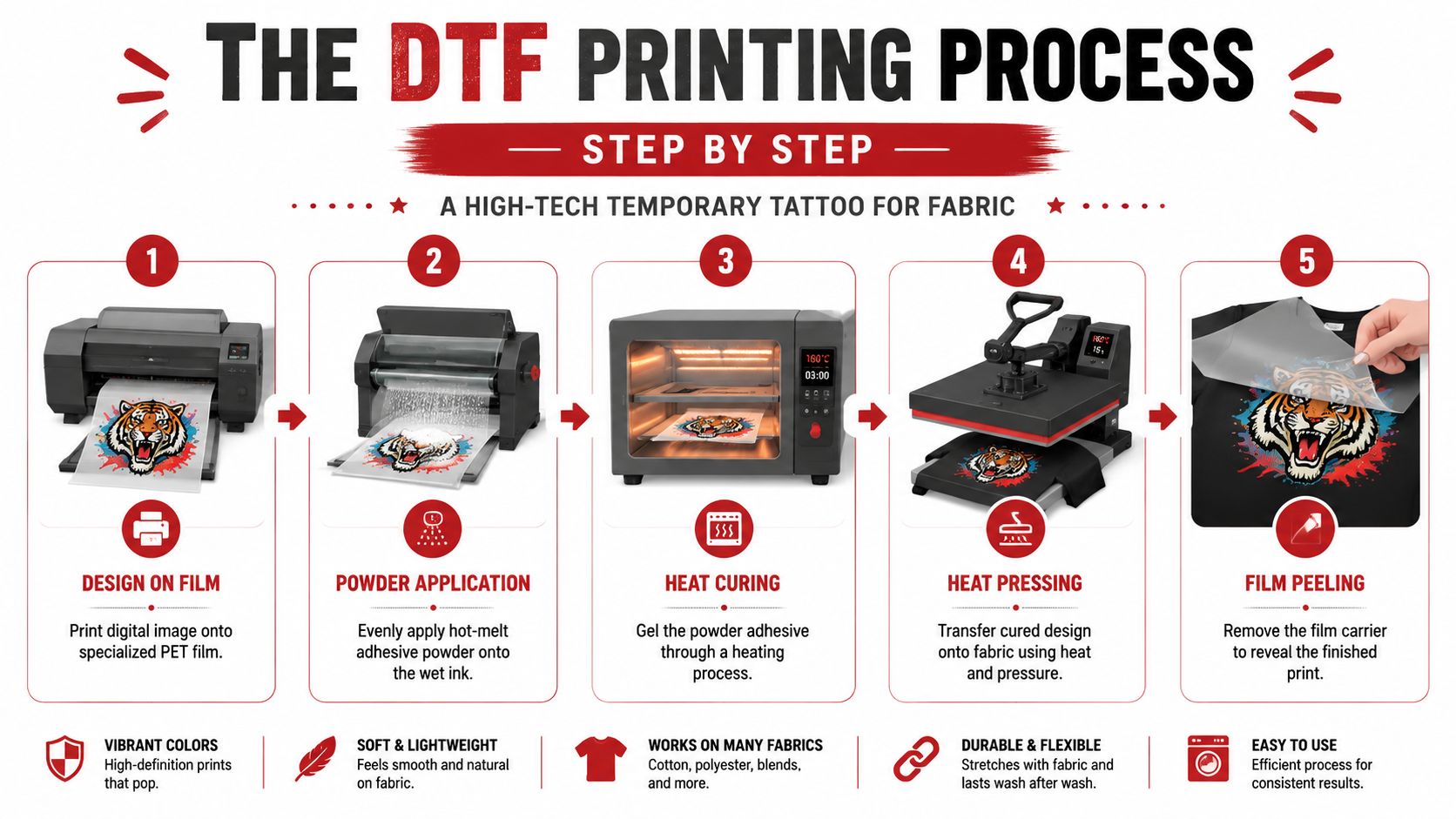
The easiest way to think about DTF is this: it works like a high-tech temporary tattoo for fabric, except it's made for production use and meant to last through normal wear and care.
The design doesn't print straight onto the hat. It's built on a transfer first, then applied to the finished item.
What happens first
The process starts with digital artwork. The printer outputs the design in mirrored format onto coated PET film. In a standard workflow, the color layers print first and the white underbase prints last, which helps the final image stay visible on darker fabrics, as described in Wikipedia's overview of direct-to-film printing.
That white layer matters more than most buyers realize. Without it, a bright logo can get swallowed by a dark cap fabric or lose punch on mixed-material hats.
How the transfer is built
Once the design is on the film, the ink is still tacky enough to accept adhesive powder. The transfer isn't finished yet. This is the stage that gives DTF its ability to move from film onto fabric.
Print the artwork onto PET film
The film acts as the temporary carrier. The design is reversed so it reads correctly after pressing.Lay down the white backing
The white layer sits behind the colors in the finished transfer and helps maintain opacity on darker materials.Apply TPU adhesive powder
A thermoplastic polyurethane (TPU) powder is dusted onto the wet ink so the printed image can bond to fabric.Cure the powder
Heat fuses the adhesive to the printed ink. At this point, the transfer becomes something you can handle, store, and later press onto a hat or garment.
The big production advantage is separation of steps. A shop can print transfers first, then press them onto hats later as orders are assembled.
What happens at the heat press
The cured transfer is placed onto the hat in the exact decoration area, then pressed with heat and pressure. After pressing, the film carrier is peeled away and the printed design stays on the fabric.
That last step sounds simple, but hat work adds complexity. A shirt lies flat. A cap doesn't. The operator has to position the transfer so it lands cleanly on the usable part of the panel without drifting into a seam or warping around the curve.
Why this process works for hats at all
DTF is a transfer workflow, which means the print is prepared before it ever touches the hat. That gives decorators more control over color, detail, and placement than methods that depend on direct printing onto the finished cap surface.
For buyers, the takeaway is straightforward:
- The film carries the image
- The powder creates adhesion
- The curing locks the transfer together
- The heat press bonds it to the hat
If any of those steps are weak, the result will show it. A clean DTF print depends on file prep, material choice, transfer quality, and press technique working together.
DTF vs The Classics DTG Screen Print and Embroidery
Most buyers don't need every printing term explained. They need to know which method fits their logo, hat style, and order size.
DTF gained traction because it works across a broad mix of substrates including cotton, polyester, nylon, and blends, and it avoids the pretreatment requirements that often come with DTG. It also fits short runs and larger gang-sheet production well, as outlined in Imaging Spectrum's discussion of DTF workflows.
Where DTF beats DTG for hats
DTG means direct-to-garment printing. On shirts, it can produce a soft print feel and strong detail. On hats, though, DTG isn't usually the first choice because headwear isn't naturally suited to direct flat-platen garment printing.
DTF solves that by moving the image through a transfer step first. For hats, that matters.
- Fabric range: DTF handles more cap material combinations comfortably.
- Decoration flexibility: It can apply to hats that aren't ideal candidates for direct garment printing.
- Small logo detail: It holds fine printed elements that embroidery may simplify or lose.
DTG still has a place in apparel, especially where softness on cotton is the top priority. But for custom hats, it usually isn't the practical comparison winner.
Screen print versus DTF on cap orders
Screen printing is still excellent in the right job. If you're running the same simple artwork over and over on suitable items, it remains a proven production method. But hats complicate the decision because the print zone is smaller and less forgiving than a shirt front.
For a useful baseline on older print approaches, Dirt Cheap Headwear has a guide to different screen printing methods for apparel and decoration.
With hats specifically, DTF often makes more sense when:
- The logo is full color
- The artwork includes fades or gradients
- The design changes between versions
- The order isn't large enough to justify more setup-heavy workflows
Screen print still wins when the art is simple, the production setup is dialed in for that exact item, and the job suits the method. But for mixed-fabric headwear and detailed graphics, DTF is easier to fit into real-world custom ordering.
Embroidery is still the benchmark for some logos
Embroidery remains the standard for a classic stitched cap look. It gives texture, dimension, and that familiar branded-hat finish many businesses want.
But embroidery has limits buyers run into fast:
- very small text can close up
- gradients don't translate naturally into thread
- photographic art isn't a realistic embroidery file
- thin lines may need to be thickened or simplified
DTF handles those problems better because it prints the artwork rather than rebuilding it with stitches.
If your logo needs to look exactly like the digital file, DTF usually preserves that better than embroidery.
That doesn't mean DTF replaces embroidery. It means each method solves a different visual problem.
DTF vs. Other Methods at a Glance
| Feature | DTF Printing | Embroidery | Screen Printing | DTG Printing |
|---|---|---|---|---|
| Best use on hats | Full-color logos, gradients, fine detail | Classic stitched branding, simple to moderate logos | Simpler graphic applications where setup fits the job | Less common choice for hats |
| Material flexibility | Strong across cotton, polyester, nylon, and blends | Broad, but depends on cap structure and stitchability | Depends on item and setup | More limited in practical hat use |
| Detail handling | Strong for small printed details and color transitions | Can lose tiny detail or require simplification | Better for simpler spot-style graphics | Strong detail on garment applications |
| Look and feel | Printed surface | Textured stitched finish | Printed ink look | Direct print feel on garments |
| Setup friction | Lower for artwork changes and multi-color jobs | Digitizing and stitch planning matter | More setup-heavy than transfer printing | Garment-specific workflow |
| Best for | Logos that are hard to stitch cleanly | Premium traditional cap branding | Repeat graphic runs that suit the method | Shirt printing more than headwear |
The real decision for a hat buyer
A lot of confusion clears up when you stop asking which method is "best" and start asking which method fits the logo.
Choose DTF when your design is visual first. Choose embroidery when your design is tactile first. Consider screen print when the job aligns with the method and the artwork is simple enough to benefit from it.
Why DTF Is a Game Changer for Custom Hats
Hats are one of the toughest places to decorate well because the surface fights you. The crown curves. The seam interrupts the art. The available print area is smaller than people expect. That's why generic DTF guides leave buyers hanging. They explain the transfer process but skip the part where a cap shape changes everything, a gap noted in Printful's article on what direct-to-film printing is.
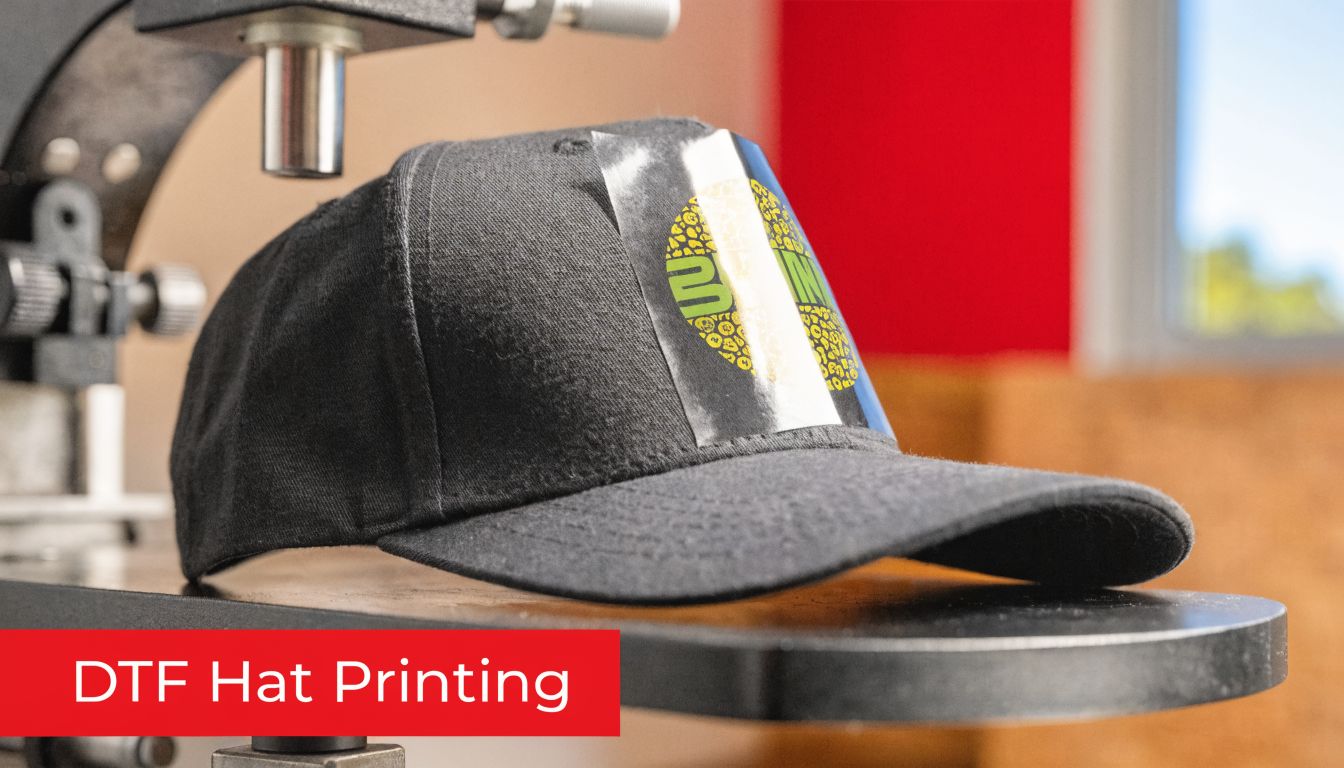
Where DTF works especially well on headwear
DTF shines when the logo would be difficult to embroider cleanly or when the visual style depends on printed color.
Good hat use cases include:
- Detailed front logos: Small text, shading, and layered colors reproduce better in print than thread.
- Promotional artwork: Event logos and sponsor-heavy designs often have too much detail for clean embroidery.
- Performance and synthetic caps: Polyester and blended headwear often pair well with transfer-based decoration.
- Short-run branded merch: If you need a smaller batch and don't want to simplify the art, DTF is a practical option.
The limits buyers should know before ordering
DTF is flexible, but it doesn't ignore physics. A transfer still has to land on a curved panel and bond evenly.
The main trouble spots are usually the same:
- Center seams: A six-panel cap with a strong front seam can interrupt artwork, especially if the design spans too wide.
- Curved crowns: Tall or heavily curved fronts can distort the visual shape of geometric logos.
- Tiny placement zones: Side panels and narrow front areas don't leave much margin for alignment.
- Mesh panels: On classic trucker hats, decoration is generally best kept off open mesh sections.
A clean hat print usually comes from designing for the cap, not forcing shirt artwork onto a smaller curved surface.
That's why cap style matters. A structured 5-panel front often gives decorators a friendlier canvas than a highly curved, center-seamed style. If you already know you want print instead of stitching, that construction choice can make the final result look far more intentional.
A short video helps show the transfer concept in motion:
When embroidery still wins
This is the part most print-first articles avoid. Some logos look better embroidered.
Choose embroidery instead if:
- You want a traditional retail cap look
- The logo is bold and simple
- Texture matters as much as color
- You're decorating a premium brand cap where stitch style fits the identity
DTF becomes a game changer for hats when embroidery would force too many compromises. If you'd have to enlarge text, remove gradients, thicken lines, or flatten a colorful brand mark into thread blocks, print starts making a lot more sense.
Artwork Prep for Flawless DTF Prints
Bad artwork creates bad prints. That's true for shirts, and it's even more true for hats because the decoration area is smaller and mistakes become obvious fast.
The most common issue isn't the transfer. It's the file. Buyers often send a low-quality screenshot, a logo pasted onto a white box, or artwork that looked fine on a laptop but falls apart when resized for a cap front.
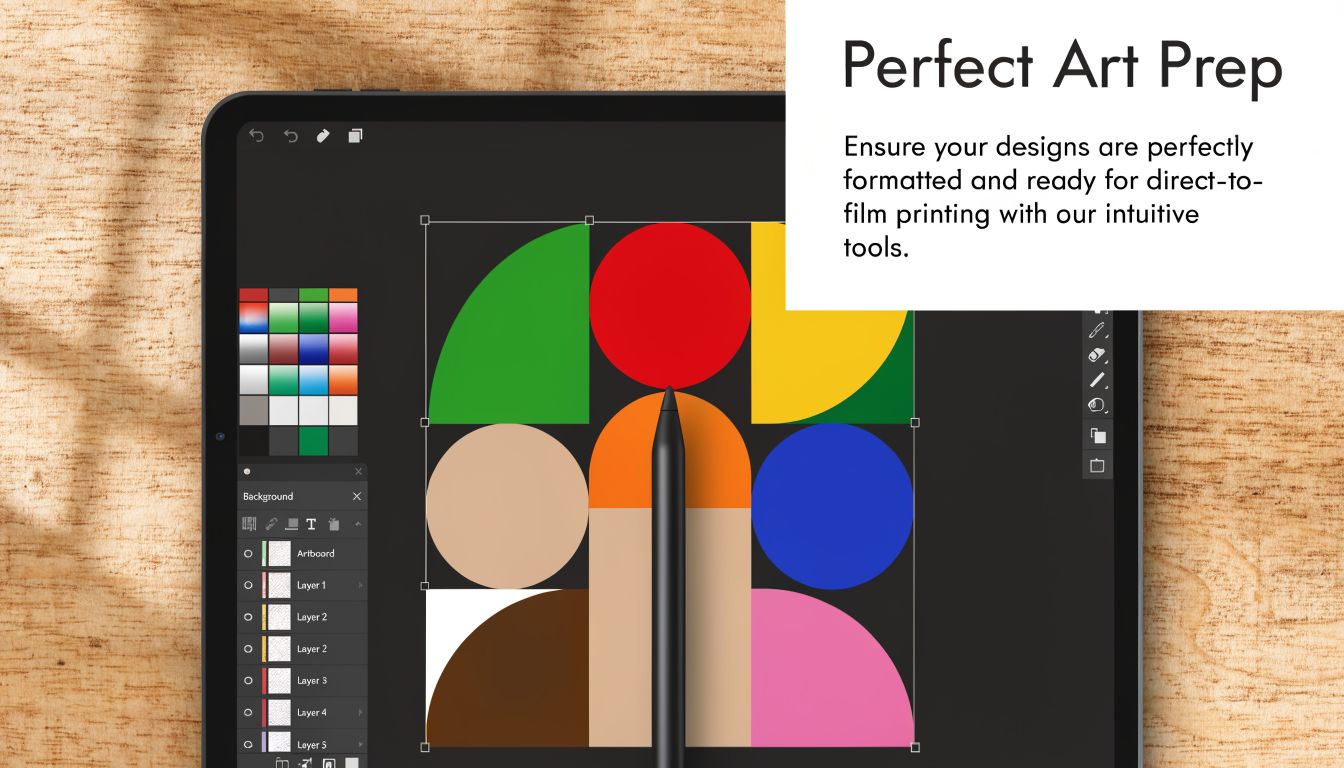
What to send your decorator
For the cleanest result, give the shop a file that's built for production, not just for viewing.
- Use high-resolution artwork: A crisp file holds edges better when the logo is sized down for a hat.
- Keep the background transparent: White rectangles and accidental background color blocks show up immediately in print.
- Send the right file type: Vector art is ideal when available. If not, a clean production-ready raster file works better than a screenshot.
- Match the actual print size: A logo that reads well on a shirt may need edits before it works on a cap.
For a practical checklist on acceptable file types and logo setup, this hat logo file requirements guide is the kind of thing buyers should review before submitting artwork.
Design choices that help on hats
Even a good file can be wrong for headwear if the layout ignores the cap shape.
A few adjustments usually improve results:
Tighten the composition
Wide logos struggle on narrower front panels. A stacked version often works better than a horizontal one.Protect small text
If taglines or web addresses become tiny, remove them. What reads on a monitor may not read on a cap.Respect the seam
A centered design on a six-panel hat needs enough structure to survive visual interruption.Avoid fake transparency effects
Soft shadows and subtle edge fades can work, but they need to be deliberate and built from clean artwork.
Clean art doesn't just print better. It gives the decorator more room to place the design where the hat will actually wear well.
A smart note on file discipline
This same discipline shows up in other custom print niches too. For example, if you've ever looked at the artwork guidance behind a Custom Bass Drum Heads printing service, the lesson is similar: large-format or specialty printing only looks professional when the source file is professional.
For buyers, the easiest rule is simple. Send the original brand asset if you have it. If you don't, ask for help cleaning the artwork before production starts.
Durability Costs and Ordering Best Practices
DTF is often sold as durable, and it can be, but durability in practice depends on how the transfer was made and how the finished hat is treated. One industry source says DTF prints are typically rated for 30 to 50 wash cycles before quality may degrade, and that outcome depends heavily on ink quality, powder quality, curing, and end-user care, according to Design Brand Print's review of DTF pros and cons.
What durability really means on hats
Hats aren't washed as often as tees, but they do take sweat, friction, sunlight, and repeated handling. That's why failure on caps often shows up as edge wear, cracking from poor adhesion, or surface damage from rough cleaning.
To protect a printed hat:
- Spot clean when possible: Scrubbing a print aggressively shortens its life.
- Avoid high heat exposure: Heat can stress transfers over time.
- Store hats properly: Crushing the crown can distort decorated areas.
- Follow care instructions from the decorator: Different hat materials may need slightly different treatment.
A good transfer on a suitable cap can hold up well. A rushed press job or poor-quality transfer usually tells on itself much sooner.
How DTF pricing tends to work
DTF is attractive for buyers because it handles multi-color artwork without forcing the same kind of design simplification that other methods often require. In practical ordering terms, pricing is usually driven by the print itself, the placement, and the hat style rather than by thread count.
That makes DTF especially appealing when:
- your logo uses several colors
- you need a shorter run
- you're testing merch before committing to larger volume
- you want printed detail without rebuilding the logo for stitches
If you think about decorated hats the same way you'd think about retail product pricing, ecommerce growth tips from Next Point Digital offer a useful reminder that your decoration choice affects not just unit cost, but also how the final product feels to the customer.
Ordering habits that save headaches
The smoothest hat orders usually have a few things in common.
- Approve the proof carefully: Check size, placement, and readability, not just the logo itself.
- Choose the hat style with the decoration in mind: A print-friendly front panel can matter more than a tiny price difference between blanks.
- Ask about seam placement: Especially for centered front artwork.
- Run a sample if the logo is complex: This is especially helpful for merch brands and event programs.
Common DTF Questions and Troubleshooting
Does DTF feel plasticky on a hat
It can, especially if the design is large and heavily inked. On smaller front logos, the feel is usually much less of an issue than buyers expect. If soft hand is your top priority, keep the artwork compact and avoid oversized solid blocks.
Is DTF good for photo-quality logos
Yes, generally speaking. DTF is one of the better options when a logo includes gradients, shading, or image-based detail that embroidery can't translate well. The key is starting with clean artwork and choosing a hat style with a usable print area.
Can DTF go over seams
Sometimes, but that doesn't mean it always should. A seam can interrupt adhesion and visual clarity. If the design has important detail in the middle, it's usually smarter to resize it, reposition it, or choose a hat style with a friendlier front panel.
What's the biggest mistake buyers make
Sending shirt artwork for a hat without adapting it. A cap front is smaller, more curved, and less forgiving. Logos often need to be simplified, stacked, or resized for headwear.
When should I skip DTF
Skip it if you want a traditional stitched look, if your brand identity depends on texture, or if the artwork is simple enough that embroidery will look cleaner and more premium. DTF is a strong tool, but it isn't the answer to every hat job.
If you're deciding between DTF, embroidery, or another decoration method for branded caps, Dirt Cheap Headwear can help you match the logo to the right hat style and decoration approach before you place the order.
Pingback: Screen Printing on Polyester: A Practical Guide – T-Shirt Envy Co.