
Unisex Baseball Caps Styles Fit and Custom Guide
You've been asked to order caps for a mixed team, a staff group, or an event. The logo is ready, the color is approved, and then someone asks the question that can derail the whole order: “Will this fit everyone?” A cap labeled unisex may look like the easy answer, but the label alone doesn't tell you whether the crown is deep enough, the closure has enough adjustment, or the brim suits the people wearing it.
That's why the smartest way to shop for unisex baseball caps is to treat unisex as a fit system, not a gender category. Closure type, crown depth, panel construction, fabric, brim shape, and decoration method all influence who can wear the cap comfortably and how the finished product looks.
Why Unisex Baseball Caps Work for Everyone
A community sports league orders one cap for players, coaches, volunteers, and parents. The group includes smaller and larger heads, thick and short hair, and different wearing preferences. Choosing by color and price alone can produce a consistent-looking order that fits inconsistently. Some wearers tighten the closure fully, others need more room, and a few stop wearing the cap because the crown sits awkwardly.
A well-chosen unisex baseball cap works because it uses a familiar shape without depending on a men's or women's size category. The useful question is not whether the label says unisex. It is whether the closure, crown depth, and panel structure can serve the actual group. The label is the sign on the box. The fit system is what determines whether the cap works once it is on someone's head.
Baseball caps also have a long history as shared headwear. The rounded cap worn by the Brooklyn Excelsiors in 1860 helped establish the form associated with modern baseball caps. The “Brooklyn-style” cap became standard by 1900, and New Era introduced the fitted 59FIFTY in 1954, a template now associated with caps worn across genders (this history of the ballcap).
Why buyers keep choosing the format
The appeal is practical. A baseball cap is easy to wear, easy to decorate, and recognizable across uniforms, merchandise collections, and promotional programs. A curved brim looks relaxed, a flat brim appears sharper, performance fabric feels sporty, and cotton twill gives the cap a classic character.
The category reaches well beyond the field. One source reports that 72% of Americans owned at least one baseball cap in a 2022 survey, while 34% owned five or more, and another estimates that more than 400 million baseball caps are sold globally each year (baseball cap ownership and market context). These figures help explain the category's familiarity, but a familiar product still needs fit checks.
Before approving a bulk order, compare the adjustment range and crown shape with the people who will wear it. If needed, learn how to position the crown and brim in this guide to how to wear a baseball cap for different head shapes.
Practical rule: Choose one shared silhouette only after checking its closure, crown, and panel structure against the actual group.
This guide then examines flexible fits, popular styles, construction details, team and brand uses, decoration planning, and ordering decisions without treating every head as the same size.
What Makes a Baseball Cap Truly Unisex
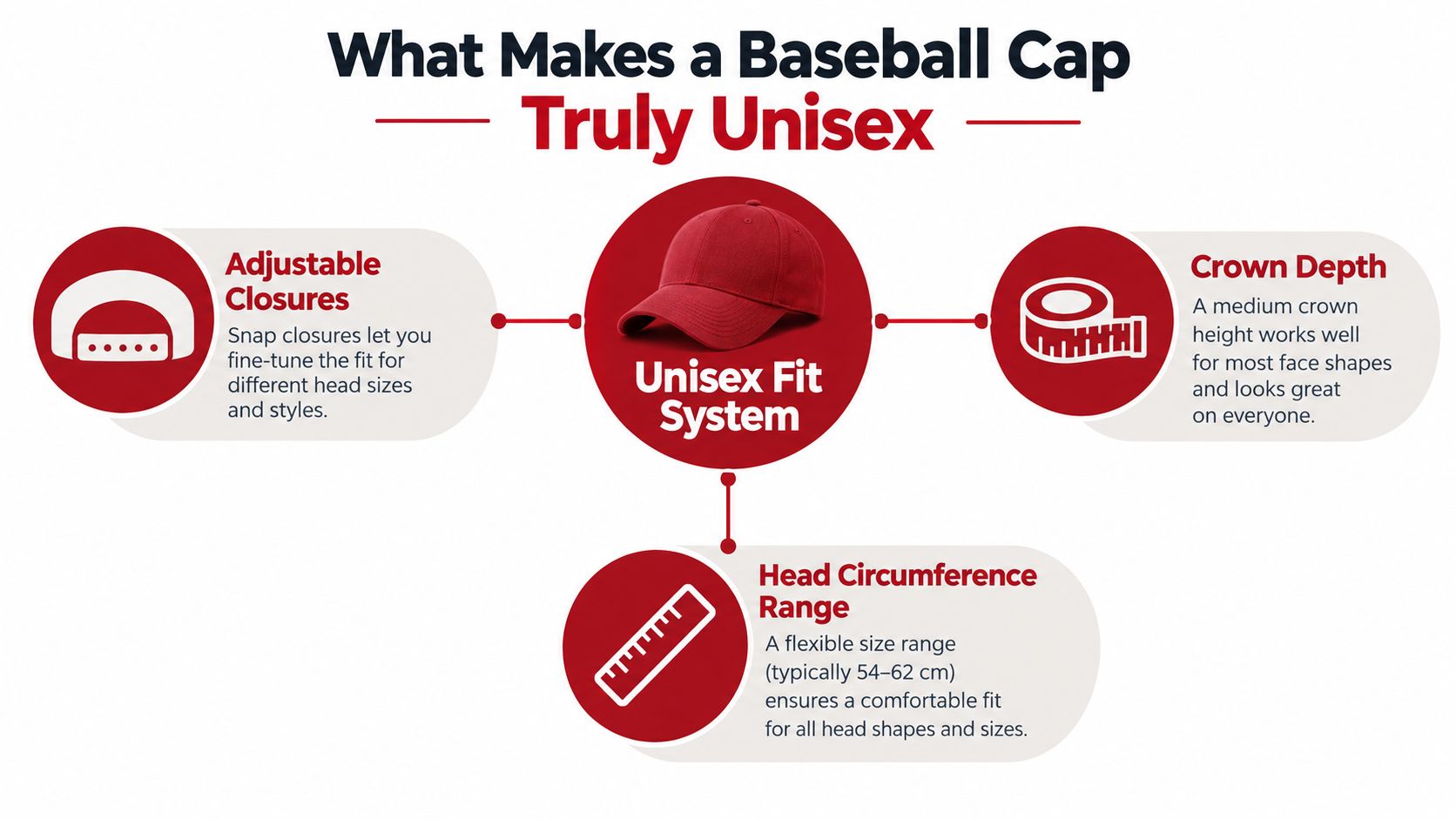
A merch team choosing a unisex cap is choosing a fit system, not a neutral color or gender-free product label. The cap needs to accommodate a useful range of head shapes, hair volume, and wearing preferences.
An adjustable shoe shows why the label alone is insufficient. A shoe marked “one size” would not fit everyone unless its strap, flexible upper, and shape supported different feet. Caps work the same way. The closure, crown, panel structure, and circumference range determine whether a cap adapts to its wearer or only claims to.
Start with the closure
The closure controls how much the wearer can change the cap's circumference. Snapbacks use plastic snaps, strapback caps use fabric or webbing straps, and hook-and-loop closures use a fastening panel. Each option changes both the adjustment range and the cap's visual finish.
A fitted cap has no adjustment point, so the buyer must select a more precise size. Stretch-fit designs add flexibility through elastic material, but their comfort still depends on the available size range and crown proportions. For a mixed group, adjustable or stretch-based options can reduce ordering risk. Fitted caps create a more uniform profile when the buyer has dependable measurements.
Check the crown and panel structure
The crown rises from the brim and surrounds the head. A shallow crown can suit someone who prefers a close, low profile, but it may feel cramped on a larger head or over fuller hair. A deeper crown provides more room, though it can appear oversized on a smaller head.
A structured vs unstructured crown changes how that room is distributed. Reinforcement helps a structured crown hold its shape, while an unstructured crown collapses more naturally around the head. Neither option automatically fits a broader audience. Choose based on whether the group needs a crisp profile, a relaxed feel, or greater flexibility around different head shapes.
Panel construction also affects fit and appearance. A firm front panel can keep decoration flat and make the cap look more defined. Softer panels follow the head more easily, but they may create a less consistent logo surface across a bulk order.
Treat “one size fits most” as a question
Ask what “most” means for the intended group. Check the actual circumference range, closure type, crown depth, fabric stretch, and sample or return policy. Public sizing charts often place fitted-cap guidance around roughly 54 to 63 cm, or about 21¼ to 24⅜ inches, while adjustable caps are frequently described only as “one size fits most” (cap sizing guidance).
For a bulk order, collect representative head measurements or test samples on people with different fit needs. A unisex selection gives wearers several ways to reach a comfortable fit without forcing the crown, closure, or brim into an awkward shape.
Most Popular Unisex Baseball Cap Styles Explained
Three styles appear repeatedly in wholesale catalogs: the dad hat, the snapback, and the trucker. They can all work for mixed audiences, but they don't create the same profile or tolerate the same decoration.
A dad hat usually has a soft, unstructured crown and a curved brim. It gives a relaxed, broken-in impression and tends to suit brands that want an approachable, vintage, or lifestyle feel. Because the crown doesn't hold a rigid shape, it can settle differently on different heads. That flexibility feels comfortable to some wearers, while others prefer the definition of a structured cap.
The snapback takes the opposite visual route. Its crown is commonly structured, its brim may be flat or slightly curved, and its plastic snap closure makes adjustment obvious. The result feels more graphic and streetwear-oriented. A snapback can provide a strong front panel for a logo, but the taller profile may look more prominent on smaller heads.
A trucker combines a structured front with mesh rear panels. The mesh supports ventilation, while the front panel gives the decoration a stable surface. It works naturally for outdoor crews, automotive brands, outdoor events, and casual promotional merchandise. The mesh also changes the feel of the cap, so it's a style decision as much as a comfort decision.
Compare the silhouettes quickly
| Style | Crown and Brim | Best For | Vibe |
|---|---|---|---|
| Dad hat | Soft, unstructured crown with a curved brim | Lifestyle brands, relaxed teams, casual events | Easygoing and vintage |
| Snapback | Structured crown, often with a flat or semi-flat brim | Streetwear, music merchandise, bold logos | Graphic and contemporary |
| Trucker | Structured front with mesh back, usually curved or semi-flat brim | Outdoor groups, workwear, summer promotions | Sporty and breathable |
Match the style to the wearer
A soft cap can feel less intimidating for a general audience, but a rigid front can make a logo more visible from a distance. A trucker can be comfortable in warm outdoor settings, while a dad hat may suit an indoor retail team that wants a quieter branded look.
You'll find additional silhouettes, including fitted, five-panel, rope, and performance styles, in this guide to different baseball cap styles. Use the style name as a starting point, then confirm the construction details. Two caps called “snapbacks” can still differ in crown height, brim curve, fabric weight, and adjustment range.
A style category tells you the cap's family. The product specifications tell you whether it belongs in your order.
For mixed-gender teams and customer-facing staff, the safest choice is usually the style that supports the brand without overpowering the wearer. A relaxed brand may want a dad hat, while a logo that needs a broad, stable display area may perform better on a structured front panel.
Materials Structure and Fit Details That Change Everything
Two caps can both be labeled unisex and still feel completely different. Construction determines how the cap sits, how much space it creates, how it handles heat, and whether your logo looks clean after decoration.
Start with the panel count. A 5-panel cap often creates a broad, uninterrupted front area with a sportier or contemporary look. A 6-panel cap uses a more traditional baseball construction, with seams converging toward the crown button. The seam layout changes the visual character of the cap and may affect where a decorator places a logo.
Structure controls the profile
A structured crown uses reinforcement to hold its shape. That helps create a consistent front panel for embroidery and gives the cap a sharper appearance. An unstructured crown uses softer fabric and usually follows the head more naturally, which can make it feel more relaxed but less uniform from wearer to wearer.
A five-panel cap may have a clean front suited to modern branding, while a six-panel cap often reads as a classic baseball shape. Neither construction guarantees better fit. Crown depth, seam placement, and closure adjustment still determine comfort.
Material changes comfort and decoration
Cotton and cotton twill tend to feel familiar and versatile. Twill has a visible diagonal weave and enough body for many embroidered logos. Mesh improves airflow through the rear panels, making it a natural option for warm outdoor programs, though the structured front still determines most logo placement.
Performance fabrics can feel lighter and manage moisture differently, but the decorator should confirm how the fabric reacts to stitching or printing. Fine lettering, dense fill areas, and raised embroidery each place different demands on the front panel.
Brim geometry affects protection
A baseball cap shades the forehead and nose more effectively than the ears, cheeks, or neck. Hat-style testing found that standard baseball caps provide good protection to the forehead and nose but are relatively ineffective at those side and rear areas. The same evidence reported predicted protection factors for direct ultraviolet exposure of about 79% in summer, 60% in spring, 41% in autumn, and 29% in winter, while diffuse exposure was around 60% and reflected exposure around 10% (facial ultraviolet exposure testing).
For practical buying, a brim of at least 7.5 cm is needed for reasonable protection to the nose and cheeks, while peaked baseball caps leave side facial areas exposed (evidence on hat brim geometry). Treat a baseball cap as partial shade, not full-face sun protection.
Read the specification sheet in this order
- Construction: Confirm five-panel or six-panel design.
- Crown: Look for structured or unstructured construction and assess depth.
- Material: Match cotton, twill, mesh, or performance fabric to the setting.
- Brim: Check whether it's curved, flat, or flexible.
- Closure: Confirm snapback, strapback, hook-and-loop, fitted, or stretch-fit.
- Decoration area: Ask whether the front panel supports your logo size and stitch density.
How Teams Brands and Events Use Unisex Baseball Caps
A staff uniform, a team accessory, and a merchandise product may all use the same cap category, but they solve different problems.
A small landscaping business may need a cap that adjusts quickly between employees and holds up outdoors. A curved-brim trucker with a stable front panel can balance airflow, visibility, and recognizable branding. The owner should still test the crown on staff members before ordering the full group, especially if the cap will be worn throughout a long workday.
A youth sports program may prioritize a familiar baseball profile and a closure that players can adjust themselves. A snapback can simplify shared sizing, while a soft strapback may create a quieter, less sporty appearance. Coaches might prefer the same decorated cap in a different fit, but keeping the logo treatment consistent helps the group look coordinated.
Different buyers, different priorities
- Small businesses: Favor easy adjustment, durable fabric, and a decoration area that keeps the logo readable on every cap.
- Sports teams: Usually want a recognizable athletic silhouette, secure closure, and color consistency across replenishment orders.
- Schools and nonprofits: Benefit from a broadly wearable style that works for volunteers, students, staff, and supporters.
- Merch creators: Need a cap that fits the brand's visual language and leaves enough room for embroidery, patches, or printing.
- Resellers: Must balance dependable blank supply, repeatable construction, and a style that won't create excessive fit complaints.
Unisex caps simplify inventory because a buyer can start with fewer style variations than a gender-separated program. That advantage disappears if the chosen cap has a narrow adjustment range or a crown that only suits one head shape.
The cap should serve the program's wearing conditions first. A stylish silhouette that sits unused isn't a successful uniform choice.
For an event, an adjustable cap generally reduces handout confusion. For a premium apparel label, fitted or stretch-fit options may support a more intentional product experience, but the size curve requires more planning. For recurring staff orders, document the exact style, color, closure, and decoration placement so future replenishment doesn't change the fit.
Customization and Wholesale Ordering Without the Guesswork
Decoration starts with the logo, but it shouldn't end there. A cap's front panel, fabric, structure, and crown height determine whether the artwork looks crisp or crowded.
Begin by simplifying the design for the product. Fine-detail stitching can preserve small elements when the cap and file support it, while 3D puff embroidery creates raised dimension that suits bold lettering and simple shapes. Dense artwork may need editing before production, especially if the front panel is narrow or the crown curves sharply.
Patches offer another route. Woven patches can show detailed artwork, embroidered patches bring texture, and printed patches can support gradients or small visual elements. Printing may suit designs that don't translate cleanly into thread, but the decorator should recommend the method after reviewing the cap material and artwork.
Use a simple ordering checklist
- Choose the wearer profile. Decide whether the program needs maximum adjustability, a close stretch fit, or precise fitted sizing.
- Order a sample or small run. Test the cap on people with different head circumferences, hair volumes, and style preferences.
- Approve the proof. Check logo scale, thread colors, placement, and how the design sits across seams or curved fabric.
- Confirm the decoration method. Use puff embroidery for suitable bold artwork, fine stitching for supported detail, and patches or print when they better match the design.
- Record the exact product. Save the style name, color, closure, crown type, and decoration specifications for reorders.
Low-minimum programs can make testing easier. Dirt Cheap Headwear states that its in-house embroidery options start at six pieces per logo, with services including 3D puff and fine-detail stitching. It also offers custom patches, printing, blank hats, and decorated headwear, so a buyer can compare a test run with a larger wholesale order through one supplier.
A print-on-demand program has different inventory logic. If you're weighing made-to-order fulfillment against buying blanks and decorating them yourself, this print on demand caps guide provides useful context for comparing the models.
Here's a practical video reference for the ordering and decoration process:
Don't approve a bulk order from a product photo alone. Photos rarely show how the closure behaves at its smallest setting, how deep the crown feels, or whether the brim overwhelms a smaller face. Those details create the fit complaints that buyers could have prevented with a sample.
Choosing Your Perfect Unisex Baseball Cap With Confidence
Use this order of decisions: fit system first, style second, construction third, use case fourth, decoration last. That sequence keeps a strong logo or attractive color from distracting you from the cap's basic job, which is to sit comfortably on a real person's head.
Start by asking who will wear it. If the group is mixed and you don't have reliable measurements, prioritize an adjustable closure and inspect the actual range rather than trusting “one size fits most.” If the audience expects a sharper retail look, compare structured and fitted options with a sample. If people will wear the cap outdoors, assess ventilation and brim coverage, then plan additional sun protection where the cap leaves skin exposed.
A fast evaluation method
Run through five questions:
- Can the wearer adjust it comfortably?
- Does the crown provide enough room without collapsing awkwardly?
- Does the silhouette match the brand or event?
- Will the material suit the environment and decoration?
- Can the supplier reproduce the same cap and logo on the next order?
A dad hat may win on relaxed comfort, a snapback on visual impact, and a trucker on airflow. A structured six-panel cap may suit a classic team identity, while a five-panel cap can support a cleaner contemporary mark. The “perfect” unisex cap is the one that answers the group's actual needs with the fewest compromises.
Start with a small test run when possible. Have people with different head sizes wear the cap, inspect the logo from normal viewing distance, and record the exact specifications before scaling up. That small discipline turns unisex from a vague label into a repeatable buying standard.
Dirt Cheap Headwear offers blank and custom-decorated baseball caps, including structured and unstructured options, embroidery, patches, printing, and low-minimum orders starting at six pieces per logo. Visit Dirt Cheap Headwear to compare cap styles, request custom decoration, and build a test order that fits your team, brand, or event.