
Structured Trucker Hat: A Complete Buyer’s Guide
You're probably staring at a row of hat options that all look similar until you read the labels. Structured. Unstructured. Mid-profile. Trucker. Snapback. Then you try to picture your logo on each one, wonder which style your staff will wear, and realize a cheap mistake here turns into a whole box of hats nobody likes.
That's where the structured trucker hat usually enters the conversation. It's one of the safest choices when you need a hat that looks clean out of the box, presents a logo clearly, and still works in warm conditions. For a new business owner, that combination matters more than most style terms do.
A lot of buyers don't really need a fashion lecture. They need a straight answer to a practical question. Will this hat make my brand look put together, and will people want to wear it more than once? A structured trucker often checks both boxes, but it's not automatically right for every brand.
Understanding what “structured” changes reveals its value. It changes how the front panel sits, how embroidery behaves, how the hat looks on a shelf, and how consistent your order feels from piece to piece. Those details are what separate a decent promo hat from one that supports your brand.
Your Guide to the Perfect Promotional Hat
A common scenario goes like this. A small business orders shirts first because that feels easy. Hats come later, usually when the owner wants something staff can wear every day, or something to hand out at an event that won't get tossed in a drawer.
Then the problems start.
The soft caps look casual, but the logo can feel less defined. The higher-profile options look sharp online, but buyers worry they'll feel too stiff. Foam-front truckers catch attention, but not every brand wants that louder look. The structured trucker hat sits right in the middle of those decisions, which is why so many buyers circle back to it.
Why this style keeps coming up
For a brand, team, or event, you usually need three things from a hat:
- A clean front for decoration so the logo doesn't look wrinkled or uneven
- A wearable shape that works for a broad group of people
- Enough airflow that the hat still makes sense outdoors or on the move
A structured trucker tends to solve all three better than many other everyday cap styles.
Practical rule: If your logo needs to look crisp from across a room, the front panel matters as much as the embroidery file.
That's also why this style has stuck around. The trucker hat's modern identity took shape in the United States during the 1970s, when feed and farming supply companies used it as a promotional giveaway for farmers and truck drivers rather than as a fashion item, as outlined in this history of the trucker cap. It started as practical branded headwear. That origin still tells you a lot about why it works.
What a new buyer should focus on
Don't get hung up on jargon first. Focus on outcome.
Ask yourself:
- Do I want a sharper, more upright look or a softer, broken-in one?
- Will the logo live on the front center panel?
- Is this for uniforms, resale, giveaways, or lifestyle merch?
If your answer leans toward clear branding, repeatable appearance, and general-purpose wearability, the structured trucker hat deserves a hard look.
What Makes a Trucker Hat Structured
“Structured” sounds like a style label, but it's really a construction choice. The simplest way to think about it is this: a structured hat has an internal frame in the front. An unstructured hat doesn't.
A tent is a useful comparison. With poles in place, the tent holds its shape. Without them, it collapses into fabric. A structured trucker hat works the same way at the crown. The front section is built to stay upright instead of folding in on itself.
The parts that create the shape
A structured trucker hat is engineered to hold a fixed crown shape through stiffer front materials and internal reinforcement. Industry guides describe structured fronts as using foam or heavier fabrics such as twill or canvas supported by buckram, while trucker construction typically combines a structured or foam front with mesh rear panels and a snapback closure for ventilation and adjustability, according to this guide to trucker hat construction.
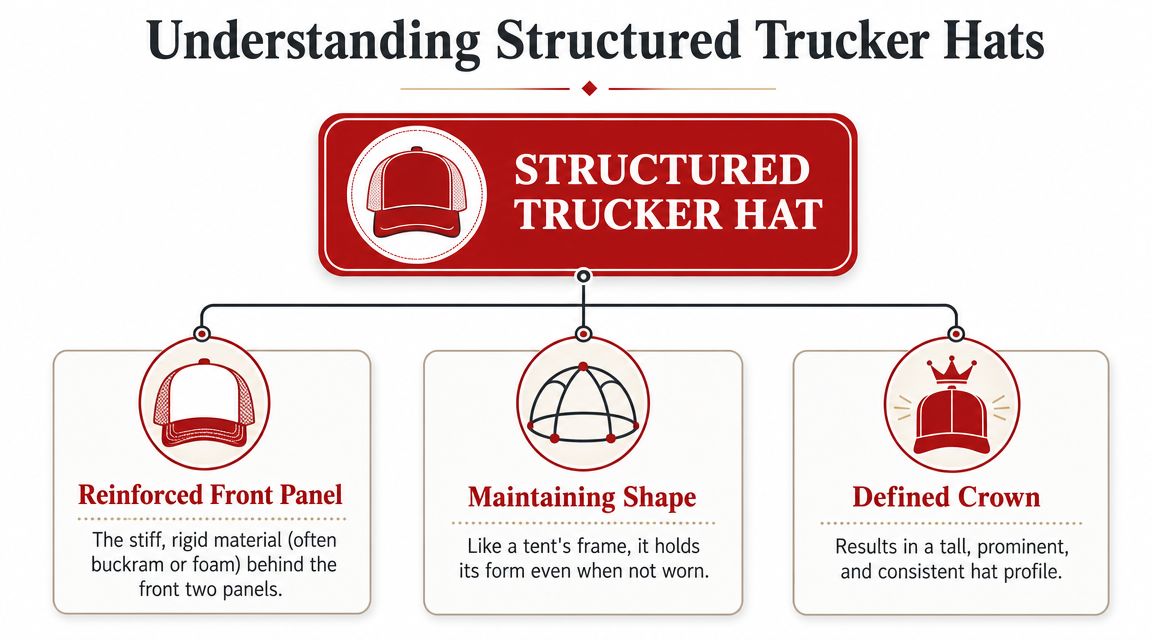
That construction gives you a few immediate results:
- A firmer front panel that doesn't cave in when the hat is off your head
- A more defined crown that reads cleaner at a distance
- A more predictable profile across multiple hats in the same order
If you've ever picked up a cap that looked great hanging on a peg but flattened out in the hand, that's usually the difference you're seeing.
Why profile and reinforcement matter
The word “structured” is often tied up with profile, but they aren't exactly the same thing. Structure refers to reinforcement. Profile refers to how high or deep the crown appears when worn. They influence each other, but they're not interchangeable.
If you need help sorting those fit terms out, this hat profiles and fits guide gives a practical breakdown.
A structured trucker doesn't just look taller because of styling. It looks more defined because the front panels resist collapse.
That matters most when the hat is being used as branded merchandise. A soft front can still look good, but a structured front gives the decoration a steadier surface. That's one reason this style shows up so often in wholesale and custom programs.
What the structure changes in day-to-day use
For the wearer, structure changes the feel on the forehead and the visual shape of the hat. For the buyer, it changes consistency.
A structured trucker hat usually arrives looking ready to wear. It holds its form in transit better than a softer cap, and it keeps a more uniform appearance when hats are displayed side by side. If you're stocking hats for a retail wall, packing team orders, or trying to keep a multi-location brand presentation consistent, that built-in shape does a lot of the work for you.
Structured vs Unstructured Trucker Hats
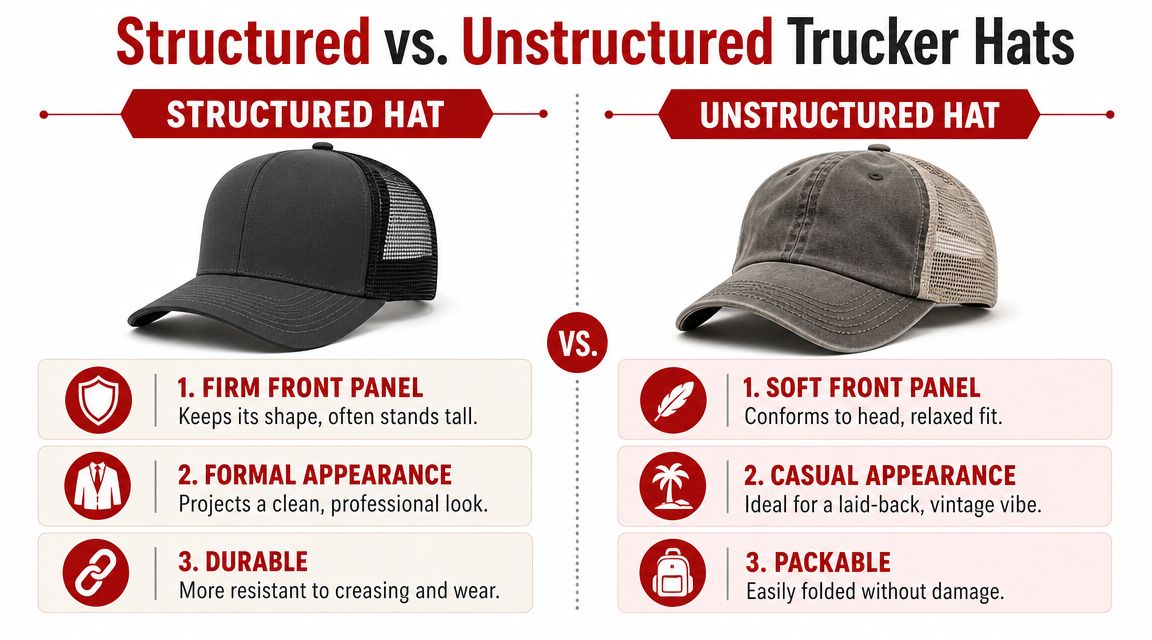
You approve a sample, then the bulk order shows up and the hats do not present the logo the same way. That problem usually starts with structure. A structured trucker hat keeps a defined front and a more consistent shape. An unstructured trucker sits softer, breaks in faster, and reads more casual from the start.
Neither option is better on its own. The right choice depends on how much shape your branding needs and how relaxed you want the finished hat to feel.
What you notice first
The difference shows up before anyone puts the hat on. Structured truckers hold a crisp front panel on the shelf, in a box, and on a merch wall. Unstructured truckers slump more naturally, which can look comfortable and lived-in, but less uniform across a wholesale run.
On the head, the trade-off gets clearer:
- Structured trucker hat feels firmer and keeps more shape through the crown
- Unstructured trucker hat settles faster and feels broken-in sooner
- Structured styles support bold front decoration better
- Unstructured styles suit quieter branding and softer styling
Structured vs Unstructured Hats at a Glance
| Feature | Structured Trucker Hat | Unstructured Trucker Hat |
|---|---|---|
| Front panel | Firm and reinforced | Soft and flexible |
| Shape off the head | Holds its form | Collapses more easily |
| Logo presentation | Cleaner and more uniform | More relaxed, can look less rigid |
| Overall vibe | Polished, branded, shelf-ready | Casual, easygoing, worn-in |
| Fit feel | Boxier and more defined | Softer and closer to the head |
| Best match | Teams, events, uniforms, merch walls | Lifestyle use, softer styling, casual brands |
The branding trade-off
Structured caps keep a firm front panel through buckram or similar stiffening, which helps embroidery, patches, and bold logos stay visible and readable. That same stiffness can work against brands that want a low-profile, easygoing look or a cap that conforms to the head faster, as discussed in this overview of structured and unstructured hat trade-offs.
For wholesale buyers, that difference affects more than style. It affects decoration results, display consistency, and how many hats in the order look like the sample. If your logo has clean borders, raised stitching, or a patch with sharp edges, a structured front usually gives you a safer surface to work with.
If your brand depends on a front-and-center logo, a structured hat usually gives you less room for disappointment.
Which one tends to work better
Choose structured when you want:
- A stronger front logo presence
- More consistency across a bulk order
- A cleaner look for staff, teams, or events
Choose unstructured when you want:
- A softer fit right away
- A lower-key fashion feel
- A cap that looks less formal and less built-up
Brand identity shows up in the silhouette, not just in the artwork. A structured trucker suggests an organized, intentional brand. An unstructured trucker gives off a more casual, relaxed identity.
Why Choose a Structured Trucker Hat
You approve the sample, place a few hundred hats, and then the true test starts. The logo has to hold up across the full run, the hats need to look consistent on staff and customers, and the style has to be wearable enough that people keep it instead of tossing it in a drawer. That is where a structured trucker usually earns its keep.
It gives your logo room to work
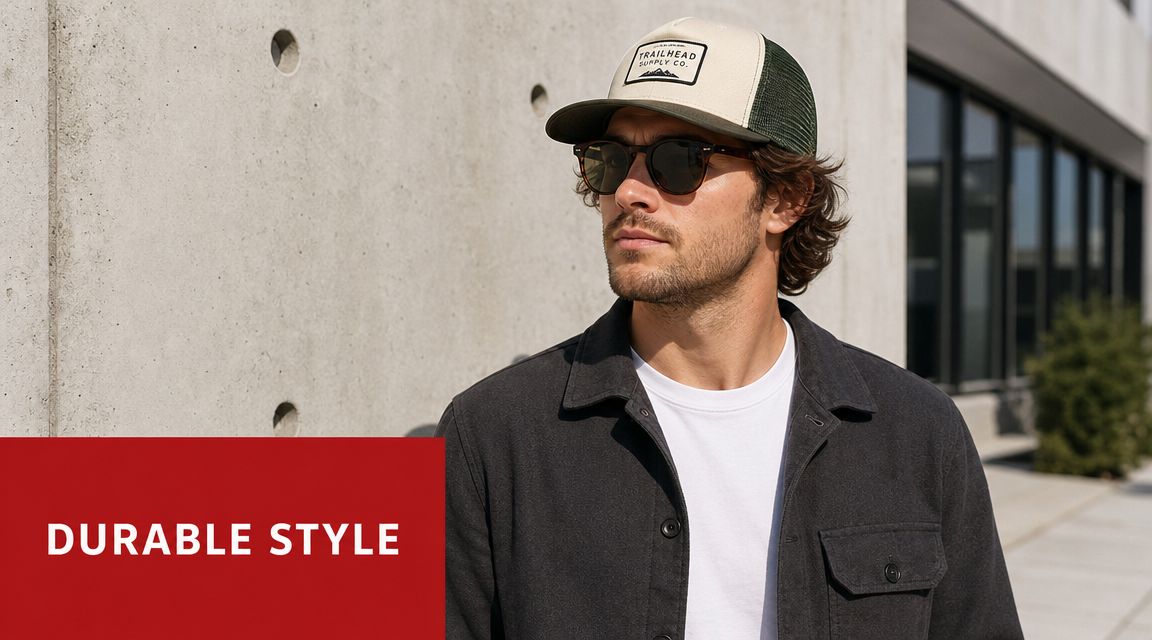
For custom decoration, the biggest advantage is simple. A structured front panel gives embroidery and patches a firmer surface, so artwork holds its shape better and stays easier to read from a distance.
That changes the result in practical ways. Small text has a better chance of staying legible. Borders on a patch look cleaner. Raised stitching tends to sit more evenly. If you are ordering hats for a brand launch, staff uniform, or retail shelf, those details affect whether the finished cap looks polished or cheap.
If you are still comparing silhouettes and suppliers, it helps to review a few common trucker cap brands for custom orders before you lock in the style.
It reduces surprises in bulk orders
Bulk buying exposes every weakness in a hat style. One sample can look great. Two hundred hats can show you where the crown collapses, where decoration placement drifts, and where the overall shape starts looking uneven from unit to unit.
Structured truckers help control that. The front profile stays more consistent during production, decoration, packing, and display. For wholesale buyers, that usually means fewer hats that look off-model and fewer awkward differences between the approved sample and the delivered run.
That matters most for orders tied to visibility and presentation:
- Staff uniforms where a clean, matched look matters
- Event merchandise where the display wall needs shape and consistency
- Team or club orders where group photos make every variation obvious
- Resale programs where inconsistent shape can hurt perceived value
It balances branding with wearability
A structured trucker is built for logo presence, but it still works as an everyday cap for a lot of buyers. The mesh back keeps airflow up, and the front structure gives the hat enough shape to look intentional without feeling like a rigid promo piece from another era.
That balance is why this style stays in the mix year after year. Buyers use it because it covers several jobs at once. It can support a front logo well, fit a broad audience, and hold up as merch instead of looking like a throwaway giveaway.
In a custom shop, that makes it a safe default for brands that need one hat style to do more than one job.
When it's the wrong call
A structured trucker hat isn't ideal if your brand leans soft and understated. If the goal is a broken-in look, a lower-profile shape, or a cap that conforms faster to the wearer's head, an unstructured style usually fits the brand better.
Choose structured when the front logo is the priority and you need the finished hats to look consistent across a full order. Skip it when comfort on day one and a relaxed silhouette matter more than a crisp front panel.
Sizing Styling and Popular Brands
Fit questions come right after decoration questions. Buyers want to know whether the structured trucker hat will suit a wide group of people, and that usually comes down to crown height, adjustability, and how the hat sits with different outfits.
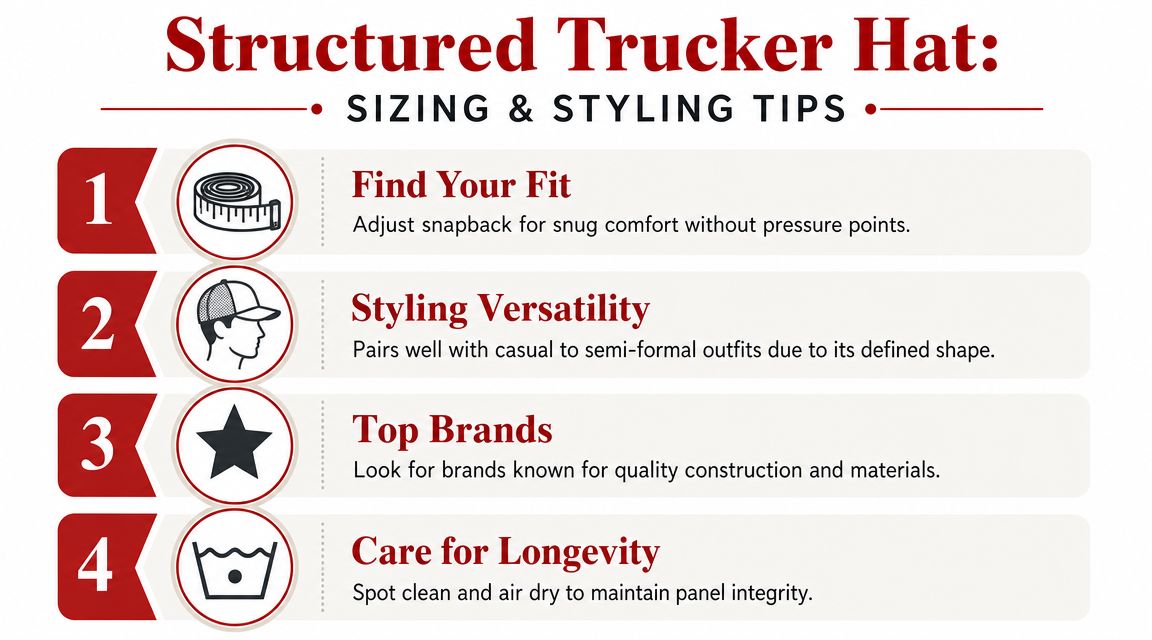
A lot of structured truckers use a snapback closure, which makes them forgiving for group orders. That adjustability helps when you're buying for a mixed audience and don't want to split your order into multiple fitted sizes.
What crown height means in real life
From a functional design standpoint, the main performance advantage is the combination of a stable front panel and a mesh back that improves airflow. Product data also shows that many structured truckers are built to approximately a 3.5-inch (8.9 cm) crown height with a six-panel layout, indicating a mid-profile format that balances branding space with a wearable fit, according to this Flexfit trucker cap guide.
That number matters because it helps explain why this style works for so many buyers. Mid-profile structured truckers usually don't feel as towering as some high-profile caps, but they still leave enough front space for decoration.
How to dial in the fit
Use these checks when you're evaluating a sample:
- Snapback setting first. Tighten until the hat feels secure, then back off one notch if the forehead pressure feels obvious.
- Watch the side view. If the front looks too upright for the wearer's style, the issue may be profile, not size.
- Check ear clearance. A hat can be technically adjustable and still sit awkwardly if the crown shape is wrong for the wearer.
- Have more than one person try it. The same hat can read sporty on one person and retail-ready on another.
You can browse different silhouettes and brands in this trucker cap brands collection.
Styling without overthinking it
Structured truckers are more versatile than some buyers expect. The defined crown makes them work with clean casual outfits, uniforms, work shirts, outerwear, and basic branded apparel.
This video gives a useful visual sense of how trucker hats fit and wear:
Popular names buyers often look at include Richardson, YP Classics/Flexfit, and Valucap. The practical differences usually come down to crown feel, fabric choice, mesh style, and how the front panel handles decoration. Some brands lean more classic and workwear-inspired. Others skew cleaner and more fashion-friendly.
A good sample hat answers more questions in ten seconds on a real head than a product grid can answer in ten minutes.
For care, keep it simple. Spot clean when possible and let it air dry. That helps preserve the front panel shape that made you choose the hat in the first place.
Customizing Structured Truckers for Your Brand
The structured trucker hat is particularly valuable due to its design. Everything about the build points back to decoration.
The firm front gives embroidery a steadier field to run on. That matters for standard stitched logos, bold fills, patches, and raised looks like 3D puff. On a softer cap, the same artwork can lose definition because the front panel gives under the needle and changes shape more easily while sewing.
Why decorators like structured fronts
When a logo sits on a stable panel, the result is usually cleaner and more repeatable. That doesn't mean every design automatically works. Tiny text can still be a problem. Overly tall layouts can still fight the crown shape. But structure gives the embroidery process a better starting point.
That makes a difference for wholesale buyers who care about consistency over a full run. If you're ordering for resale or for a branded staff program, “close enough” isn't usually good enough.
A few decoration notes that matter in practice:
- Front-center embroidery usually benefits most from a structured crown because the design has support behind it.
- Patches also tend to present well since the panel holds the patch flatter and more visibly.
- Large bold marks often read better on structured truckers than on soft relaxed caps.
- Soft fashion logos with a subtle, worn-in look can be better on unstructured styles.
Matching the hat to the brand, not just the logo
This category has also widened. Newer retail listings show structured trucker caps in lower-profile forms and mixed fabrics such as wool-acrylic blends and chino twill, and product descriptions increasingly position them as fashion-forward blanks rather than strictly workwear, as shown in this look at newer structured trucker variations.
That's useful because not every custom trucker needs to look rugged or old-school. Some brands want a modern streetwear shape. Others want team merch that feels cleaner and more premium. Others just need a practical event hat that won't make the logo look sloppy.
The right question isn't “Should I get a trucker hat?” It's “Which structured trucker shape and material fits my brand?”
What works and what usually doesn't
What tends to work:
- Simple front logos with clear contrast
- Artwork sized for the panel, not oversized for effect
- Choosing the hat after seeing how the logo behaves on the crown
- Testing one style against another before committing to the full run
What usually causes trouble:
- Very fine detail on a logo that was never simplified for embroidery
- Picking a hat by trend alone
- Ignoring crown shape and focusing only on color
- Assuming all trucker fronts sew the same
For businesses that want blanks or decorated runs, Dirt Cheap Headwear's guide to bulk blank trucker hats that stitch well is relevant because it focuses on selecting trucker styles that support embroidery performance.
If you're ordering custom, keep the process practical. Start with the logo placement. Then pick the crown shape that supports it. Then choose the fabric and mesh combination that fits the audience. That order saves time and usually avoids the most common remake conversations.
A small test run is often the smartest move, especially if you're balancing staff wear and resale potential in the same style. Dirt Cheap Headwear handles blank hats and custom embroidery with low minimums starting at six pieces per logo, plus options like 3D puff and fine-detail stitching, which is useful when you need a short branded run before scaling.
If you're weighing styles for uniforms, merch, or a first branded hat order, Dirt Cheap Headwear offers blank trucker caps and custom embroidery for small runs and bulk orders, which makes it a practical place to compare structured options before you commit.
Pingback: Low Minimum Logo Hats Without the Bulk Risk | Dirt Cheap Headwear
Pingback: Mesh Trucker Hat Guide for Bulk Buyers and Brand Builders | Dirt Cheap Headwear