
Streetwear Snapback Hats: The Complete Buyer’s Guide
The popular advice is simple: buy a flat-brim snapback, add a large logo, and call it streetwear. That approach ignores the details that decide whether a cap feels premium or disposable, whether embroidery lies cleanly or puckers, and whether a bulk order fits the people who buy it. Streetwear snapback hats are product decisions, not just fashion decisions. Crown structure, fabric, closure design, decoration method, and reorder planning all affect the final result.
A good snapback gives a brand a rigid, visible canvas with adjustable wearability. A poor blank can undermine strong artwork before the needle reaches it. The right buying process starts with construction and ends with care, not with a logo mockup.
How Snapbacks Became a Streetwear Essential
A snapback earns its streetwear role through more than cultural history. Its structured crown, adjustable closure, and broad front panel also make it practical merchandise for teams, labels, and event programs. Those same features affect decoration quality, wholesale sizing, and the final feel in hand.
From baseball equipment to consumer headwear
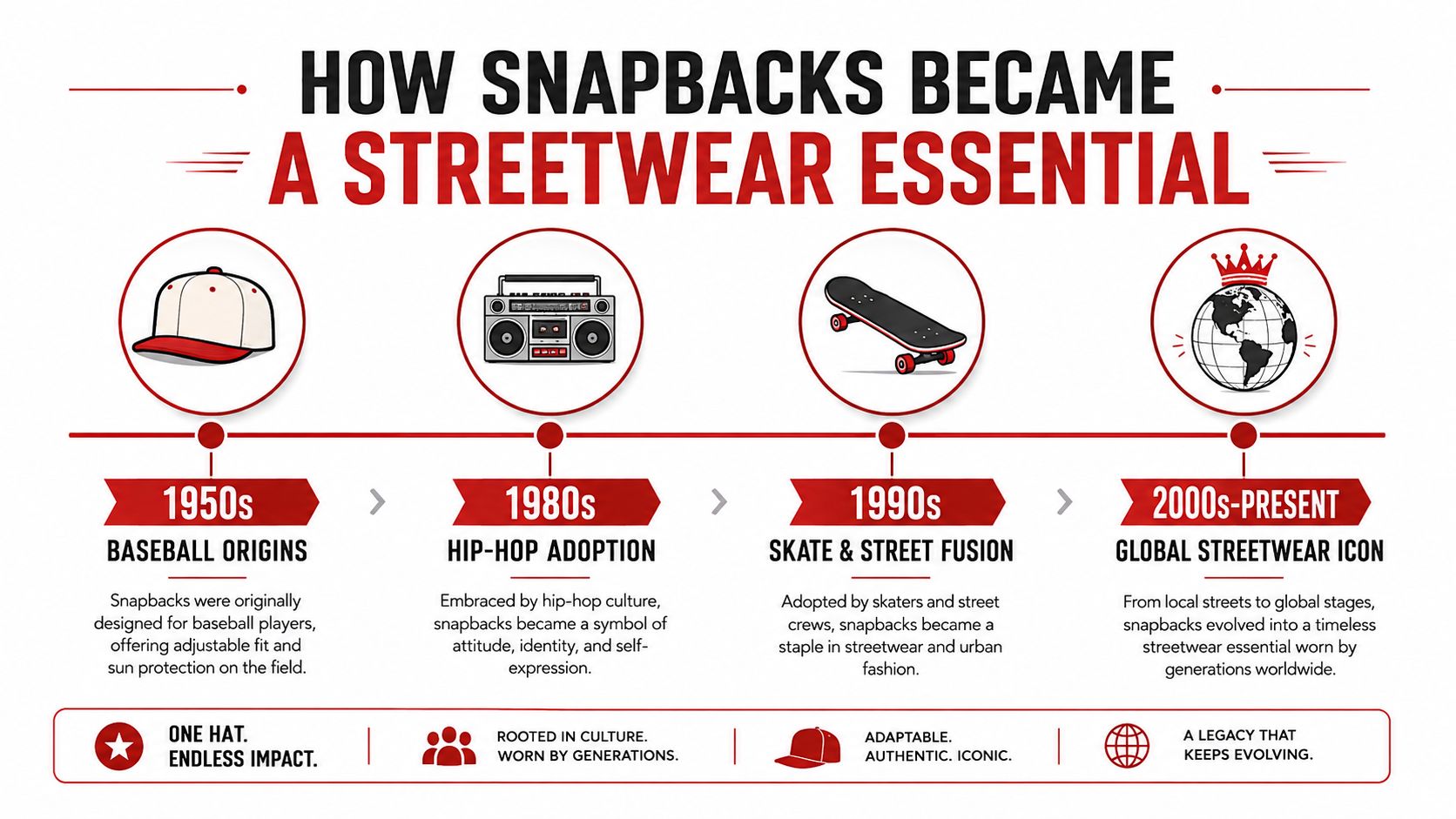
The modern structured cap took shape in 1954, when New Era introduced the 59FIFTY with a six-panel crown and flat brim. Designed for professional baseball, it established a firm silhouette that differed from the softer curved-brim caps associated with traditional sportswear. That construction later gave streetwear brands a reliable surface for visible logos and patches. The history of snapback hats traces how this performance-oriented form gained importance beyond the field.
A major commercial shift followed in 1978, when New Era publicly released the 59FIFTY after developing it for professional baseball players in 1954. The move from on-field equipment to consumer product helped caps become part of everyday identity and merchandise culture. Adjustable styles then made the format easier for brands to sell across a wider customer base.
Why street culture made the format durable
The plastic snap closure changed the buying calculation. A fitted cap requires a brand to plan several size runs. One adjustable base style can serve youth programs, team uniforms, event merchandise, and limited drops with less leftover inventory. It also gives decorators a consistent crown and front panel across the order, which simplifies sampling and artwork approval.
Hip-hop culture pushed the format into wider visibility during the 1980s and 1990s. The cap came to signal identity, affiliation, and attitude, not only team loyalty. A flat brim presents a sharper silhouette, while a curved brim keeps a stronger sports connection. The better choice depends on the audience, crown profile, and artwork proportions. A dense embroidered mark may need a stable front and enough height, while a simpler patch can tolerate a different visual balance.
Streetwear labels eventually treated headwear as a core product rather than an afterthought. Supreme, BAPE, and New Era reinforced the idea that color, placement, and limited availability could carry a complete visual language. Independent brands still benefit from the same practical setup. A structured front gives the logo a clear viewing surface, and the closure reduces some sizing risk in a fitted program. The trade-off is consistency: one adjustable size does not guarantee the same fit for every wearer, so wholesale buyers should inspect the closure range and crown dimensions before committing to a large run.
Practical rule: Treat the snapback as a wearable product with its own silhouette. A logo can't rescue a crown that feels wrong.
Understanding Snapback Construction and Anatomy
A snapback's decoration quality starts with its anatomy. The crown, reinforcement, seams, visor, sweatband, and closure each impose limits on what a decorator can produce. Choosing a blank by color alone often creates avoidable problems later.
Crown panels and embroidery stability
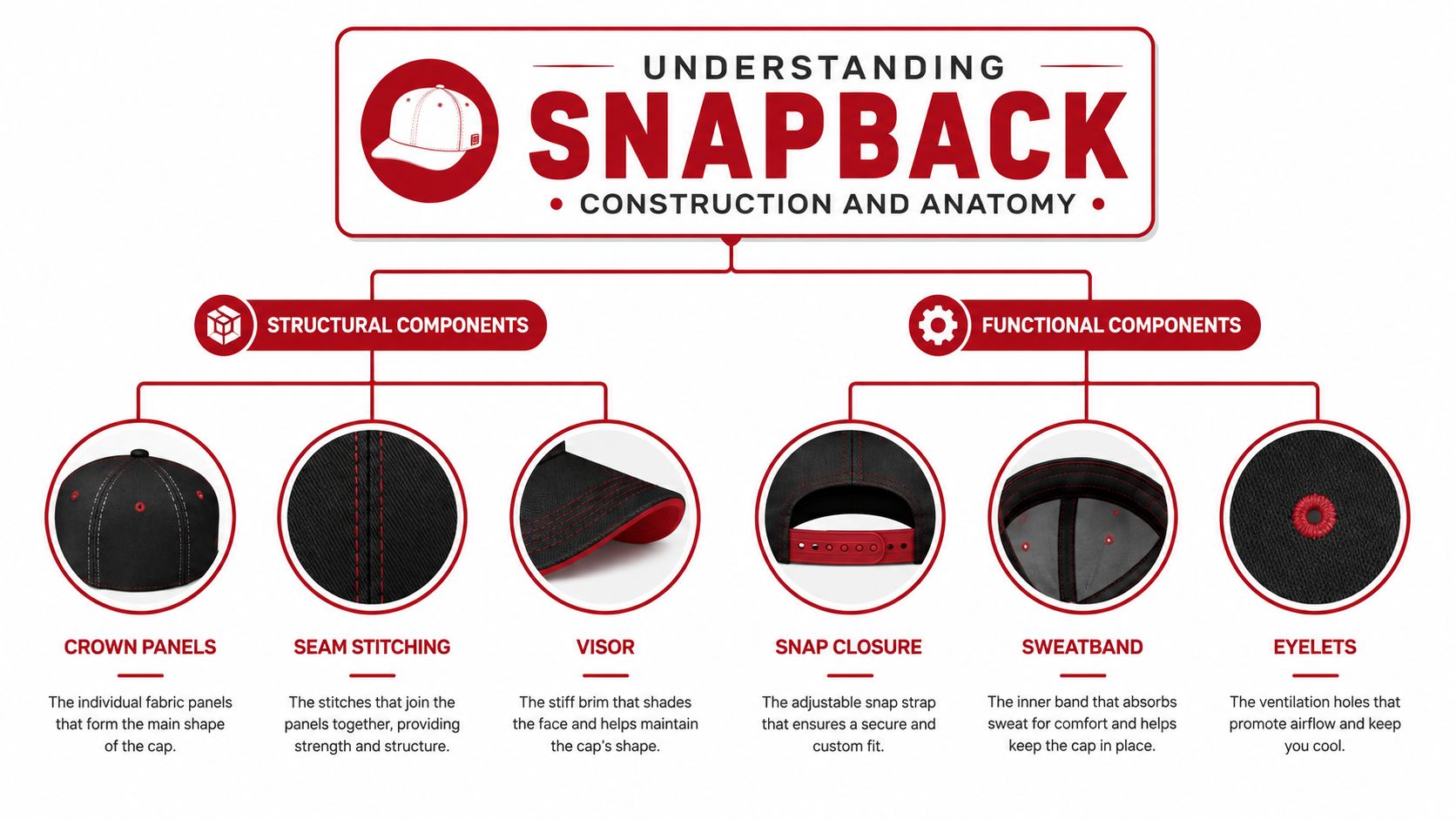
Most retail-grade snapbacks use a structured crown made from multiple panels. The front panels are commonly reinforced with buckram, a stiffening material that keeps the surface upright during decoration. That support is why structured snapbacks generally accept embroidery and patches more cleanly than unstructured caps. The anatomy of a snapback explains how buckram supports the front while the remaining components contribute to fit and function.
Six-panel construction gives decorators a broad front area, but it also introduces a center seam. A logo placed directly across that seam can show distortion, especially when the artwork contains fine lettering, narrow outlines, or dense fills. The digitizer should account for the seam rather than treating the front as a completely flat sheet.
Five-panel caps solve that particular issue with a clean front panel, but they create a different visual proportion. The front may offer a clean decoration field, while the crown profile, rope detail, or lighter fabric changes the intended streetwear character. Blank selection should follow the artwork and silhouette together.
Visor, closure, and interior details
The visor affects both appearance and decoration. A flat visor with multiple rows of stitching supports the bold profile associated with streetwear, but the stitching lines can restrict placement near the edge. The top button finishes the crown, while eyelets allow airflow and add small points of visual contrast.
The sweatband sits against the wearer's forehead, so its material affects perceived quality even when customers can't see it. A rough or poorly secured band can make a cap feel cheap during extended wear. The plastic snap closure provides adjustable fit through locking positions, but its flexibility and finish matter. Rigid, poorly molded closures can create pressure at the back of the head.
For a practical reference point, review a structured snapback for merch programs alongside the blank you're considering. It's useful to compare crown reinforcement, visor construction, and closure design before approving decoration.
If your program includes multiple closure types, use this guide to compare hat closure types before you standardize the blank. The closure changes how the product fits, packs, and presents at retail.
Material Blends and What They Mean for Quality
Fabric composition changes more than hand feel. It affects how a crown holds its profile, how thread sits in the surface, how colors read under light, and how the cap ages after repeated wear. A low-cost material can be the right choice for a promotional run, but it isn't automatically the right choice for a retail product.
A common retail baseline is an acrylic and wool blend in a six-panel construction. One listed specification uses 80% acrylic and 20% wool, while white variants use 100% acrylic, according to Yupoong's listed snapback specifications. Those compositions illustrate the basic trade-off. Acrylic supports shape retention and consistent color, while wool adds a firmer, more premium hand.
| Material Blend | Embroidery Clarity | Shape Retention | Cost Tier | Best Decoration Method |
|---|---|---|---|---|
| 100% acrylic | Clean on stable structured blanks | Reliable, with a uniform feel | Accessible | Direct embroidery, woven patches |
| Acrylic and wool blend | Strong for dense logos and raised work | Firm, premium-feeling structure | Higher | Direct embroidery, appliqué, puff embroidery |
| Polyester performance fabric | Clear when properly stabilized | Strong against routine moisture and movement | Mid to higher | Embroidery, heat transfer, sublimated decoration where compatible |
| Cotton twill | Soft, with a broken-in appearance | Less rigid and more likely to relax | Varies by blank | Light embroidery, patches, screen-based decoration |
Match the fabric to the product promise
Acrylic-heavy caps suit brands that need repeatable color and a crisp profile across a broad program. They're also practical when the decoration is a straightforward embroidered mark. Wool blends suit premium drops where texture and firmness are part of the perceived value, but dense stitching can make digitizing and production more demanding.
Polyester performance fabrics make sense for outdoor teams and active programs where quick-drying behavior matters. They can look less traditional than wool or cotton, and the surface may require testing before a decorator commits to a particular transfer process.
Cotton twill gives a softer, more vintage result. That can work beautifully for relaxed lifestyle branding, but it won't deliver the same rigid streetwear outline as a reinforced acrylic or wool-blend crown. Ask for a decorated sample, not just a blank, because thread density can change the way each fabric behaves.
Getting the Right Fit and Sizing for Every Wearer
“One size fits all” is useful sales language, not a complete buying strategy. A standard snap closure accommodates a broad group, but crown depth, brim width, and overall profile decide whether the cap feels comfortable, bulky, or poorly proportioned.
The commonly referenced fitted equivalent for standard snapbacks runs from 6 7/8 to 7 5/8. That range can suit a mixed group, though it will not match every head shape or styling preference. For wholesale orders, confirm the actual blank measurements instead of treating the closure as the entire fit specification.
Read the fit beyond the closure
A closure offers several locking positions, allowing a brand to avoid splitting one basic style into multiple fitted sizes. It still has limits. A smaller wearer may need to tighten the snap strip and end up with excess material, while someone near the upper end of the range may feel pressure when the crown is shallow.
Crown profile changes both comfort and decoration potential. A high-profile cap provides more vertical volume and a stronger streetwear statement. A shallower crown sits closer to the head and often suits customers who prefer less visual height. A narrow brim can make the cap feel lighter, while a broad flat visor gives the front a more assertive shape.
Those proportions also affect embroidery. A taller, structured front generally gives dense lettering more room to sit cleanly. A shallow or highly curved crown can distort wide artwork, especially when the design approaches the center seam. Approve a decorated fit sample before committing to a bulk run.
Build a wholesale size strategy
Request fit samples from the exact blanks under consideration. Richardson 112, Yupoong 6089, and Flexfit 6511 all sit within the snapback category, yet their crown heights, visor proportions, and perceived volume differ. Supplier samples should confirm the measurements for the selected color and construction. A model name alone is not enough.
| Blank Model | Crown Profile | Brim Width | Snap Adjustment Range | Best For |
|---|---|---|---|---|
| Richardson 112 | Structured, trucker-style profile | Broad, traditional trucker visor | Adjustable through snap positions | Team programs, outdoor brands, casual merchandise |
| Yupoong 6089 | Structured, high-profile streetwear shape | Flat visor with a bold front | Adjustable snap closure | Retail drops, logo-forward streetwear |
| Flexfit 6511 | Structured performance-oriented profile | Flat visor suited to a clean front | Adjustable snap closure | Athletic lines, branded uniforms, modern merch |
For gender-inclusive programs, one large silhouette should not be expected to serve every customer. Add a secondary option with a shallower crown or narrower brim when the audience includes women and younger customers. Recent trend analysis also points to interest in women's and gender-inclusive snapback design, while fit receives limited attention in much category coverage. Recent snapback trend analysis supports treating audience-specific silhouettes as a product opportunity, not a niche concern.
Custom Embroidery and Decoration Options
The front crown is the safest place to start, but decoration decisions should follow the blank's structure. A design that looks balanced on a flat digital mockup can shift once it meets a center seam, a curved crown, or a line of visor stitching.
Place the artwork where the cap can support it
Front-panel embroidery benefits from buckram reinforcement. The stiffened surface resists collapse under stitch density and gives patches a stable base. That doesn't eliminate puckering. Dense fills, tight satin columns, and poorly compensated lettering can still pull the fabric, especially across a curved surface.
Side panels work for smaller marks, but the available area is narrower and more rounded. Back embroidery belongs above the closure, where the fabric is usually more stable. Keep the artwork compact and check the clearance around the snap strip. On trucker styles, mesh panels are difficult to hoop consistently, so heat-transfer graphics or carefully selected patches may work better than direct embroidery.
Use the decoration method to control complexity:
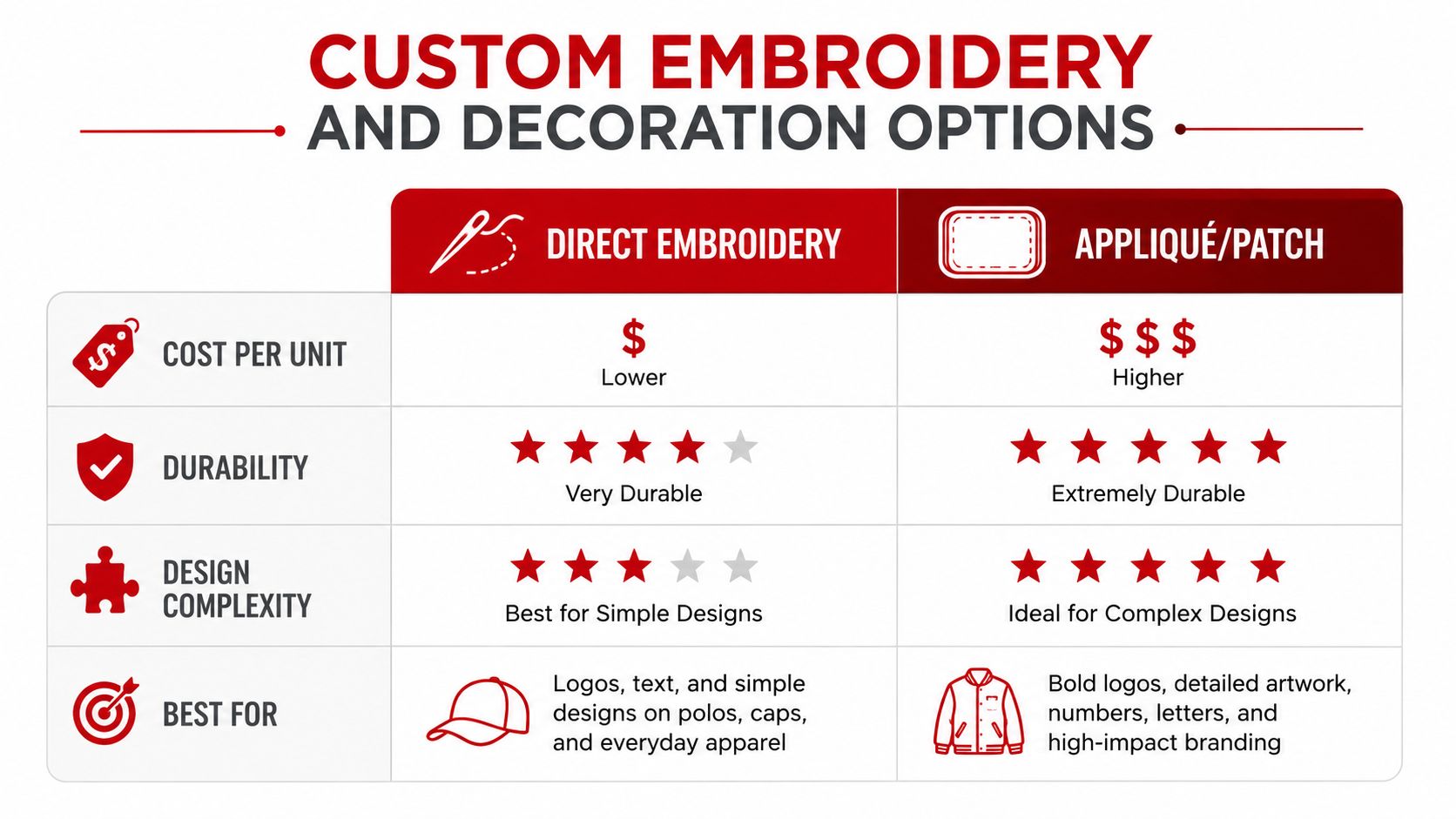
- Direct embroidery: Best for clean logos, strong lettering, and durable thread-based branding on reinforced panels.
- Appliqué patches: Useful for large shapes, layered colors, and designs that would become too stitch-heavy as direct embroidery.
- Three-dimensional puff embroidery: Creates raised lettering on a structured front, but the artwork needs simplified shapes and adequate spacing.
- Under-brim printing: Adds hidden or reveal-style branding without fighting the front crown's seams.
- Brim stickers and labels: Offer a controlled way to decorate a flat visor when direct stitching would distort the bill.
- Heat-transfer vinyl: Often more practical than embroidery for smooth mesh or performance surfaces, provided the fabric tolerates the heat process.
Test the design at production size
A decorator should digitize for the actual cap, not reuse a file prepared for a flat garment. The center seam, crown curvature, backing, needle path, and thread direction all influence the result. Small lettering that reads clearly on screen may close up in thread, while a broad logo may need reduced density to prevent a stiff, puckered field.
Direct embroidery on a flat brim is rarely the first choice because the visor's internal layers and stitching make hooping awkward. Under-brim printing, appliqué, or a small label usually gives better control. Laser etching can suit certain brim materials, but it must be tested on the exact visor because surface response varies.
For production references and decoration planning, review this guide to snapback hat embroidery. Approve a physical sample before committing to a large run, especially for puff lettering, multi-color fills, or artwork that approaches the front seam.
Decoration rule: If the sample looks crowded before production, simplifying the artwork usually improves the finished cap more than adding more stitches.
Smart Wholesale Buying for Brands and Teams
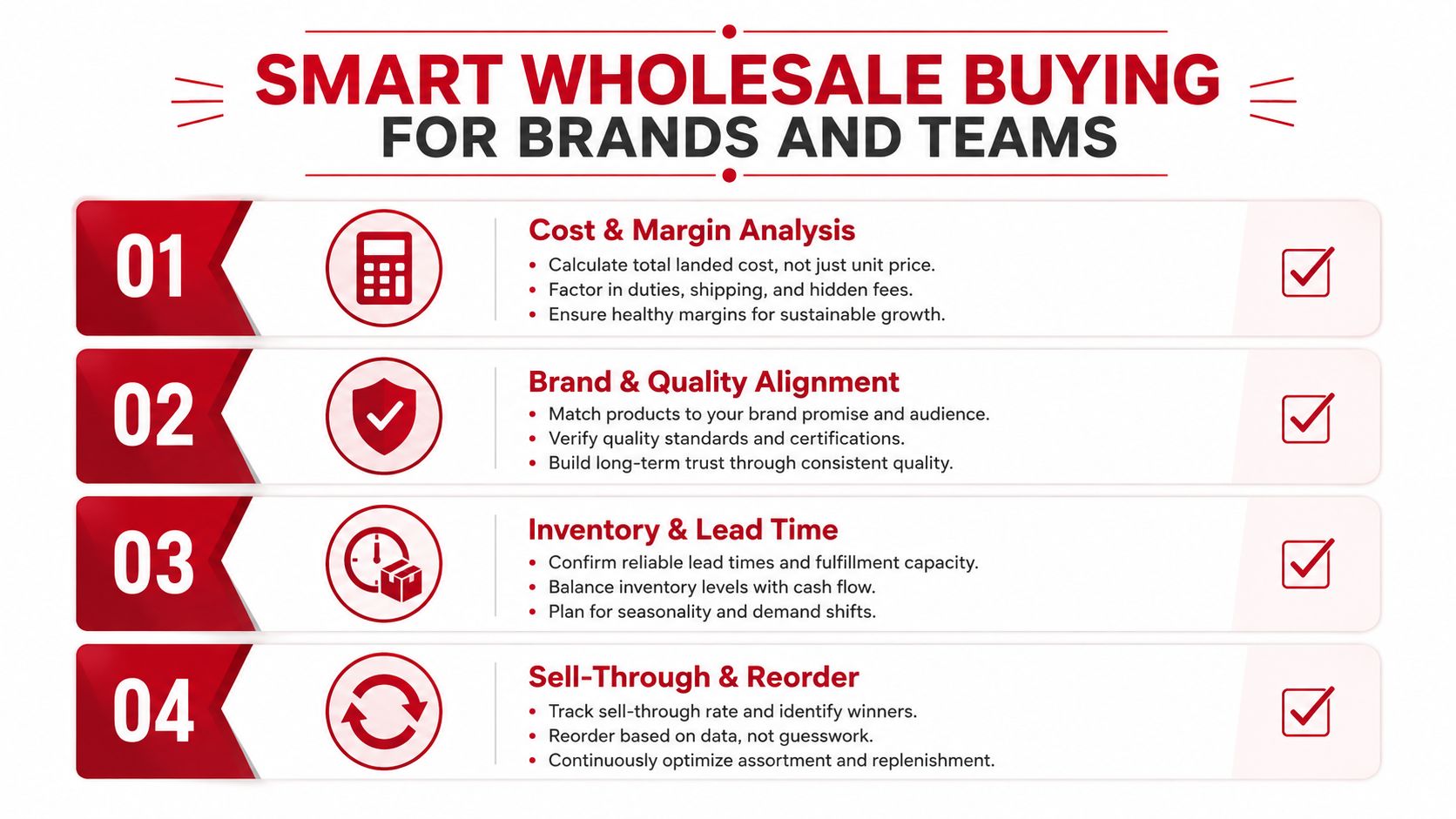
Wholesale buying is where attractive cap programs either become dependable products or expensive inventory mistakes. The cheapest blank isn't necessarily the lowest-cost choice once decoration failures, inconsistent colors, and unsold variations enter the calculation.
Choose the supply path deliberately
Domestic blank distributors usually offer faster communication, easier sample access, and more predictable replenishment when stock is available. Overseas manufacturing can provide deeper customization, but it often demands more planning around minimums, freight, approvals, and quality control. Neither path is universally superior. The right choice depends on whether your priority is speed, unique construction, or repeatable availability.
Request a pre-production sample in the actual color and decoration method. Inspect the front panels for alignment, the center seam for straightness, the visor for even stiffness, and the snap closure for secure locking. Check the sweatband attachment and examine the inside for loose threads. A blank that passes a casual visual check can still fail once an embroidery machine adds dense stitching.
Protect margin without creating dead stock
Ask suppliers how volume pricing works, but don't chase a tier that leaves you with colors or sizes your audience hasn't validated. A smaller test order can reveal whether the crown profile, closure, and decoration are commercially right before you commit to a wider palette. If spoilage during embroidery is a concern, build a reasonable replacement allowance into the purchasing plan rather than treating every unit as guaranteed sellable stock.
Color consistency deserves written attention. Reorders can show shade variation between dye lots, particularly when a brand's signature color is central to recognition. Request a retained reference sample, define acceptable variation in the purchase terms, and require approval before a replacement lot enters production.
For artwork-heavy programs, it can also help to compare unlimited design services before assigning repeated revisions to an internal team. The relevant question is whether the service can deliver production-ready files that a headwear decorator can use, not attractive mockups.
For a practical buying checklist covering blanks, quantities, and supplier questions, use this guide on buying blank hats in bulk.
This video gives another visual reference for evaluating wholesale headwear decisions:
Care and Maintenance to Keep Snapbacks Looking Fresh
Structured snapbacks need gentler care than soft, unstructured caps. Don't submerge one in water. Saturation can weaken the buckram, collapse the front panels, and distort the flat visor.
Use a soft-bristle brush and mild detergent for surface marks on acrylic or wool-blend crowns. For embroidered areas, dab with a damp microfiber cloth instead of rubbing across the stitches. Sweat stains on the inner band can be treated with a diluted white vinegar and water solution, followed by air drying away from direct sunlight.
Store the cap on a hat rack or support the crown with acid-free tissue. Keep flat brims on a level surface or in a hat box, and don't bend them into a curve during storage. Premium wool-blend caps with complex embroidery may justify professional cleaning, but tell the cleaner that the cap is structured and decorated before treatment.
Dirt Cheap Headwear supplies wholesale blank snapbacks and custom decorated headwear for brands, teams, businesses, and events, with in-house embroidery options including fine-detail stitching and 3D puff. Visit Dirt Cheap Headwear to compare structured blanks, request custom decoration, and plan a small test run or larger headwear order.