
A Guide to Screen Printing Pricing in 2026
When it comes to screen printing, the most important rule of thumb is simple: the more you order, the cheaper each item gets. It’s a classic volume game. The real work happens upfront, and those fixed setup costs get spread thinner and thinner across a bigger order.
Factors like the actual garment you choose, how many colors are in your design, and where you want it printed all mix together to create your final per-piece price.
Decoding Your Screen Printing Price Quote
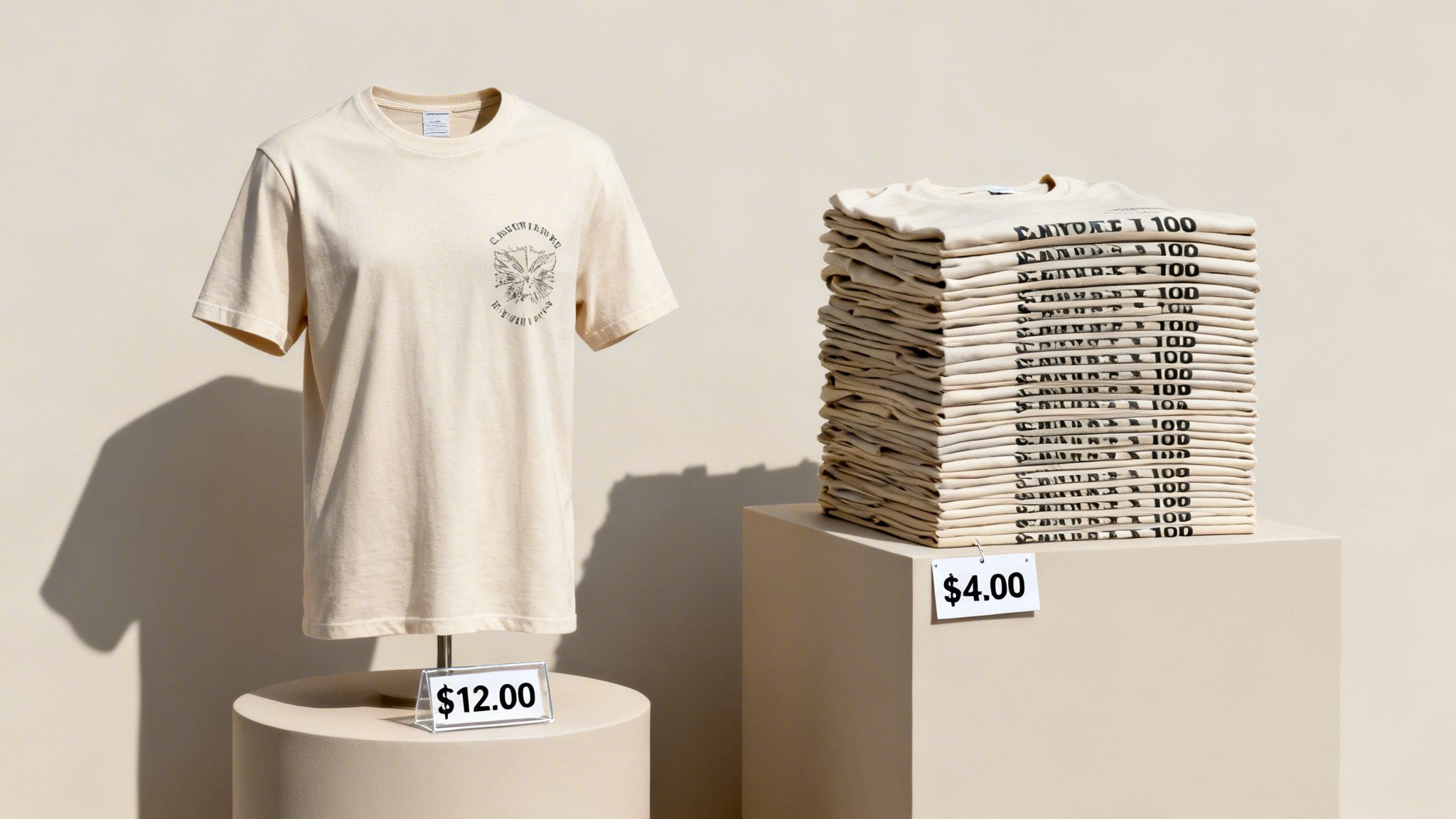
If you've ever gotten a quote for custom shirts and felt like you needed a secret decoder ring, you're not alone. That final price isn't just a number pulled out of thin air; it’s a careful calculation based on several key pieces of the puzzle. Once you understand them, you can make smarter choices and get way more bang for your buck.
Here’s a good analogy: think about ordering custom cupcakes. A single, super-fancy cupcake costs a lot because the baker has to mix the frosting and dedicate a bunch of time for just that one item. But if you order 100 of them? The price per cupcake drops dramatically because all that initial prep work is now divided across the whole batch.
The Core Cost Drivers
Screen printing works the exact same way. There's a ton of upfront effort involved in preparing the screens and machinery, and the cost of that time and material is what gets divided by the number of shirts you order.
Four main things will always drive your per-item cost:
- The Blank Garment: This is the base cost of the t-shirt, hoodie, or hat itself. A simple, budget-friendly tee will naturally cost less than a premium, retail-brand one.
- Order Quantity: How many pieces are you getting? This is, without a doubt, the single biggest lever you can pull to lower your per-piece price.
- Color Count: How many ink colors are in your artwork? Every single color requires its own custom screen and setup, which adds to the initial labor cost.
- Print Locations: Are you printing on just the front, or the front, back, and a sleeve? Each location is essentially a separate job with its own setup process.
The secret to affordable screen printing is realizing it's a volume-based service. The more you print, the more the fixed setup costs are diluted, resulting in a significantly lower price per shirt. A small, multi-color order will always have a higher per-item cost than a large, single-color one.
To get a better handle on how this all comes together, it's helpful to see how these factors stack up. If you're looking for some ideas for your next project, you can browse a huge selection of products ready for custom printing.
The table below breaks down the primary variables that go into your quote, giving you a clear picture of what impacts your budget the most.
Key Factors That Determine Screen Printing Prices
| Cost Factor | Description | Impact on Per-Piece Price |
|---|---|---|
| Order Quantity | The total number of items in your order. | High |
| Color Count | The number of colors used in your design. | Medium-High |
| Print Locations | The number of places the design is printed. | Medium |
| Garment Type | The specific brand and style of the apparel. | Low-Medium |
As you can see, your order quantity has the most significant impact, while the garment itself has a more moderate effect. Keep these drivers in mind as you plan your next order, and you'll be well on your way to getting a great deal.
The Building Blocks of Your Screen Printing Bill
To really get a handle on screen printing pricing, you have to stop thinking about it like buying a t-shirt off the rack. It’s much more like commissioning a custom piece of furniture—your final bill is an itemized receipt that tells the story of how your apparel was made from scratch.
Every line item represents a specific part of the process, from the raw materials to the skilled labor involved. Let's pull back the curtain and break down the core components so you can see exactly where your money is going.
The Blank Garment Cost
This one’s the easiest to understand. It’s simply the wholesale cost of the blank t-shirt, hoodie, or hat that your design will be printed on. Think of it as the canvas for your artwork.
A basic, budget-friendly tee from a brand like Valucap will obviously have a much lower starting cost than a premium, retail-quality shirt from a brand like Richardson or YP Classics. The garment you choose is the first major factor that sets the foundation for your total price.
Setup Fees Explained
Here’s the charge that trips up most people. A setup fee is a one-time charge for each color in your design, per print location. This fee covers all the critical prep work that has to happen before a single drop of ink touches a shirt.
For every single color in your artwork, a technician has to:
- Create a separate screen, which is basically a finely-tuned stencil for that color layer.
- Meticulously align (or "register") every screen on the press to ensure the colors line up perfectly.
- Mix the exact Pantone ink colors needed to match your design.
This is a skilled, time-consuming process. Whether you’re ordering 12 shirts or 1,200 of them, this initial setup is a fixed cost that has to be done.
Think of it like this: The setup fee is the cost of creating the unique rubber stamps for your design. Once the stamps are made, using them is easy, but the initial carving takes real skill and effort.
The Run Charge
If the setup fee is the cost of making the tools, the run charge is the cost of actually using them. This is the per-piece fee that covers the labor and ink needed to physically print each garment.
The run charge pays for the work of pulling the squeegee, applying the ink, and running each shirt through a massive dryer to cure it. While this is a per-item cost, it's where economies of scale really start to kick in and drive your unit price down on larger orders.
This entire pricing model exists in a surprisingly huge market. The global screen printing industry generated USD 20.743 billion in 2024 and is projected to climb to USD 37.359 billion by 2030. That intense competition is what keeps both setup fees and run charges from getting out of hand.
Specialty Ink and Add-Ons
Not all inks are the same. If your design needs a little something extra beyond standard plastisol inks, you can expect to see an upcharge. Specialty inks often cost more per bucket and can demand a slower, more delicate printing process.
A few common examples include:
- Puff Ink: Creates a cool, raised 3D effect.
- Metallic Inks: Gold, silver, and glitter options add serious sparkle but are more expensive.
- Glow-in-the-Dark: Uses special phosphorescent pigments to get that signature glow.
Understanding these individual building blocks is the key to making smart decisions. By dissecting the various factors that drive overall custom T-shirt costs, you can adjust your design or order details to hit a specific budget. When you can read an invoice and know what each line item means, you gain a much better appreciation for the total screen printing cost and the craftsmanship involved.
When it comes to screen printing, two factors have the biggest say on your final bill: your order quantity and the number of colors in your design. Getting a handle on how these two play off each other is the secret to getting a great price, whether you’re a new brand ordering your first dozen tees or an event manager outfitting a small army of volunteers.
Think about it like this: every screen printing job starts with a fixed amount of prep work. We have to create a separate screen for each color in your design, burn the image, and set up the press. Those are your setup costs. They're the same whether you’re printing 12 shirts or 500.
The Power of Volume
Once the press is ready to go, the real magic of screen printing begins. Because all that initial setup cost is front-loaded, ordering more shirts allows you to spread that cost out. The more shirts you print, the less each individual shirt has to "pay" toward the setup fee.
This is why a simple, one-color design is often the smartest move for a startup brand testing a new product. It keeps the setup fees to a minimum, making your per-shirt cost much more manageable on a small run. On the flip side, if you're ordering a few hundred shirts for a big corporate event, adding an extra color or two barely moves the needle on the per-shirt price.
The image below shows you exactly how these costs stack up. The setup fee is a one-time charge, while the garment and printing costs apply to each piece.
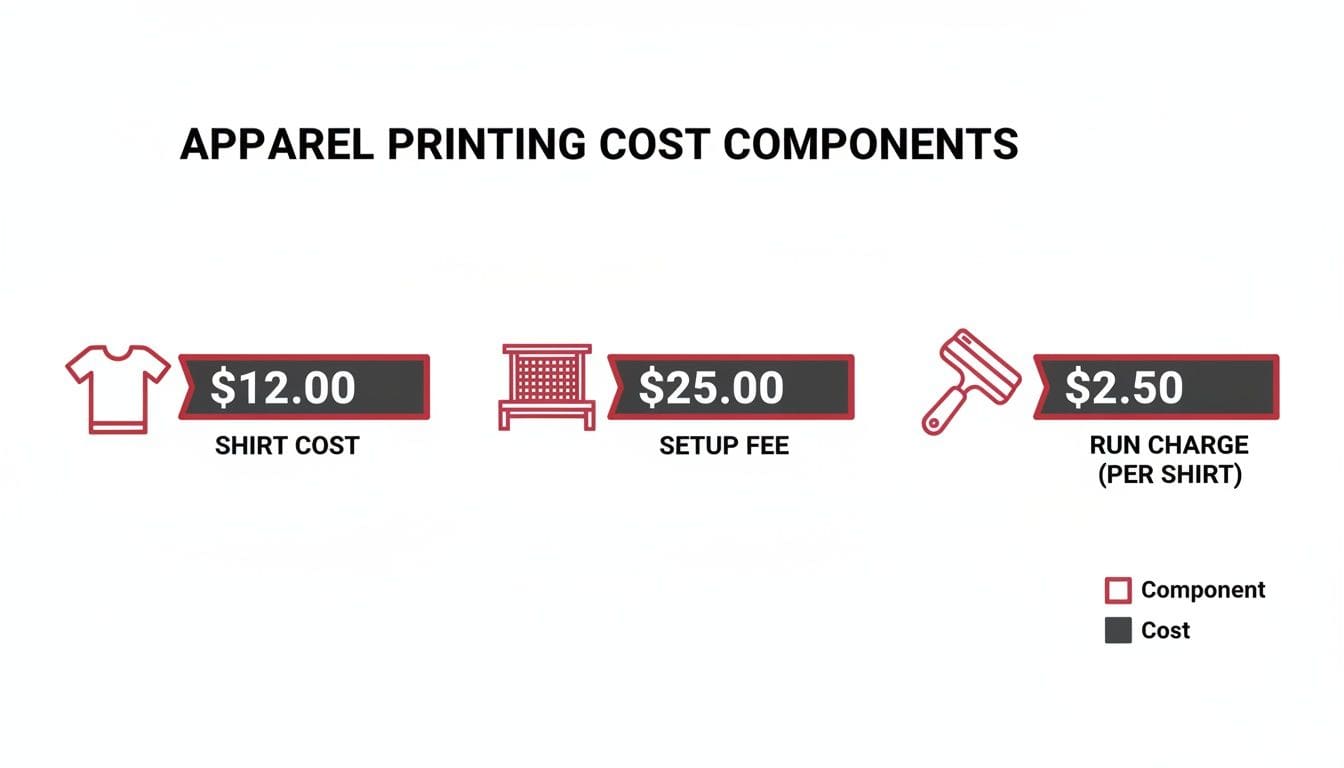
As you can see, that one-time setup fee gets divided across your entire order, which is why bigger orders always get you a better deal per shirt.
Putting Numbers to the Concept
Talk is cheap, so let's look at what this means for your wallet. This table shows you how the per-shirt price changes based on both quantity and the number of colors in the design.
Sample Per-Piece Pricing By Quantity And Color Count
| Order Quantity | 1-Color Print Price | 2-Color Print Price | 4-Color Print Price |
|---|---|---|---|
| 12 Pieces | $14.95 / item | $17.50 / item | $21.25 / item |
| 72 Pieces | $8.25 / item | $9.50 / item | $11.00 / item |
| 500 Pieces | $6.50 / item | $7.25 / item | $8.15 / item |
Look at the difference. Simply jumping from a dozen shirts to 72 cuts the per-item price nearly in half. Bumping that up to 500 pieces delivers an even steeper discount, making each shirt incredibly affordable.
The price gap between a 1-color and a 4-color print is huge on small orders. But at 500 pieces? The difference is much smaller, giving you way more creative freedom without breaking the bank.
Industry numbers back this up. For example, a four-color print job that costs $14.20 per shirt on a small batch can drop to just $10.30 per shirt on a larger volume order—that's a 27.5% price cut right there. You'll see similar savings on five- and six-color designs as the quantity goes up, proving just how much you can save by ordering in bulk. If you're interested, you can explore detailed cost calculations and see how shops build their price tiers.
Hidden Variables That Affect Your Final Price
Once you’ve locked in your quantity and number of colors, you might think you have the final price nailed down. Those are definitely the biggest pieces of the puzzle. But a few other factors can creep in and change the final number, and they're often the ones that catch people by surprise.
Think about it like buying a car. The sticker price gets you the base model, but if you want the leather seats, a sunroof, or that killer sound system, the total starts to climb. Screen printing works the same way. Knowing about these "upgrades" ahead of time means you can budget accurately and avoid any last-minute sticker shock.
Let’s pull back the curtain on these details so you know exactly what to expect on your invoice.
Garment Choice Matters More Than You Think
The blank item you choose to print on is the single biggest material cost in your order. We’ve already touched on this, but it’s worth digging into just how wide the price gap can be between a basic, budget-friendly tee and a premium, retail-quality garment.
For instance, a simple, no-name cap might run you a few dollars wholesale. But if you want a cap from a top-tier brand like Richardson or YP Classics, you could easily be looking at two or three times that cost. What you're paying for is the better construction, higher-quality materials, brand recognition, and a fit people know and trust.
Choosing a garment is always a balancing act between your budget and the value you want to create. A premium brand can seriously elevate your merch and let you command a higher price, while a budget-friendly option is perfect for giveaways or keeping costs razor-thin on a huge order.
Additional Print Locations Add Up
Adding a second print location isn't just a small tweak—it's essentially setting up a whole new, smaller print job. Every extra print, whether it's on the back, a sleeve, or the side of a hat, needs its own set of screens, its own setup process, and its own run charge.
For each new location, you have to account for:
- New Setup Fees: If your back design has three colors, that means three more screens and three more setup fees.
- Additional Run Charges: Every single shirt has to be handled and printed all over again for that second location.
- Specialized Equipment: Printing on a sleeve or a pant leg often requires a special "pallet" or attachment for the press, adding another layer of complexity.
This is why a shirt with a front and back print is never quite double the cost of a front-only print, but it's always significantly more. The printer has to go through the entire setup and print cycle a second time for that new location.
The Cost of Specialty Inks
Want your design to have that extra flair? Maybe make it pop, shimmer, or even glow in the dark? Specialty inks are a fantastic way to make a product stand out, but they do come with a higher price tag. It's not just that the ink is more expensive; it's also that these inks can be trickier to work with.
Here’s a quick breakdown of why specialty inks increase your screen printing pricing:
- Material Cost: Inks with metallic, glitter, or glow-in-the-dark properties are made with more expensive pigments and additives.
- Slower Production: Puff ink is a great example. To get that cool 3D effect, it needs to be applied in a thick layer and cured just right. This slows the press down, meaning fewer shirts can be printed per hour.
- Extra Screens: Certain effects, like a thick gel print, might need an extra "underbase" screen (a layer of white ink) to make sure the color is vibrant, which adds another setup fee to the job.
Rush Fees and Design Services
Finally, there are two service charges that can show up on your bill: rush fees and design work. If you need your order completed faster than the shop's standard turnaround time (which is usually around 7-10 business days), you can expect to pay a rush fee. This fee isn't a penalty; it compensates the shop for having to rearrange its entire production schedule, sometimes even requiring overtime, just to hit your deadline.
Likewise, if your artwork isn't "print-ready," most shops will charge a design fee to fix it. This happens when a design needs to be converted into a vector format or cleaned up by a graphic designer. It’s usually an hourly rate that covers the time needed to get your idea ready for the press. Honestly, planning ahead and providing high-quality artwork are two of the easiest ways to keep your costs in check.
Actionable Tips for Reducing Your Printing Costs
Alright, you now understand the mechanics behind screen printing quotes. So how do you use that knowledge to your advantage? Let's get into the practical side of things—this is your playbook for becoming a smarter buyer and getting more for your money.
Whether you're launching your first merch line or outfitting a team for an event, these strategies can seriously impact your final bill. A few thoughtful tweaks to your design or order plan can lead to big savings without sacrificing quality.
Simplify Your Design to Reduce Colors
The number of colors in your design is the most common reason for a surprisingly high quote. Every single color requires its own custom screen and a separate setup process, and those costs add up fast, especially on smaller orders. The easiest way to bring your price down is to simply use fewer colors.
Take a good look at your design. Could that four-color logo be just as bold and effective with only two colors? Can you combine a few similar shades into one ink? This change alone can often save you several dollars per shirt.
Here's an industry trick: use halftones. This clever design technique uses tiny dots of a single ink color to create the illusion of different shades and gradients. It allows you to achieve a detailed, almost photographic look without paying for all the extra screens.
Leverage the Power of Bulk Ordering
Screen printing is, and always will be, a volume game. The single most effective tool you have for slashing your per-shirt cost is to increase your order quantity. All those initial setup costs are fixed, so the more shirts you run, the more that cost gets spread out.
Planning ahead is your best friend here. Instead of placing several small orders over a few months, try to consolidate them into one larger run to hit a much better price tier. Bumping an order from 24 to 72 shirts can easily drop your per-item price by 30-40%.
This is absolutely critical for event planners and sports teams. Always try to estimate your needs and order a few extras from the get-go. The cost of adding 10 more shirts to a big order is tiny compared to placing an entirely new, small reorder down the road.
Be Strategic with Your Garment Choices
The blank apparel you choose—the t-shirt, hoodie, or hat—sets the baseline cost for your whole project. While a premium brand like Richardson certainly feels great, opting for a standard, high-quality brand like Valucap can save you a bundle without looking cheap.
Here are a couple of ways to be smart with your apparel selection:
- Choose Core Styles: Stick with the classic, popular items. Standard t-shirts, crewneck sweatshirts, and basic hats are produced in massive quantities, which makes them far more affordable.
- Print on Mixed Colors: As long as your ink colors stay the same, you can print the same design across a mix of shirt colors (like black, navy, and forest green) and still have them all count toward your bulk discount. This gives you variety while locking in that better price point. You can learn more sourcing tricks in our guide on how to buy wholesale blank hats in bulk.
Thinking this way does more than just cut costs; it makes you a more informed player in a rapidly expanding market. The global screen printing industry was valued at USD 8.16 billion in 2025 and is projected to reach USD 10.24 billion by 2030, according to the latest industry reports on MordorIntelligence.com. By understanding the pricing game, you’re better positioned to navigate this market and get the best possible value for your project.
Frequently Asked Questions About Screen Printing Pricing
Let's tackle some of the most common questions that come up when people are trying to budget for a screen printing project. Getting these details straight can make a huge difference in your final cost and help you order with confidence.
Is Screen Printing Cheaper Than Embroidery?
For most orders, especially those with larger designs, screen printing is definitely the more budget-friendly option. This is particularly true once you hit about 24 pieces.
The real difference is how the cost is calculated. Embroidery pricing is based on the stitch count, so complex, dense designs get expensive quickly. Screen printing, on the other hand, is priced by the number of colors. That makes it a fantastic deal for 100 t-shirts with a big back graphic, but embroidery is often the smarter, more professional choice for a small logo on 12 company polos or hats.
What Is a Setup Fee and Why Do I Have to Pay It?
I get this question all the time. A setup fee is a one-time charge that covers the significant prep work that happens before a single shirt is ever printed. For every color in your artwork, we have to create a separate screen and then meticulously align them on the press. It’s a physical, hands-on process.
Think of the setup fee as a fixed cost for your entire project. Because it doesn't change whether you order 25 shirts or 250, the per-shirt price drops dramatically as you order more. That initial cost gets spread thinner across more items. Some shops will list it separately on your invoice, while others simply build it into their per-piece price.
Why Can I Not Just Order One Screen Printed Shirt?
The detailed setup process we just talked about is exactly why ordering a single screen printed shirt isn't really feasible. The cost to create and align screens for even a simple two-color design can run into the hundreds of dollars. That would make for one very, very expensive t-shirt!
To make screen printing affordable, nearly every shop has a minimum order, usually around 12 or 24 pieces. This allows them to distribute that setup cost effectively. If you truly just need one custom shirt, Direct-to-Garment (DTG) printing is a much better, and cheaper, way to go.
Can I Mix and Match Shirt Sizes and Colors?
Absolutely! This is one of the best ways to get variety while still taking advantage of bulk pricing. As long as the design itself and the ink colors stay exactly the same across all garments, you can mix and match sizes (S, M, L, XL, etc.) and even different shirt colors.
For example, if you need 25 black shirts and 25 navy shirts, all with the same white ink design, we can print them together. You’ll get the much better 50-piece price instead of being charged for two separate small orders.
Ready to bring your own custom headwear to life? The team at Dirt Cheap Headwear makes it easy with low minimums, professional quality, and a huge selection of top brands. Start your custom order today at https://dirtcheapheadwear.com.