
Custom Embroidered Trucker Hats No Minimum: A Buyer’s Guide
Dirt Cheap Headwear starts embroidery at six pieces per logo, so that's the effective minimum to expect even when a vendor advertises “no minimum.” A single custom embroidered trucker hat may be available elsewhere, but a six-hat order is the practical starting point for this program.
You're probably here because you need a small run, not a warehouse full of caps. Maybe your launch is next week, your crew has six people, or you want to test a logo before spending heavily on inventory. The phrase custom embroidered trucker hats no minimum sounds simple, but it can hide setup fees, artwork requirements, blank availability, and a per-piece price that changes sharply with quantity.
I'd treat “no minimum” as an operational choice, not a magic pricing category. Small-batch embroidery makes sense when you need a wearable sample, a coordinated team order, or a limited merch release. It makes less sense when the artwork has intricate detail, the deadline is extremely tight, or a simple print or patch would deliver the same look for less.
Why Small-Batch Custom Embroidered Trucker Hats Make Sense
A small business owner once came to a hat shop with a clean logo, a launch date, and a request for six caps. She didn't need a hundred hats. She needed something her team could wear at the launch, photograph for social media, and evaluate before committing to a larger branded inventory order.
That's the core use case for low-quantity embroidery. A small run lets you test the hat profile, thread colors, logo size, and everyday comfort without tying up cash in unwanted stock. The practical starting point is six pieces carrying the same logo, even when other sellers use “no minimum” to describe one-piece or very small orders.
Shop-owner advice: Treat the first order as a production test, not just a purchase.
Embroidery carries setup work whether you order a few hats or a large run. The design has to be converted into stitch instructions, stabilized on the front panel, positioned correctly, and checked before production. On a small order, those tasks are spread across fewer hats, so the per-hat premium is real. That doesn't automatically make the order a bad deal. It means you're paying for flexibility and risk control.
A six-hat order can fit several practical situations:
- A small launch team: Outfit the people appearing at the event without creating leftover inventory.
- A product sample: Test a logo on a real cap before ordering a larger wholesale run.
- A short event: Give staff or volunteers a consistent look for one occasion.
- A limited merch release: Validate whether customers want the design before expanding the collection.
The global hats market was estimated at USD 11.04 billion in 2025 and projected to reach USD 19.16 billion by 2034, with a projected 6.31% CAGR, according to Straits Research's hats market estimate. That scale helps explain why small-batch programs matter. Brands and event buyers increasingly need a way to test designs and replenish selectively rather than guessing at a large order.
Before requesting a quote, decide whether you need true embroidery. If the logo is simple and you only need a visual sample, a printed transfer or patch may be more economical. If you want the texture, durability, and traditional branded look of thread, use Dirt Cheap Headwear's small-batch embroidered hats and budget for the setup being concentrated across a short run.
Trucker Hat Styles and Blanks Worth Knowing
A trucker hat isn't just a blank canvas with mesh attached. Its front panel, crown shape, closure, and mesh construction all affect how the finished logo looks and feels.
The classic design has a structured front panel, a breathable mesh rear, and either a snapback or another adjustable closure. Industry supplier information describes common mesh backs as 100% polyester hex mesh, with mesh weights around 115 to 140 gsm and foam fronts around 3 to 5 mm thick, as outlined in this mesh-back trucker cap construction guide. The solid front receives the embroidery. The mesh is mainly there for airflow and should not carry dense front-style stitching.
Start with the front panel
A firm front panel supports cleaner stitches and a sharper logo. Foam-front caps can create a bold foundation for puff embroidery, while softer or less structured panels are better suited to restrained flat stitching.
Choose the blank in this order:
- Pick the profile. A high or mid crown creates a more prominent trucker look. A lower crown feels less oversized.
- Choose the front material. Foam, polyester, cotton blends, and other fabrics produce different stitch behavior.
- Confirm the closure. Snapbacks offer broad adjustability, while stretch-fit options create a different wearing experience.
- Check stock by color. A low-minimum order is only useful if the exact blank and color are available when you need them.
- Match the logo to the panel. Dense artwork needs more support than a simple wordmark.
Some recognizable blanks are commonly considered for embroidered trucker projects, but availability and exact construction can vary by supplier.
| Common Trucker Hat Blanks for Custom Embroidery | Panel Type | Crown | Best For |
|---|---|---|---|
| Richardson 112 | Structured fabric front with mesh back | Mid profile | Outdoor brands, crews, events |
| Yupoong 6606 | Structured front with curved visor | Mid profile | Traditional everyday trucker wear |
| Otto 31-069 | Structured front | Mid profile | A more substantial branded feel |
| Flexfit 110 | Structured front with adjustable stretch closure | Mid profile | Teams wanting flexible comfort |
The trucker cap brands collection is a useful place to compare brand families before you approve artwork. Don't choose by color alone. Hold the logo against the actual front panel, check whether the crown suits your audience, and ask whether the supplier can keep that blank available for reorders.
Practical rule: A simple logo on a stable panel will usually outperform a detailed logo on a fashionable but floppy cap.
Embroidery Options From Flat Stitch to 3D Puff
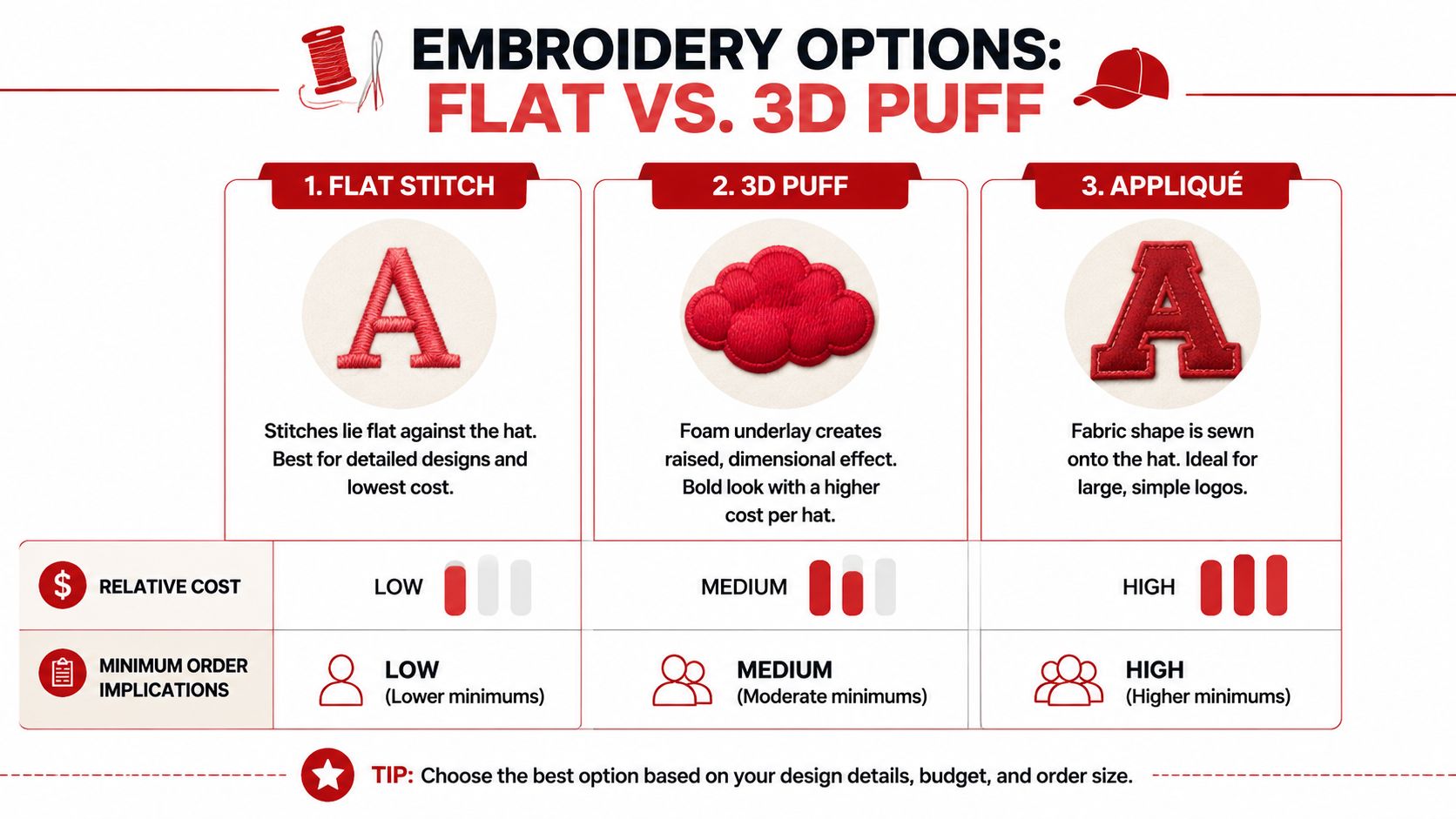
Decoration controls both the hat's appearance and its low-quantity economics. For a no-minimum order, choose flat embroidery for detail, 3D puff embroidery for a bold simplified mark, or appliqué when stitched coverage would cost too much.
Flat embroidery
Flat stitching sits directly on the front panel. It handles fine outlines, smaller lettering, and internal details with a clean, conventional finish. Choose it for:
- Detailed brand marks
- Short wordmarks
- Team names with moderate lettering
- Side placements with limited space
For a one-off sample or a small event run, flat embroidery is usually the practical starting point. It gives the digitizer more room to preserve detail, and it avoids the design restrictions that come with foam.
3D puff embroidery
Puff embroidery places foam beneath the stitches, raising selected areas above the panel. The result is bold and highly visible, but the artwork must be simple, with lettering large enough to remain open after stitching. Tiny counters, thin lines, and crowded shapes can close up where foam and thread meet.
Avoid lettering below roughly 0.25 inches in height, a limitation covered in this hat embroidery production guide. Keep puff and fine-detail treatment in separate design areas because they require different construction decisions.
Appliqué and fine detail
Appliqué sews a fabric shape onto the cap. It suits a large, uncomplicated emblem and creates a color-blocked look without filling the entire design with thread. Fine-detail embroidery takes the opposite approach, relying on careful digitizing and stabilization to retain small elements.
Stitch count and design complexity matter more than the number of words in your logo. A short, dense emblem can take more work than a longer open wordmark, which raises the per-hat cost in a no-minimum run. If you want a raised front-panel treatment, compare custom puff embroidery hats before approving the artwork.
How the Order Process Actually Works
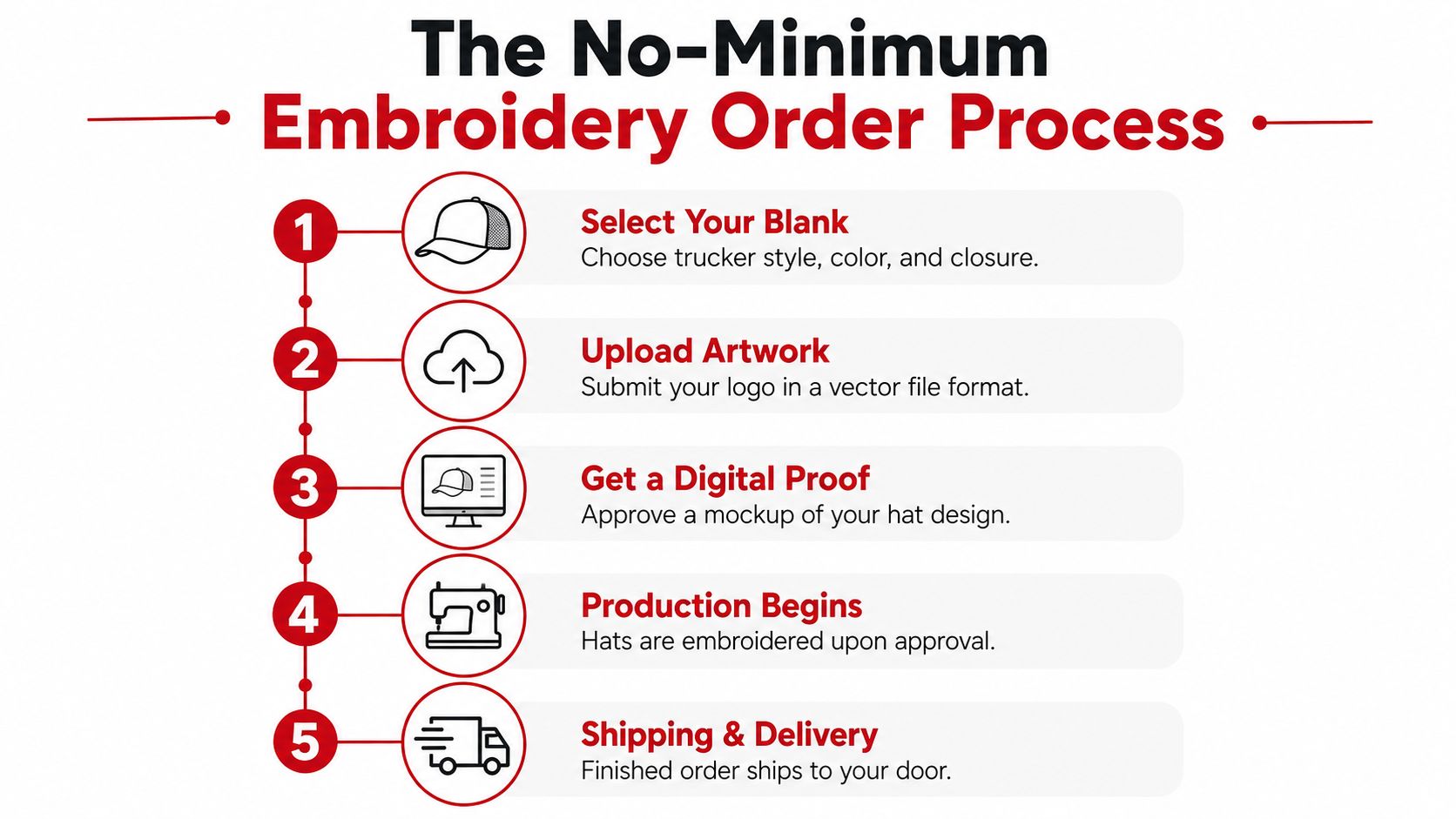
A smooth small-batch order depends on decisions being made in the right sequence. Don't start by asking for a price on “some trucker hats.” Start with the blank, color, logo file, decoration style, and deadline.
Choose the blank first
Select the trucker style, front-panel material, color, profile, and closure. In-stock options can include Richardson, Yupoong, Otto, and Flexfit caps. If the color is unusual or the order is tied to a fixed event date, ask about availability before approving the proof.
Submit the artwork
Upload the logo with the quote request. A vector file gives the decorator more control, but a usable raster file can still be evaluated during proofing. Include the intended placement and whether you want flat or puff embroidery.
Review the digitized proof
The proof should show the approximate size, placement, thread colors, and overall appearance on the selected cap. Look closely at small text, narrow gaps, and the relationship between the design and the bill. Request changes before production, not after the hats arrive.
Approve production
Once the proof is approved, the shop digitizes and prepares the order for stitching. Dirt Cheap Headwear states that small runs of six to twenty-four pieces generally take roughly five to seven business days for setup, hooping, and stitching, based on its stated small-batch workflow. Shipping time comes after production and depends on the service selected and destination.
Plan the delivery leg
Ground, two-day, and overnight services can change the landed cost quickly. Give the shop the in-hand date, not only the event date. A cap that leaves the decorator on time can still miss your event if shipping was left until the last moment.
Before approving: Check the blank color, logo width, thread shades, placement, and required arrival date in one review.
Pricing Expectations at Different Order Sizes
Small-batch embroidery costs more per piece because the setup is divided across fewer hats. I won't pretend that six hats will carry the same unit price as fifty. The trade-off is that you avoid buying inventory you may not need.
For a practical estimate, Dirt Cheap Headwear describes embroidery as starting at six pieces per logo. The exact quote depends on the blank, stitch count, thread changes, decoration method, shipping, and any rush requirement. The table below is a buying framework, not a fabricated price list.
| Per-Unit Embroidery Cost Estimates by Order Size | Setup Fee Impact Per Hat | Approximate Per-Unit Range | Best Use |
|---|---|---|---|
| 6 pieces | Highest impact because setup is spread across a short run | Request a quote, expect the strongest small-batch premium | Samples, tiny teams, launch events |
| 12 pieces | Lower setup burden per hat than a six-piece run | More efficient than the smallest order | Merch tests, staff groups, small promotions |
| 24 pieces | Setup becomes a smaller part of the order | Better unit economics with more inventory | Clubs, events, growing teams |
| 50 pieces | Setup is diluted across the largest listed run | Usually the most favorable unit-cost position | Wholesale, fundraisers, established merch |
A quote should separate the blank, embroidery, setup or digitization, shipping, and rush charges. If the vendor rolls everything into one number, ask what changes if you order more. That answer tells you whether the program is scalable.
Thread color changes can add work, and puff embroidery can cost more than a straightforward flat design. Rush production also affects a small order disproportionately because the added service charge is spread across fewer hats.
Budgeting rule: Compare the total landed cost, not only the advertised hat price.
The global headwear market's size helps explain why low-minimum programs exist, but market scale doesn't make every small order economical. If you're buying six hats for a specific event, judge the order by its usefulness and deadline. If you expect repeat purchases, ask whether the same blank, thread colors, and digitized file can be used again.
File Prep and Artwork Requirements That Hold Up
A logo that looks sharp on a phone can still embroider poorly. The machine follows stitch paths, underlay, density, thread changes, and trims, so fine lines, gradients, and small lettering need adjustment before production. Send artwork that can survive thread, not just a polished digital preview.
Keep the main mark within the proofed front-panel area. A trucker cap commonly gives you about 2.1 inches by 4.2 inches, while lettering below roughly 0.25 inches may lose legibility. Those dimensions are practical starting points, not permission to fill every available space. Leave clearance from the seams and bill.
Send usable artwork
Provide AI, EPS, or SVG files when possible. These vector formats let the decorator inspect clean shapes and rebuild the design accurately. A high-resolution PNG can serve as a reference, but effects and unclear edges may require extra interpretation, which can slow approval or add setup work.
Remove or simplify:
- Gradients: Convert them into solid thread colors.
- Shadows: Replace them with intentional outlines or fills.
- Hairline strokes: Thicken them so the needle can reproduce them.
- Tiny text: Rewrite, enlarge, or remove it.
- Overlapping elements: Separate them clearly in the proof.
Thread charts, not screen RGB values, determine the production color. If brand matching matters, specify the intended thread family and approve the proof's physical appearance. Thread can look different on a dark cap than it does against a white screen.
The front panel also needs room for the needle and stabilizer. Keep important details away from seams and the bill. Ask for a digitized proof at the intended size, then inspect lettering, spacing, and color before approving it. A large mockup can hide problems that become obvious on the finished hat. That approval is where you prevent a no-minimum order from becoming an expensive test of avoidable artwork errors.
Real Use Cases for No-Minimum Orders
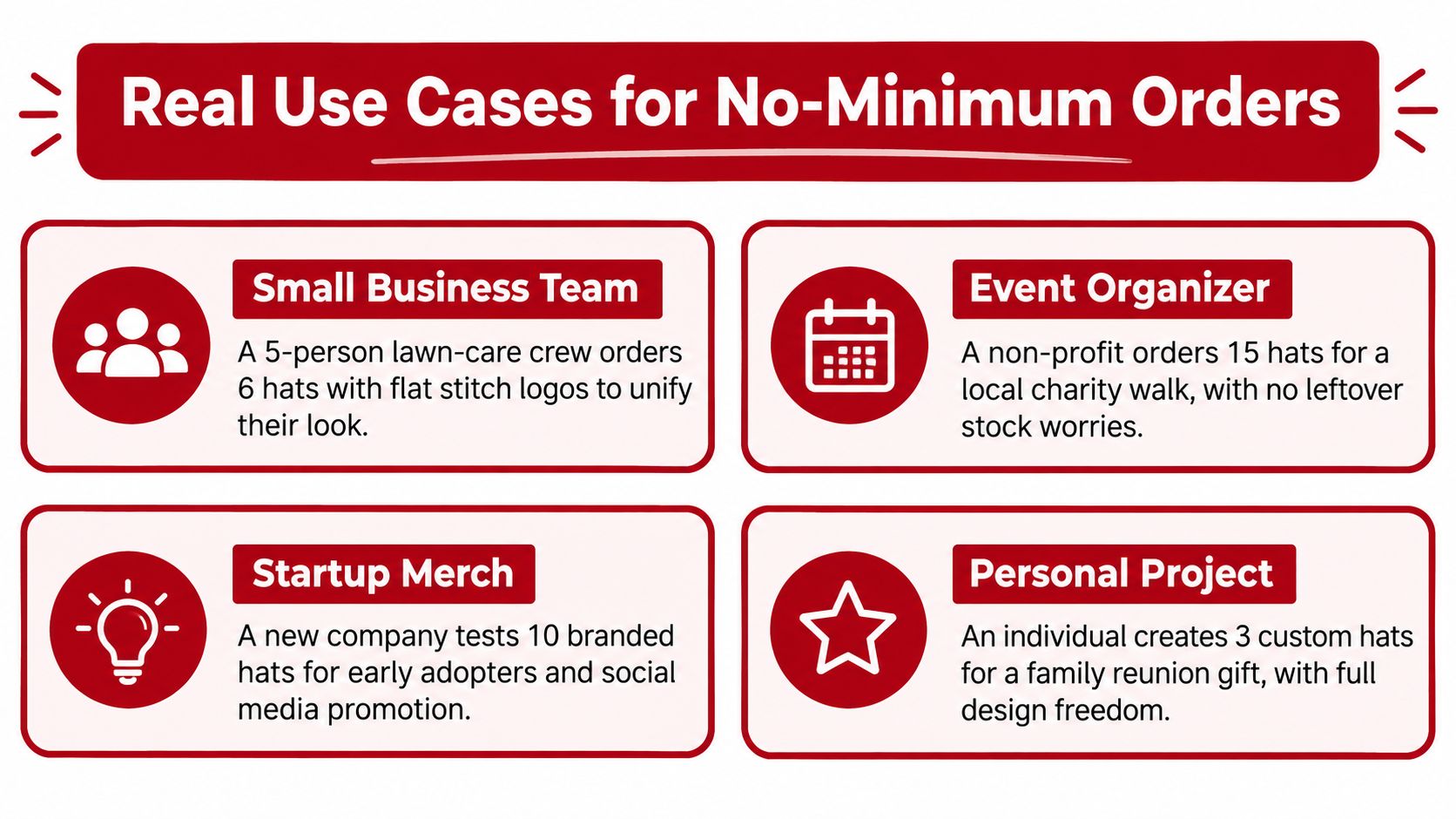
A low-minimum order works best when the buyer has a clear reason to keep the quantity small. The following situations all justify testing before scaling, but they don't use the hats in the same way.
A small service crew
A five-person lawn-care crew orders six structured trucker hats with a flat logo. One extra cap gives the owner a spare, and the group avoids buying a large inventory before confirming that the profile works on the job.
The trucker style suits outdoor work because the mesh back supports airflow. A clean, moderately sized logo also holds up better than fine lettering that can disappear against a busy panel.
A limited merch drop
A coffee roaster orders twelve foam-front caps for a new blend. The wordmark uses 3D puff because it's short, bold, and intended to stand out in product photography.
That buyer isn't trying to stock a permanent collection yet. The small run tests customer interest, cap comfort, and whether the raised decoration fits the brand's visual language.
A fundraiser or club event
A booster club orders a short run in two colorways for a travel fundraiser. The organizers can compare which cap people choose without committing to a broad assortment. They should confirm whether the vendor counts each logo separately if the colorways use different artwork.
A sampling program
A boutique hat seller orders samples across several blank styles to compare crown height, mesh feel, color, and stitch quality. That's a smart use of low quantities because the buyer is evaluating the production system, not merely purchasing finished merchandise.
The same approach works for a startup, nonprofit, or event planner. Order enough to answer a specific question, then scale only after the proof, fit, and blank availability make sense.
Common Questions About Low-Minimum Embroidery
Can I reorder the same design? Usually, yes, once the digitized file is on record. A reorder using the same logo and comparable blank is simpler than starting from scratch, but a new colorway, placement, or artwork revision may require another review. Ask the shop to identify the file name and thread colors so future orders stay consistent.
Will the blank still be in stock? Don't assume it will. Stock can change by brand, color, and profile, especially when you're buying in short runs. If the exact cap matters, ask whether the supplier can reserve it or recommend a comparable substitute before approving production.
Can I see a sample first? Ask about a stitch-out on scrap material or a pre-production sample on the finished hat. A scrap stitch-out can reveal density and lettering behavior, while a finished-cap sample gives you better information about placement and panel shape. Either option may add cost or time, so include it in the quote conversation.
What mistakes cause problems?
- A seam crosses the logo: Move the artwork inward or choose a different panel.
- Puff is used for tiny detail: Simplify the design or switch to flat embroidery.
- The front lacks structure: Reduce density and avoid oversized fills.
- Thread colors are chosen from a screen: Approve the actual proof and thread references.
- The deadline is too close: Submit artwork early and ask whether rush capacity is available.
Vendors use “no minimum” differently. Some allow one cap, others offer low minimums only for certain methods, and Dirt Cheap Headwear's embroidery program starts at six pieces per logo. Read the quantity rule together with the setup policy, blank availability, proof timing, and shipping schedule.
Dirt Cheap Headwear offers blank trucker caps, custom embroidery, flat and 3D puff options, and small runs starting at six pieces per logo. Visit Dirt Cheap Headwear with your logo, preferred blank, quantity, and deadline ready, then request a proofed quote before you commit to production.