
Custom Black Corduroy Hat: Guide to Styles & More
You're probably looking at the same merch problem a lot of brands hit. The logo is solid, the audience is there, but the hat itself feels interchangeable. Another cotton twill cap rarely gives people a reason to notice it, keep it, or wear it more than once.
That's where a black corduroy hat earns its spot. It doesn't just change the color or silhouette. It changes the surface, the hand feel, and how the branding reads from a few feet away. In custom headwear, that matters more than most retail guides admit.
Why Your Next Brand Hat Should Be Corduroy
A black hat already does one job well. It's easy to match, easy to sell, and usually safer across different age groups and dress styles. Corduroy adds the part that plain black hats often lack, which is visual depth.

That texture changes the whole impression of the product. Even before someone tries it on, corduroy signals that this wasn't the cheapest blank picked from a standard promo catalog. It reads more considered, more tactile, and more connected to vintage and streetwear styling.
A black corduroy hat also solves a branding issue I see all the time. Some logos are simple, but the merch around them feels flat. Corduroy gives the hat enough personality that the logo doesn't have to do all the work.
It stands out without getting loud
Black corduroy works because it's subtle. You still get a neutral base, but the ribbed face catches light differently than twill. That means the hat has dimension even when the decoration is minimal.
For a lot of brands, that's the sweet spot:
- Retail-minded brands want something with shelf appeal that still feels wearable.
- Coffee shops and hospitality teams want staff hats that look more premium than standard uniform gear.
- Bands and creators want merch that feels like part of a collection, not an afterthought.
- Agencies and startups want welcome-kit items people might keep in rotation.
Existing coverage of black corduroy hats leans hard into silhouette and novelty, but it rarely answers the practical questions businesses care about, such as wearability, lint visibility, durability, or repeated cleaning, as noted by this product listing context.
It gives your merch a point of view
Corduroy has style history behind it, and that helps. It doesn't feel random. A black corduroy hat can fit vintage retail, outdoor-inspired branding, music merch, restaurant uniforms, and understated corporate gifting without looking out of place.
That flexibility is a primary reason to consider it. You get a hat that feels more distinctive than basic cotton, but you don't box yourself into a trend color or an overly niche shape.
Understanding the Corduroy Fabric
A black corduroy hat can look great on a screen and still fail in production if the fabric and decoration are a bad match. That usually comes down to one detail retail guides skip. The wales.
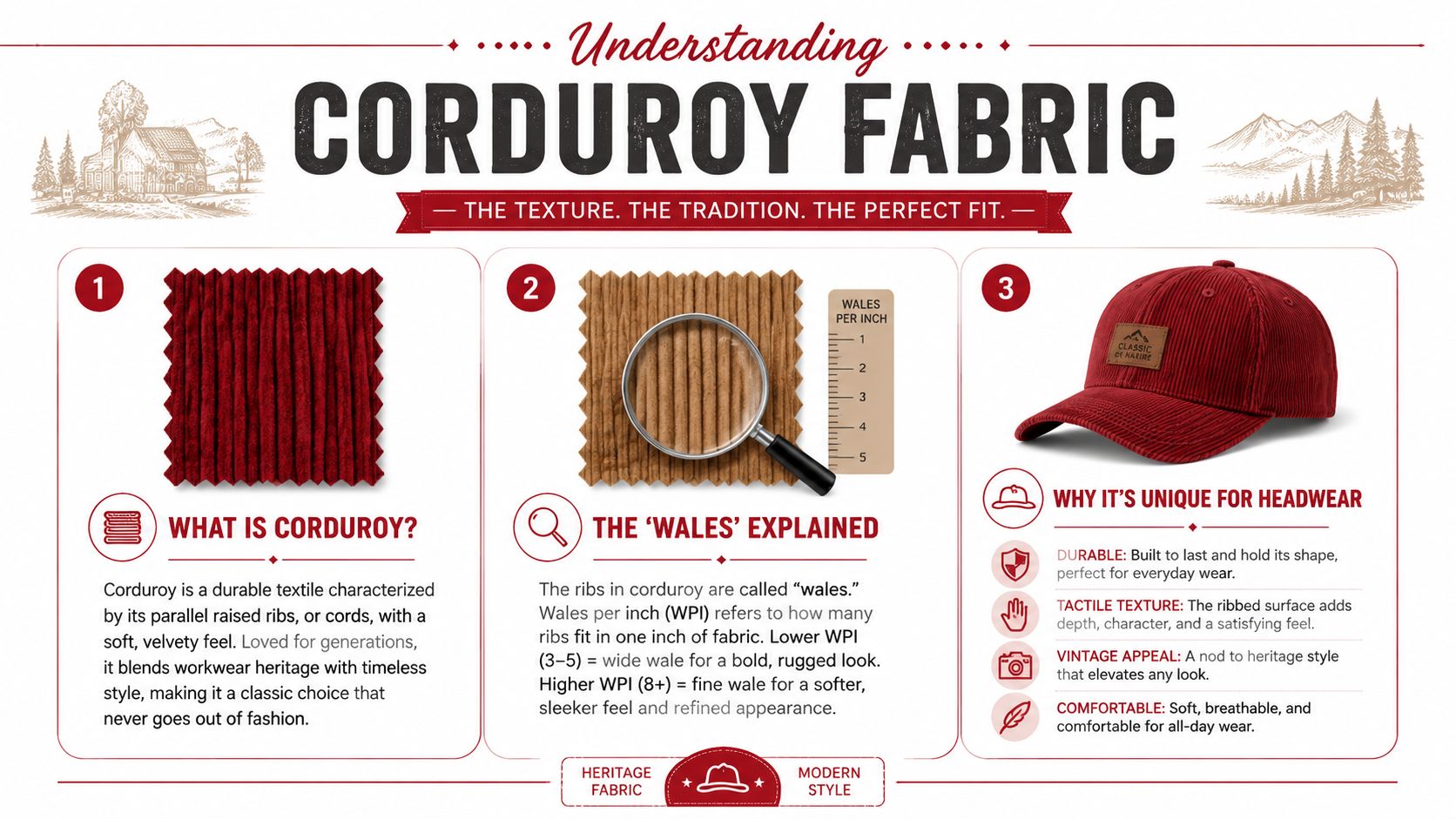
Wales are the raised ribs running through corduroy. On hats, they affect more than appearance. They change how the crown breaks in, how the fabric reflects light, and how embroidery sits on the surface.
That last point matters most for custom work.
What the wales change
On cotton twill, the embroidery needle enters a fairly even face. On corduroy, the needle crosses ridges and channels. That can soften the edge of small type, break up thin outlines, and make tight details look less crisp than they did in the proof.
Wale size also changes the result. Wider ribs give the hat more texture and more visual character, but they create a rougher base for fine stitching. Finer wale corduroy gives you a cleaner decoration surface, though it loses some of the bold texture people want from the fabric in the first place. That is the trade-off.
The fabric weight matters too. A heavier cotton corduroy cap usually feels firmer in hand and holds its shape better over time than a thin promo cap. If you want a reference point, the Richardson Timberline corduroy cap is a good example of the kind of blank buyers choose when they want real texture without giving up everyday wearability.
Corduroy versus common hat fabrics
Here is the comparison that helps during sourcing:
| Fabric | What it does well | Where it gets tricky |
|---|---|---|
| Corduroy | Texture, depth, shape retention, strong visual identity before decoration | Lint shows faster, embroidery needs cleaner art and better digitizing |
| Cotton twill | Sharp embroidery, easy daily wear, broad style availability | Surface can feel flat or generic |
| Canvas | Durable feel, workwear look, stable structure | Can wear stiff or heavy |
| Brushed cotton | Soft hand, relaxed finish | Less surface definition and less contrast under light |
If the logo carries very fine detail, twill is usually the safer call. If the blank needs to contribute to the look of the finished hat, corduroy earns its keep.
The upside and the trade-offs
Corduroy rewards simple, confident branding. It is excellent for block lettering, clean symbols, felt or woven patches, and embroidery with enough spacing to read across the ribs. It is less forgiving with tiny copy, sharp serifs, and artwork that depends on perfectly smooth fill coverage.
That is why we often recommend adjusting the art before production instead of forcing standard embroidery settings onto corduroy. A small increase in stitch spacing, border thickness, or logo size can make the finished hat look cleaner.
Buyers should also plan for everyday use. Black corduroy hides general wear well, but it can show lint and dust faster than smoother fabrics. For retail, merch, and hospitality programs, that is usually an acceptable trade for the richer surface and better hand feel. For heavy-uniform use in dusty settings, it is worth discussing whether twill is the better operational choice.
Corduroy also has staying power as a fabric category. Its long history helps explain why it still feels familiar even on newer hat silhouettes. In practical terms, that means it reads as textured and distinct without feeling costume-like or overly trend-driven.
Finding Your Perfect Corduroy Hat Style
Once you've decided on corduroy, the next decision is shape. This choice often determines the success or failure of custom orders. Buyers focus on color and logo size, then realize too late that the silhouette doesn't match the audience.
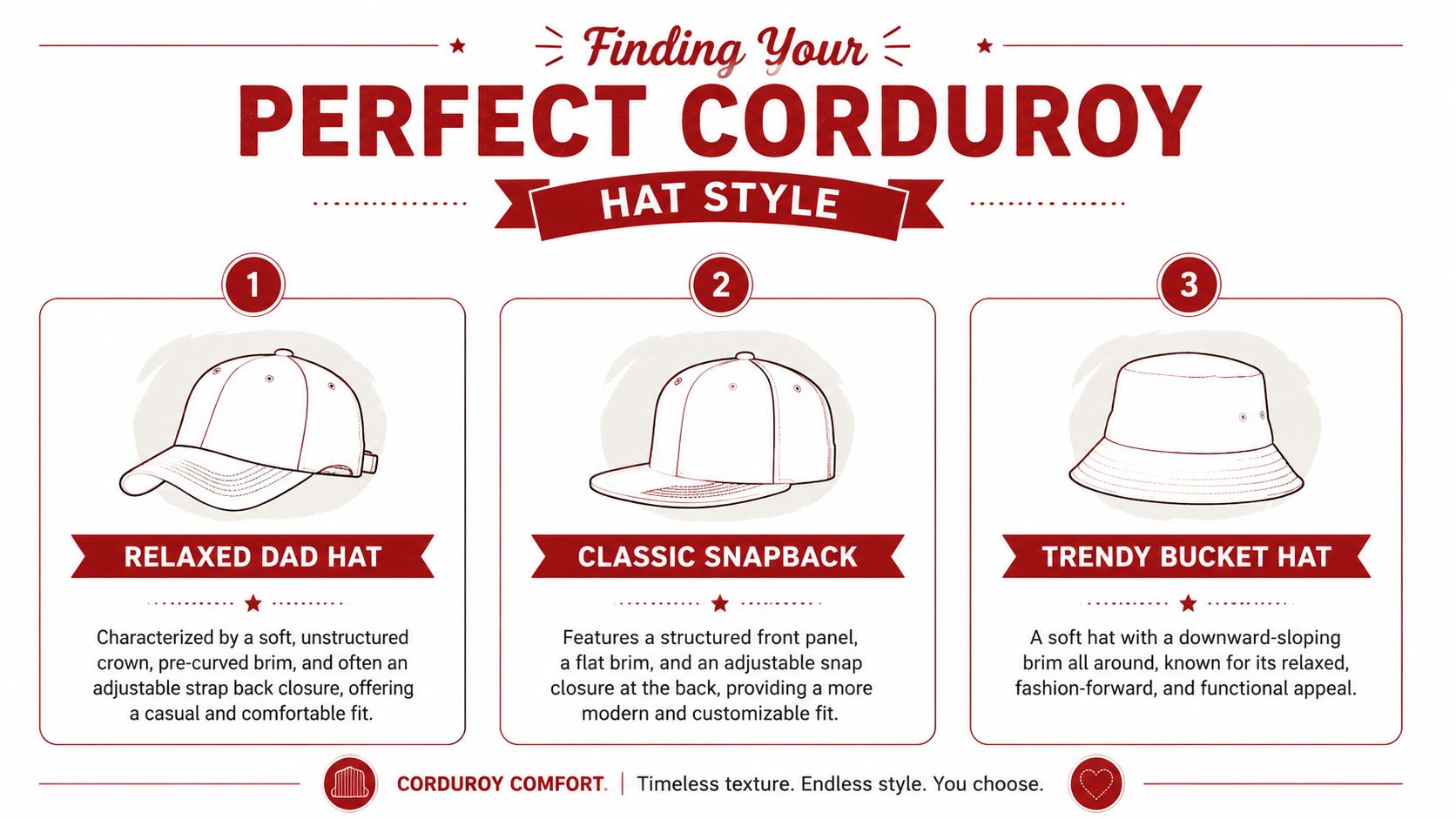
The main styles in black corduroy each push the branding in a different direction. They also handle decoration differently because front panel structure matters.
Relaxed dad hat
This is the easiest entry point. A corduroy dad hat usually has a softer crown, curved brim, and an everyday fit that doesn't ask much from the wearer.
It works well for:
- cafes
- bookstores
- lifestyle brands
- nonprofits
- event merch with a softer visual identity
The trade-off is decoration precision. Unstructured fronts drape more naturally, but they also move more. On textured corduroy, that means logo placement needs care, and highly dense embroidery can look less controlled.
Structured snapback and A-frame
This is the strongest option when branding needs to lead. Black corduroy hats are often offered as A-frame or 5-panel snapbacks, and some use a structured front panel that helps logos reproduce more cleanly, especially for dense embroidery and puff embroidery, as described in this black corduroy cap listing.
That structure gives the decorator a more stable surface. If your design includes bold block letters, thicker borders, or raised elements, this is usually the safer route.
A good visual reference for that lane is the Richardson Timberline corduroy cap, which fits the outdoor-retail and vintage-streetwear overlap that a lot of brands want from a black corduroy hat.
Here's a quick style breakdown:
| Style | Fit feel | Best branding use |
|---|---|---|
| Dad hat | Soft, relaxed, low pressure | Small logos, simple marks, casual uniforms |
| A-frame snapback | More defined front, stronger profile | Bold embroidery, streetwear drops, merch tables |
| Bucket hat | Soft and fashion-forward | Minimal branding, patches, seasonal capsules |
A short visual helps here if you're comparing shapes before ordering:
Bucket hat
Corduroy bucket hats can work, but they serve a narrower purpose. They're less about logo presentation and more about overall vibe. The soft brim and full fabric exposure put the material front and center.
That makes them useful for:
- fashion drops
- festival merch
- curated retail collections
- brands leaning into vintage references
A bucket hat can be the right style and still be the wrong wholesale choice if your logo depends on a crisp front-facing read.
If your main goal is broad team wear or easy resale, dad hats and A-frames usually move more cleanly.
Customizing Your Black Corduroy Hat
Corduroy serves to separate buyers who plan from buyers who guess. The same logo that looks clean on twill can turn muddy on corduroy if no one accounts for the wale texture.
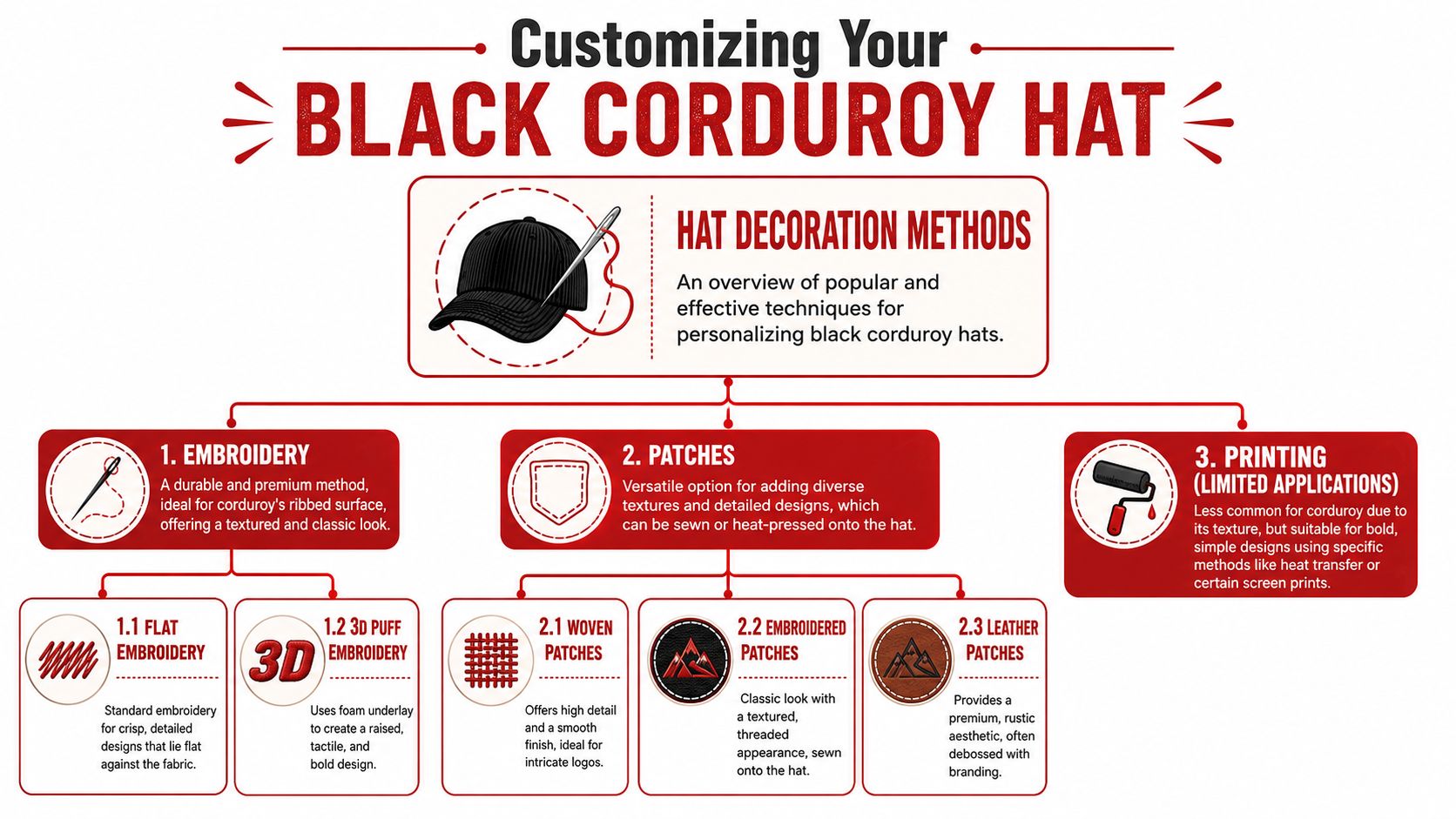
The fabric isn't the problem. The mismatch between design and fabric is the problem.
Flat embroidery on corduroy
Standard flat embroidery is usually the first place to start. It's durable, familiar, and it can look excellent on a black corduroy hat if the art is built for the surface.
What tends to work:
- bold letters
- medium-weight outlines
- compact icons
- tonal embroidery with enough fill to read over the ribs
What tends to struggle:
- tiny script
- thin serifs
- delicate line art
- tightly packed interior detail
The key issue is stitch clarity. Raised wales can make fine edges look slightly uneven compared with a smoother blank. That doesn't mean the result is bad. It means the design should be edited for the material rather than forced onto it.
Puff embroidery needs the right base
3D puff looks strong on corduroy when the front panel is stable. It looks rough when the crown is too soft.
If you're using puff, pay attention to two things:
Panel structure matters first
A structured front supports the foam and helps the shape stay clean.Letterforms need room
Thin letters and tight counters don't usually translate well in raised embroidery, especially on textured fabric.
A lot of failed puff jobs come from trying to make a delicate logo do a heavy technique.
If you want a raised look, simplify the art first. Corduroy already adds texture. The embroidery doesn't need to carry every visual effect on its own.
Patches often solve the biggest corduroy problem
When the fabric surface fights logo precision, patches are often the smartest answer. They create a cleaner presentation layer above the wale texture.
Good options include:
- Woven patches for finer detail and a flatter finish
- Embroidered patches for a classic, tactile look
- Leather-style patches for outdoor, heritage, or workwear branding
Patches also give you more freedom with shape. A rectangle, oval, or badge form can look more intentional on corduroy than a dense stitched logo dropped directly onto the ribs.
For brands comparing methods, a practical resource is this custom hat decoration guide, which helps clarify when embroidery, patches, or alternate methods make more sense.
Printing has limits here
Printing on corduroy is possible in certain cases, but it's rarely the first recommendation for a textured black cap. The ribs interrupt smooth ink lay, so bold and simple designs are the only ones I'd consider.
In most custom programs, printing is a niche option on corduroy. Embroidery and patches are usually the safer path.
A decoration checklist that saves headaches
Before approving art for a black corduroy hat, check these:
- Simplify small elements: Remove micro text and thin lines that won't survive the ribbed surface.
- Match the logo to the panel: Put denser embroidery on structured fronts when possible.
- Consider thread contrast: Black-on-black can look premium, but it needs enough depth to stay readable.
- Ask for proof review with texture in mind: Don't approve based only on flat digital art.
- Use patches when precise detail is essential: This is often the cleanest compromise.
One practical option in this space is Dirt Cheap Headwear, which offers low-minimum custom hat embroidery, patch options, and in-house decoration across common wholesale cap styles. That matters when you need to test a black corduroy hat in a small run before committing to a larger buy.
Styling and Use-Case Ideas for Your Brand
A black corduroy hat gets easier to evaluate when you stop thinking about it as a product page item and start thinking about where it resides.
Corduroy picked up strong casual-fashion credibility during its 1960s and 1970s revival as a counterculture staple, which helped make corduroy headwear feel natural in modern streetwear and vintage-inspired collections, as noted in TOAST's history of corduroy. That background is part of why the material still feels current without feeling disposable.
The coffee shop uniform that doesn't feel like a uniform
A neighborhood coffee shop usually wants staff gear to do two jobs. It has to look consistent behind the counter, and it can't make the staff feel like they're wearing a giveaway cap.
A black corduroy dad hat with a small embroidered wordmark handles that well. It looks softer than a stiff uniform cap, and the texture works with aprons, sweatshirts, and work jackets. The result feels more retail than restaurant-supply.
The band merch table piece people actually try on
For bands and independent artists, the black corduroy snapback usually makes more sense than a basic cotton cap. It carries enough attitude on its own, and it works with a larger front logo or patch without needing loud colors.
If the release is tied to a launch, collab, or gifting push, the outreach side matters too. Teams planning creator seeding often need a system for sending merch to the right people, and this guide to influencer collaboration platforms is useful if you're trying to organize gifting in a less chaotic way.
The startup welcome kit that doesn't look sterile
A lot of tech-company merch gets trapped in the safe zone. Clean, minimal, forgettable. A black corduroy hat changes that without creating HR problems or dress-code weirdness.
A subtle tonal logo on an unstructured cap can feel polished enough for a welcome kit and casual enough for actual use. That's the line most companies miss. People wear pieces that fit into their real wardrobe, not just branded items that photograph well on onboarding day.
The reseller drop with built-in story
Resellers and boutique operators can position black corduroy hats inside a vintage-inspired collection without forcing the concept. The material already carries that reference. It works beside washed tees, chore jackets, heavyweight hoodies, and outdoor-adjacent pieces.
The strongest presentation usually keeps the branding controlled. Small front embroidery or a shaped patch tends to sell the story better than overbuilt decoration.
The Practical Guide to Ordering and Care
Ordering a black corduroy hat for a business is less about picking a cool blank and more about reducing avoidable mistakes. The cleanest custom orders usually come from a short proofing process, not from speed alone.
What to lock down before you order
Start with the essentials:
- Choose the silhouette first: Don't approve decoration before you know whether the hat is unstructured, structured, dad hat, or A-frame.
- Match the logo to the fabric: Corduroy needs bolder artwork than smooth twill in many cases.
- Confirm closure and fit: Snapback, strapback, and profile all affect who will wear the hat.
- Review the decoration method: Direct embroidery and patches don't behave the same on ribbed surfaces.
If you're ordering custom embroidery and want a practical walkthrough of proofing, placement, and common order steps, use this custom hat embroidery ordering guide.
Think in test runs, not guesses
For small brands and startups, a sample-minded approach is usually better than overcommitting. If the logo is new to corduroy, test one decoration treatment and one silhouette before expanding the program.
That's especially important if:
- you've only stitched the logo on twill before
- the artwork contains thin details
- you're deciding between direct embroidery and patches
- you're building hats for resale rather than one-time event use
A small first run also helps answer a practical question that product pages often skip. Does your audience like corduroy in your use case, or do they just like the idea of it online?
Care matters more than people think
Black corduroy looks good because of its surface. That same surface needs a little more care than a basic smooth cap.
A few habits help:
- Spot clean first: Don't treat it like a gym hat and dunk it without thinking.
- Use gentle brushing for lint: A lint roller or soft brush helps keep black corduroy looking cleaner between wears.
- Avoid aggressive scrubbing: That can rough up the ribs and make the hat look tired faster.
- Air dry with shape support: Keep the crown formed while drying so the front doesn't collapse awkwardly.
Keep the care simple. Clean the area that's dirty, remove lint often, and don't crush the crown when it's wet.
For team wear, include care notes with the order if the hats are going to staff or event crews. That one small step can keep the hats looking better much longer.
Common Questions About Corduroy Hats
Are black corduroy hats practical for everyday wear
They are, if the hat matches the job.
For casual retail merch, brewery uniforms, artist drops, and staff wear where appearance matters, black corduroy is a strong option. It looks richer than plain cotton and holds up well in regular rotation. The trade-offs are straightforward. Black corduroy shows lint, feels warmer than lighter summer fabrics, and asks for more discipline on logo setup.
Is corduroy too hot for warm weather
Corduroy works better in shoulder seasons, cool evenings, and indoor use than in peak heat.
If the audience will wear the hat at festivals, job sites, or outdoor events in high summer, I usually point them toward lighter fabrics. If they still want the corduroy look, an unstructured profile with a softer crown is the safer call than a stiff, heavy build.
Does a black corduroy hat hold its shape well
Usually yes, but fabric alone does not determine shape retention.
The answer comes from the full build: panel structure, buckram, crown height, and how heavy the corduroy is. A structured 5-panel or trucker-style front will present very differently from a relaxed dad hat in the same fabric. Corduroy has enough body to feel substantial, but the pattern controls the final shape.
What decoration works best on a black corduroy hat
This is the question buyers should ask first.
Corduroy's ribbed surface changes how decoration reads from a few feet away. Wider wales create a bumpier stitch field, so bold embroidery usually performs better than fine lettering or tight linework. On logos with small details, a woven patch, embroidered patch, or leatherette patch often gives a cleaner result than stitching directly into the fabric.
Why do some embroidered logos look less crisp on corduroy
The needle is working across raised ribs instead of a flat weave.
That matters more than many retail guides admit. On corduroy, stitch edges can wander slightly, small counters can fill in, and thin lines can break up visually once the thread sits across the wale pattern. Fine on-screen artwork does not always translate cleanly to the cap. Good production starts by simplifying the art, increasing spacing, and choosing a logo size that respects the fabric.
Is corduroy just a trend fabric
No. It cycles in and out of fashion, but it has stayed relevant because it offers something smooth fabrics do not.
Corduroy adds texture, depth, and a more tactile finish to a hat program. That is why it keeps showing up in branded merchandise, streetwear, workwear-inspired collections, and seasonal retail assortments. Buyers are not only choosing a color. They are choosing a surface that changes how the logo feels and looks.
How do you keep a black corduroy hat looking good
Regular light maintenance works better than occasional aggressive cleaning.
Use a lint roller or soft brush to keep the ribs clear, spot clean dirty areas, and let the hat air dry while supported so the crown keeps its shape. Avoid hard scrubbing, especially on the front panel. Once the ribs get roughed up, the hat starts looking tired even if the fabric is still structurally sound.
What's the biggest mistake buyers make with corduroy hats
They approve corduroy with the same artwork setup they use on flat twill caps.
That is where orders go sideways. Fine serif text, narrow outlines, and dense fill areas often look cleaner on a proof than they do on the finished hat. A better approach is to sample the logo on the actual corduroy style, compare direct embroidery against patch options, and adjust before committing to volume.
If you're sourcing a black corduroy hat for staff, merch, resale, or an event, Dirt Cheap Headwear is a practical place to start. You can compare wholesale styles, request custom embroidery or patches, and build a small test run before scaling into a larger order.