
Leather Strap Hats: Your Guide to Custom Styles 2026
You're probably looking at a merch refresh, team order, retail drop, or event giveaway and trying to solve three problems at once. You need a hat that looks better than a cheap promo cap, fits enough people to keep ordering simple, and doesn't wreck the budget once decoration is added.
That's exactly where leather strap hats tend to earn their place.
For bulk buyers, the value isn't just the strap itself. It's what that detail signals. A leather closure makes a blank cap feel more intentional, more giftable, and more aligned with brands that want to look established instead of improvised. If you're comparing samples on a desk, the hat with the leather strap usually gets picked up first.
Why Leather Strap Hats Elevate Your Brand
A lot of business buyers land in the same spot. The logo is done. The deadline is moving closer. Someone on the team says, “Let's just get hats people will wear.” That's when the closure starts mattering more than most first-time buyers expect.

A leather strap changes the read of the hat immediately. Plastic snaps feel casual and familiar. Leather with metal hardware feels deliberate. Even before someone notices the logo, they've already made a judgment about quality based on touch, weight, and finish.
That matters if you're buying for staff uniforms, resale merch, brewery goods, alumni gear, hospitality groups, or client gifts. The back of the cap is part of the product. If the closure feels cheap, the whole hat feels cheap.
Small details shape brand perception
The strongest part of leather strap hats is that the upgrade is subtle. You're not relying on loud styling to create value. You're using materials and trim to make the hat feel more polished.
A few examples:
- For retail shelves: A leather strap helps a basic dad hat look closer to boutique merchandise than event swag.
- For team issue: Coaches and staff often prefer a cleaner, lower-profile back closure than a plastic snap.
- For client-facing brands: Metal hardware and leather read as more mature than molded plastic.
Practical rule: If your brand story includes words like heritage, craft, premium, outdoor, local, handmade, or classic, a leather strap usually supports that story better than a snapback.
The style also fits naturally into the broader world of recognizable cap silhouettes and established labels. If you're comparing blanks across different suppliers, it helps to understand how major brands position these styles in the market. A quick scan of popular hat brands used for wholesale and custom programs can make that comparison easier.
Understanding Strapbacks and Other Closures
A strapback is exactly what it sounds like. Instead of plastic tabs or fixed sizing, the hat uses a strap at the back to adjust fit. On leather strap hats, that system usually works like a small belt, using genuine leather with metal press fasteners or brass clasps for secure, micro-adjustable tuning across a one-size-fits-most range, typically accommodating head circumferences between 55cm and 59cm, according to this leather strap closure product specification.
That setup is standard on premium and heritage-style caps, especially unstructured crowns that benefit from stable rear adjustment. For a wholesale buyer, that means fewer size headaches and a cleaner finish than some bulk promo options.
What a strapback does differently
A leather strapback doesn't just adjust. It adjusts smoothly.
Snapbacks move in set increments. Fitted and Flexfit styles depend on selecting the right size in advance. A leather strap sits in the middle. It gives you adjustability without the chunky feel of plastic hardware, which is why buyers often choose it for lifestyle merch, hospitality uniforms, museum shops, golf events, and premium giveaways.
Hat Closure Comparison
| Feature | Leather Strap (Strapback) | Plastic Snap (Snapback) | Fitted / Flexfit |
|---|---|---|---|
| Fit style | Adjustable | Adjustable | Fixed or semi-fixed |
| Adjustment feel | Smooth, low profile | Stepped, click-in fit | No rear adjustment |
| Perceived quality | Premium, heritage-leaning | Casual, sporty | Clean and uniform |
| Inventory complexity | Easier to stock | Easier to stock | Harder to size-plan |
| Best for | Retail merch, brand programs, gifting | Streetwear, promo, team fanwear | Uniform looks, size-specific programs |
| Common risk | Moisture sensitivity if poorly matched to use case | Can feel less elevated for premium brands | More SKUs and sizing errors |
Which closure works for which buyer
If you're ordering in bulk, closure choice affects more than style.
- Leather strap: Best when brand image matters and you want one-size simplicity without a mass-market feel.
- Snapback: Good for bold, structured caps and teams that want a familiar streetwear look.
- Fitted or Flexfit: Better when uniform appearance matters more than sizing flexibility.
Buy the closure that matches how the hat will be used, not just how it looks in a mockup.
If you need a broader breakdown of fit systems before choosing blanks, this guide to different hat closure types for wholesale buyers is useful for sorting through the options.
Judging Quality in Materials and Construction
The phrase “leather strap” doesn't tell you enough. In bulk buying, weak materials hide in vague product descriptions. If you want hats that hold up and still look right after repeated wear, you need to inspect the strap, hardware, and crown construction together.

Leather has deep roots in headwear. The history of baseball caps and early leather elements notes that leather hats trace back to ancient times, and the first cap resembling today's style with leather elements was worn by baseball teams like the New York Mutuals in the 1800s. That history still affects how buyers read the material now. Leather carries a built-in heritage association that synthetics usually don't.
What to check in the strap and hardware
Start at the back.
A quality leather strap should feel supple, not papery or stiff. Hardware should close firmly and sit flush. If the metal feels flimsy in your fingers, the hat will feel flimsy to your customer too.
Look for these signs:
- Strap substance: Genuine leather tends to feel denser and wear in better than thin synthetic substitutes.
- Clean edge finishing: Rough-cut edges can make even a good front logo look careless.
- Hardware finish: Brass or antiqued metal often complements heritage styling better than bright, lightweight plated parts.
- Consistent attachment: Uneven stitching where the strap joins the body is a red flag on bulk orders.
The crown matters as much as the closure
A good leather strap can't rescue a bad hat body.
Unstructured cotton twill, washed canvas, and soft brushed cotton usually pair well with leather because the closure matches the relaxed silhouette. On a stiffer, high-crown cap, the same strap can feel disconnected unless the rest of the style is built around that contrast.
That's why experienced buyers review closure and crown together, not separately. If you're deciding between softer and firmer silhouettes, this overview of structured vs. unstructured hats helps clarify which direction fits your project.
Here's a quick visual reference for construction details worth noticing before you place a larger order:
The best leather strap hat doesn't look expensive because of one feature. It looks expensive because nothing on it feels out of place.
What doesn't work
The weakest bulk programs usually make one of two mistakes.
First, they pair a premium closure with the cheapest possible blank. Second, they choose decorative hardware that photographs well but feels fragile in hand. Both choices backfire once the hat reaches staff, customers, or resale buyers.
Styling Tips for Different Brands and Events
Leather strap hats work best when the style supports the identity of the organization buying them. The same closure can feel rugged, polished, collegiate, or understated depending on fabric, profile, logo treatment, and color.
That flexibility isn't new. The history of European hat development and sports adoption notes that leather straps had become integrated into sports headwear by the 19th century, with the first lid resembling today's ballcaps worn by teams like the New York Mutuals in 1860. That long association with sport and utility is one reason the style still adapts so well across modern brand categories.
Four practical use cases
Craft brewery or distillery
A washed cotton or canvas dad hat with a debossed leather patch usually lands well here. Earth tones, off-black, faded olive, and navy all pair naturally with tan or dark brown leather.
This is a case where a little texture helps. The product should feel handmade, even if the production run is large.
Tech startup or agency
Go cleaner. Black or charcoal twill, minimal front embroidery, no distressed finishes.
For this buyer, the leather strap works best as a quiet premium signal. You're not trying to make the hat rustic. You're trying to make it feel intentional.
University alumni event
A wool-blend or brushed cotton cap with vintage lettering can do a lot here. Leather adds the right amount of tradition without forcing a costume look.
Use it when the event leans reunion, donor, or legacy-focused. If the audience skews younger and trend-driven, a snapback might fit better.
Outdoor brand or lodge merch
Canvas, pigment-dyed cotton, and tonal embroidery usually fit this category. Leather closure makes sense because it aligns with trail, field, guide, and camp aesthetics.
If the brand wants to feel durable and grounded, pair the leather strap with fabrics that have visible texture. Smooth synthetic fronts can fight the look.
Matching decoration to the audience
Not every logo treatment fits every buyer.
- Embroidery works well for clean marks, initials, club logos, and staff programs.
- Leather patch applications fit best when the identity already has a craft or heritage tone.
- Tone-on-tone branding suits premium retail and hospitality groups that don't want loud merch.
A common mistake is overbuilding the hat. A leather strap already contributes personality. You usually don't need aggressive side hits, oversized back embroidery, and multiple contrast details on the same cap.
Customizing Your Hats with Patches and Embroidery
A lot of bulk hat programs go off track at the decoration stage. The blank looks right, the colors are approved, then the logo goes on and the product starts reading cheaper than the brand intended. On leather strap hats, decoration has to work with the premium cue already built into the closure. If the front treatment feels too busy, too glossy, or too detailed for the cap body, buyers notice.
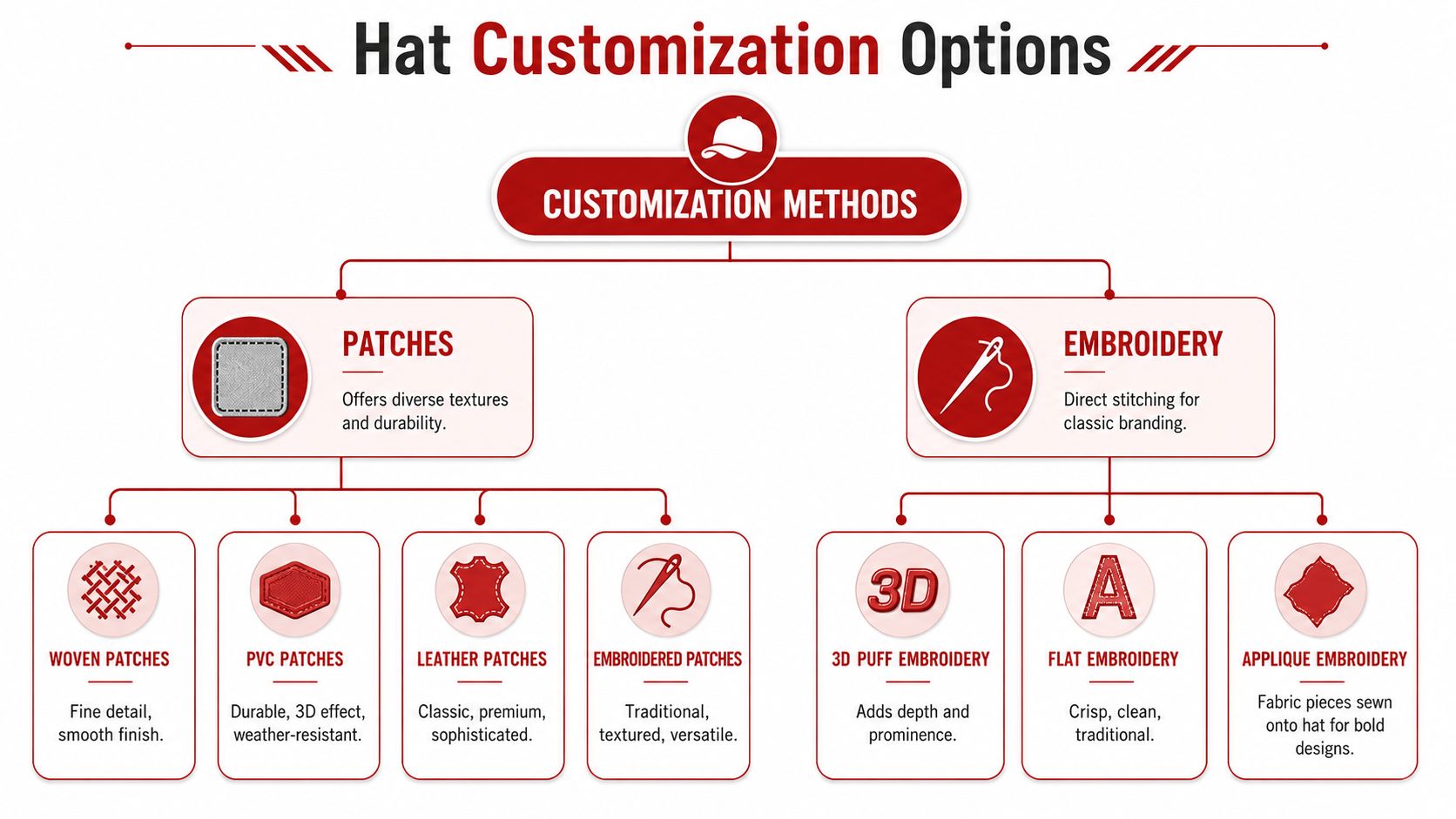
What usually works best
For bulk orders, flat embroidery is usually the safest starting point. It holds up well in staff programs, corporate merch, campus retail, and event runs because it is durable, familiar to buyers, and relatively predictable in production. If your logo has clean shapes and limited detail, flat embroidery keeps the process simple.
3D puff embroidery works best for bold artwork with thick strokes and enough open space. It can add shelf impact, but it also raises the chance of disappointment if the logo has small counters, narrow outlines, or fine type. Structured fronts handle puff better than soft, unstructured caps.
Patches give you more control over texture and edge definition, which matters if the brand identity is doing more than just placing a logo on a hat.
- Leather patches: Best for heritage, outdoor, brewery, ranch, lodge, and gift-shop programs
- Woven patches: Better for logos with fine detail or small lettering
- PVC patches: Better suited to technical, utility, or motorsport looks than classic premium branding
- Embroidered patches: Useful when you want dimension and a traditional feel without stitching directly into the cap front
For many B2B buyers, the primary consideration is less about trend and more about where the hats will be used. Staff uniforms need consistency across reorders. Retail programs need perceived value. Event hats often need to stay inside a target unit cost. The decoration method changes all three.
The file issues that slow production
Artwork problems cause more delays than cap selection. That is especially true on patch programs, where the logo has to be translated into a physical format with line limits, stitch limits, or engraving limits.
For engraved leather patches, use vector art. AI, EPS, and true vector PDF files are the standard formats most decorators ask for because they scale cleanly and give production teams usable paths. A PNG or JPEG can be fine for a mockup or internal concept review, but it often is not enough for final production.
A few rules save time and redraw fees:
- Send vector files first if the design includes engraved or debossed leather.
- Check whether the PDF is vector. A raster image dropped into a PDF still behaves like a raster image.
- Clean up small text and thin strokes before approval. If it looks delicate on screen, it usually gets worse on a patch.
- Review the proof at actual size on the hat panel. A logo can look balanced by itself and still feel too small, too dense, or too high once placed on the cap.
File check: Before placing a wholesale order, ask your designer or supplier one direct question: “Is this production-ready vector art for the decoration method we chose?”
That question matters for budgeting too. If your supplier has to redraw files, simplify artwork, or test multiple patch shapes, your timeline stretches and your setup costs can climb. On a one-off consumer order, that is an annoyance. On a 144-piece staff order or a resale launch with a fixed event date, it becomes an operations problem.
Mockups are useful, but they are not approvals
Mockups help with internal signoff, buyer presentations, and early sales planning. They are useful for comparing patch shapes, cap colors, and logo scale before you commit to sampling. If your team needs a quick visual before final art is sent to production, MerchLoom's guide to AI mockups is a practical starting point.
Use mockups to decide direction. Use proofs and samples to approve production.
That distinction keeps a lot of bulk programs out of trouble. A digital mockup can show a clean leather patch with crisp edges and perfect contrast, while the actual result depends on the patch material, stitch border, logo simplification, and the way the hat front handles the attachment method. For business buyers, that is the difference between a hat that supports the brand and a carton of inventory that never sells through.
Ordering Wholesale Hats for Your Business
The first bulk order usually feels more complicated than it is. Most issues come from unclear specs, rushed approvals, or ordering the wrong style for the audience. If you handle those three points early, wholesale buying gets much easier.
The terms that matter most
MOQ means minimum order quantity. It's the smallest run a supplier or decorator will accept for a specific product or decoration method.
For business buyers, MOQ affects risk. A lower minimum lets you test a style, launch a small merch batch, or order staff hats without sitting on excess inventory. A higher minimum can still make sense if you already know the design sells or the event size justifies it.
Proof approval is the checkpoint that matters most before production begins. At this point, you confirm logo placement, dimensions, thread or patch interpretation, and cap color. If something is wrong after approval, fixing it gets expensive fast.
How to make ordering smoother
The cleanest wholesale orders usually follow this sequence:
- Choose the use case first: Staff wear, resale, event giveaway, alumni merch, and team gear all point to different hat bodies.
- Match closure to audience: Leather strap hats work well when perceived quality matters and one-size inventory is a priority.
- Submit usable art early: Don't wait until the blank is selected to find out the logo needs redraw work.
- Review one physical sample when the project is sensitive: This matters for retail launches, donor programs, and branded resale.
Where buyers make avoidable mistakes
Some buyers chase the cheapest blank and then spend heavily on decoration to compensate. Others buy a premium blank but use artwork that's too weak or too cluttered to carry the front panel.
The best value usually comes from balance. Pick a hat that already supports your brand. Then decorate it in a way that fits the material, the crown shape, and the audience who'll wear it.
Wholesale success comes from reducing surprises. Clear artwork, the right blank, and realistic timelines solve most problems before production starts.
Common Questions About Leather Strap Hats
A lot of bulk buyers ask these questions late in the process, usually after they have chosen the front decoration and started comparing blank costs. That is understandable. The closure looks like a small detail, but it affects wear life, replacement rates, perceived quality, and whether the hat fits the job you are buying it for.
Are leather strap hats durable enough for everyday use
They are durable enough for normal brand use if the cap is built well and the strap material is decent.
For retail programs, casual staff wear, donor gifts, alumni merchandise, and event caps, leather strap hats usually perform well. Problems start when buyers treat all use cases as equal. Daily office wear, light weekend use, and shelf-ready resale put very different stress on a hat than sun exposure, sweat, rain, and repeated packing into gear bags.
That is why I look at the end use first, not just the price sheet. A leather strap can hold up for a long time in the right setting, but it is less forgiving than synthetic closures when moisture and rough handling are part of the job.
Are they a bad choice for outdoor teams and hot-weather events
They can be the wrong choice for heavy sweat and weather exposure.
If the hats are headed to golf events, brewery patios, campus weekends, or branded resale tables, leather often works well because the hat is part of the presentation. If they are for sideline crews, outdoor installers, youth sports programs, or summer staff who will wear them hard every day, I would compare strap materials before approving the order.
The reason is simple. Leather can dry out, stiffen, darken, or wear unevenly after repeated moisture exposure. That does not always create a product failure, but it can create an appearance problem, and appearance matters if your logo is attached to it.
Leather looks premium. It also asks for a better fit between product and environment.
Do leather strap hats cost more
Usually, yes.
The better question for a business buyer is whether the added cost improves the result enough to justify it. On a resale hat, employee uniform piece, client gift, or sponsor item, a leather strap often helps the cap feel more intentional and less disposable. That can support a higher selling price or a better brand impression.
On a high-volume giveaway, the math can change fast. If the hat is meant to be handed out by the hundreds and replaced without much thought, a standard snapback or fabric closure may be the smarter spend.
Are they harder to fit than snapbacks
No. They are still adjustable, and that matters for bulk programs where carrying multiple sizes adds cost and complexity.
The difference is in how the fit feels and how the back of the cap looks. Leather strapbacks usually sit cleaner and look less sporty than plastic snaps. That can help if your brand wants a more polished retail look, but it can slow quick readjustment compared with a snapback. For public distribution, that trade-off is usually acceptable.
What's the easiest way to care for them
Keep the instructions basic and realistic. Complicated care guidance rarely gets followed, especially after events or in resale settings.
- Store them dry: Do not leave hats sealed in damp cartons, duffels, or promo bins after use.
- Clean the body carefully: Spot clean first. Avoid soaking the closure.
- Protect the back hardware: Overpacked master cartons can bend buckles or mark straps during transit.
- Match the hat to the job: Choosing the right closure upfront prevents more problems than any after-sale care step.
If you are selling the hats at retail or including them in a premium merch drop, add a short care card. It reduces avoidable complaints and helps customers keep the hat looking presentable longer.
If you're comparing blanks, planning decoration, or trying to keep a bulk hat order on budget without settling for low-grade merch, Dirt Cheap Headwear is a practical place to start. They offer wholesale blanks, custom embroidery, patch options, low minimums, and a wide range of cap styles for brands, teams, events, and resellers that need reliable headwear without overcomplicating the process.