
American Flag Hat Made in USA: A Buyer’s Guide for 2026
You're probably in one of two situations right now. You need patriotic hats for a seasonal push, staff uniforms, a fundraiser, or resale, and you assumed finding an American flag hat made in USA would be simple. Then the product pages started blending together.
One brand says “Made in America.” Another says “decorated in the USA.” A third says nothing clear at all, but the price looks too low to make any sense. If you've sourced headwear before, you already know what that usually means. The hat body may be imported, the patch may be applied domestically, and the listing is written to keep the details fuzzy.
That's the fundamental problem with this category. It isn't demand. It's verification. Buyers don't usually struggle to find flag hats. They struggle to prove which ones are American-made before they put their logo, budget, and reputation behind them.
Why Sourcing US-Made Flag Hats Is Worth the Effort
A patriotic hat only works if the story holds up under scrutiny. If you're selling merch tied to national identity, military support, tourism, or a Fourth of July campaign, buyers notice the difference between a hat that feels authentic and one that feels like a shortcut.
That matters more than most first-time buyers expect. A flag design already carries symbolism. When the product itself is vague on origin, the disconnect shows up fast in customer questions, wholesale conversations, and internal team discussions. Nobody wants to explain why a “USA” hat turns out to be an imported blank with domestic decoration.
The trust piece is bigger than the hat
For small brands, headwear often does double duty. It's both merchandise and message. The same is true in other domestic-made categories. If you've ever looked at the artisan's guide to faux fur, you've seen the same pattern. Buyers aren't just paying for a finished item. They're paying for traceability, workmanship, and a story they can repeat without hesitation.
That's exactly why genuine domestic sourcing is worth the extra work in patriotic headwear.
Practical rule: If the product's message depends on American identity, the supply chain has to support that message.
What businesses usually get wrong
The common mistake is buying on appearance alone. The sample photo looks fine. The embroidery looks acceptable. The listing uses enough red, white, and blue language to sound convincing. Then the order arrives and the shape is inconsistent, the crown feels cheap, or the origin details still aren't clear enough to use in your own marketing.
A verified American-made hat gives you three advantages:
- Cleaner brand positioning because your product claim matches the product reality.
- Better internal confidence when your sales team, event staff, or retail partners ask where the hats come from.
- Stronger resale value because customers tend to respond well to authenticity in patriotic goods.
There's also a simple operational benefit. Suppliers who can clearly explain where and how the hat is made are usually easier to work with overall. They tend to understand specs, decoration limits, reorder consistency, and accountability.
That doesn't mean every U.S.-made option is automatically better. Some are overpriced. Some lean too hard on sentiment and not enough on construction. But when the sourcing is legitimate and the build is right, these hats are easier to stand behind and easier to sell.
What Made in USA Actually Means for Headwear
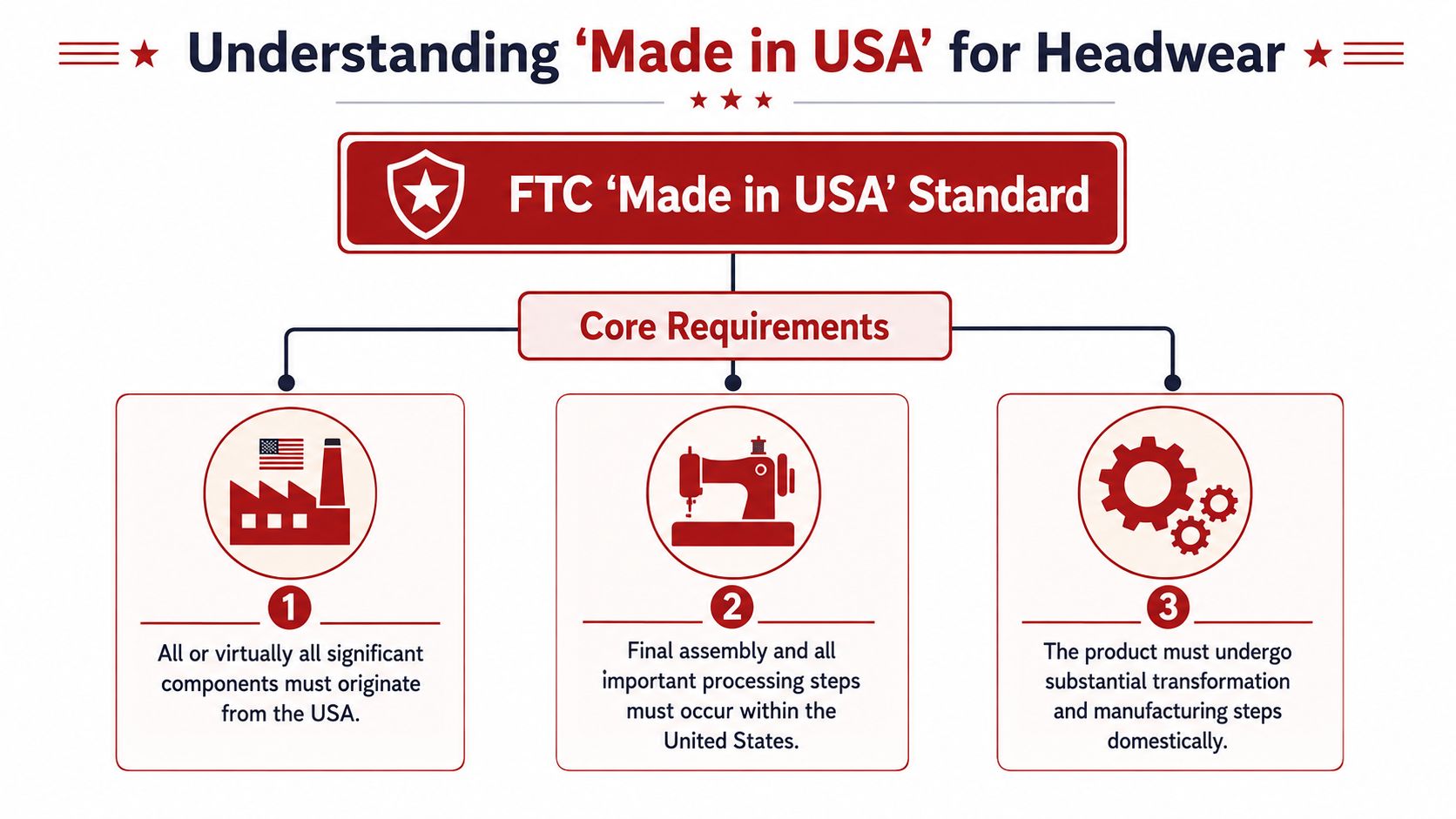
The phrase Made in USA isn't just marketing language. It has a legal meaning. Under the Federal Trade Commission standard, a product labeled “Made in the USA” must be composed of “all or virtually all” U.S.-made components, and all significant parts and processing must be of U.S. origin, as outlined in this PBS summary of the FTC standard.
Think of it like baking versus decorating
A good way to understand it is to compare two very different scenarios.
If a factory weaves the fabric, cuts the panels, sews the cap, installs the closure, and finishes the hat domestically, that's like baking a cake from scratch in your own kitchen.
If someone imports a finished blank cap and only adds embroidery or a patch in the United States, that's more like buying a cake at the store and adding frosting at home. You changed the appearance, but you didn't create the product from the ground up.
For headwear buyers, that distinction is everything.
What counts and what doesn't
These claims are not interchangeable:
- Made in USA means the product must meet a high threshold for domestic components and processing.
- Assembled in USA usually means major components may have been made elsewhere and only put together domestically.
- Decorated in USA often means the blank itself came from overseas and the final embellishment happened here.
- Designed in USA says almost nothing about manufacturing origin.
A lot of confusion starts when buyers treat those phrases as close enough. They aren't.
If the supplier can only verify domestic embroidery, you're not looking at a fully American-made hat. You're looking at a decorated import unless they can prove otherwise.
What this means in practical sourcing terms
For an American flag hat made in USA, the question isn't whether the flag graphic was sewn on in the United States. The question is whether the hat itself meets that standard.
That means looking at the full build:
| Part of the product | What a serious buyer should ask |
|---|---|
| Fabric | Where was the fabric sourced and made? |
| Hat body | Where were the panels cut and sewn? |
| Processing | Where did the important manufacturing steps happen? |
| Decoration | Was the embroidery or patch added domestically, and to what base hat? |
California law can be even stricter. The same PBS coverage notes that California requires 95 percent of a “Made in the USA” product's total value to come from U.S. sources unless key components are unavailable domestically.
That's why vague language should make you slow down. A real domestic claim should survive specific questions.
How to Verify Made in USA Claims Before You Buy
Verification is where most buyers hit the wall. Product pages are full of confident wording, but the proof often stops at the headline.
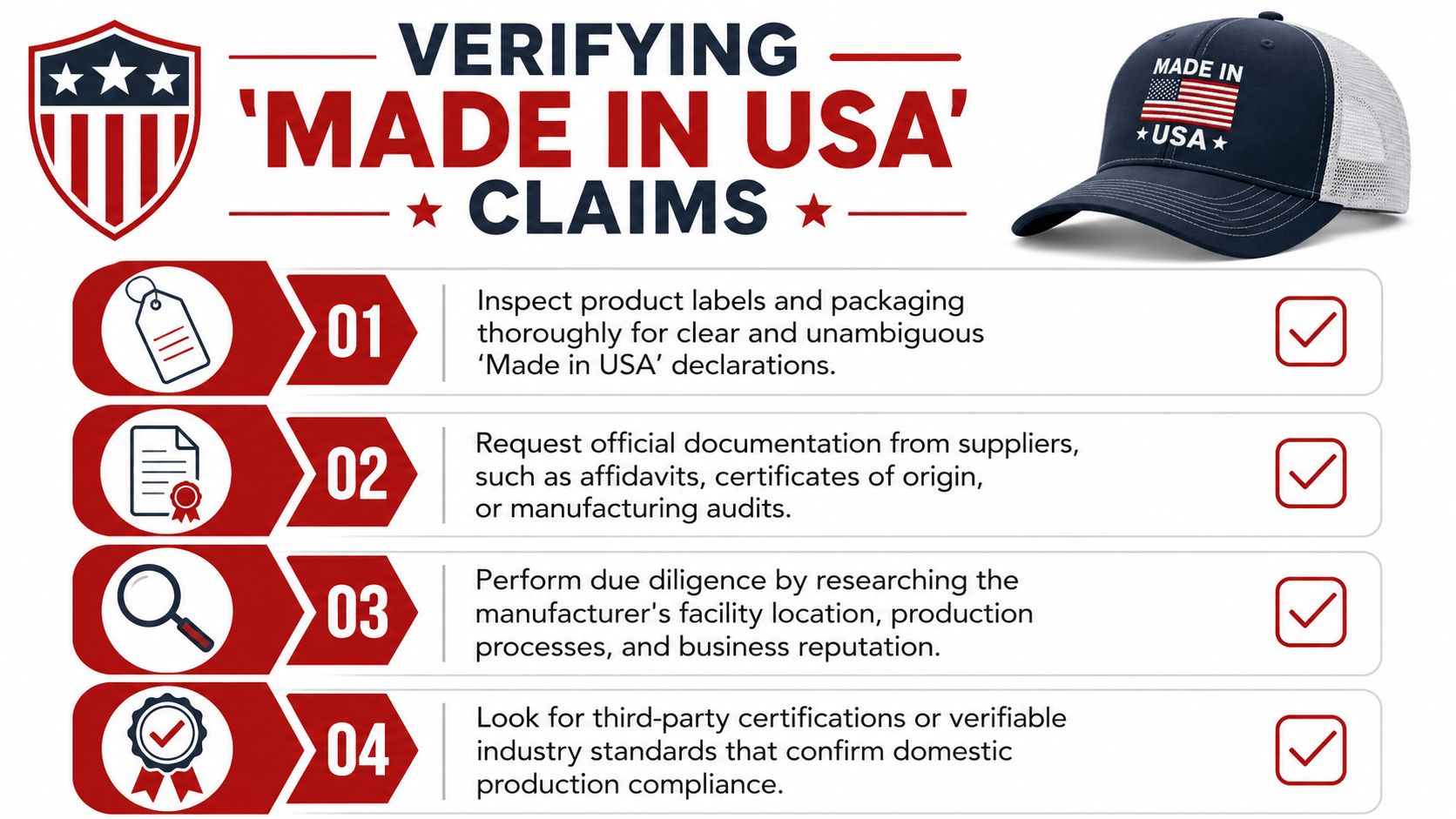
That's not a small issue. A 2025 industry report from the National Association of Manufacturers indicates that 68% of “Made in USA” labeled apparel lacks third-party audit verification, which creates a trust gap for buyers sourcing branded hats, as cited in this discussion referencing the report.
The questions that actually matter
Most bad sourcing decisions happen because the buyer asks broad questions and gets broad answers. “Is this American-made?” invites a polished response. Specific questions force specifics.
Use a checklist like this:
- Factory location: Ask for the city and state where the hats are cut and sewn.
- Fabric origin: Ask where the main fabric was produced.
- Blank status: Ask whether the hat starts as a finished imported blank or is manufactured domestically from fabric.
- Decoration process: Ask whether the American flag is embroidered directly, added as a patch, or applied another way.
- Documentation: Ask for any affidavits, certificates of origin, or written manufacturing statements they can provide.
If you need help comparing local shops against online suppliers, this guide on finding a headwear shop near me is useful for understanding what to ask before you commit.
Red flags buyers should take seriously
Some answers sound helpful but don't verify anything.
Watch for phrases like:
- “Made in America” with no factory details
- “Finished in the USA” with no explanation of where the hat body came from
- “Premium patriotic cap” with no country-of-origin statement
- “Imported materials” buried in fine print after a bold domestic headline
Another warning sign is when a seller avoids direct written confirmation. If the company says they'll “check with the warehouse” but never send a clear answer about fabric, sewing, or origin, assume you don't have enough proof.
Build a paper trail before the order
You don't need to be difficult. You do need to be thorough.
Buyer habit: Save product listings, supplier emails, and any origin documents before you place the order. If a claim changes later, you'll want the original record.
For resale, group ordering, or any branded program, written confirmation protects more than the transaction. It protects your own product descriptions, customer support answers, and event marketing. If you can't defend the claim in writing, don't print it on your website or sales sheet.
Quality and Materials in American Made Hats
The label matters, but the build matters just as much. A lot of businesses buy patriotic hats for hard use, not shelf display. Staff wear them outdoors. Customers stuff them into bags. Teams reorder the style months later and expect the same fit.
That's where construction tells the truth quickly.
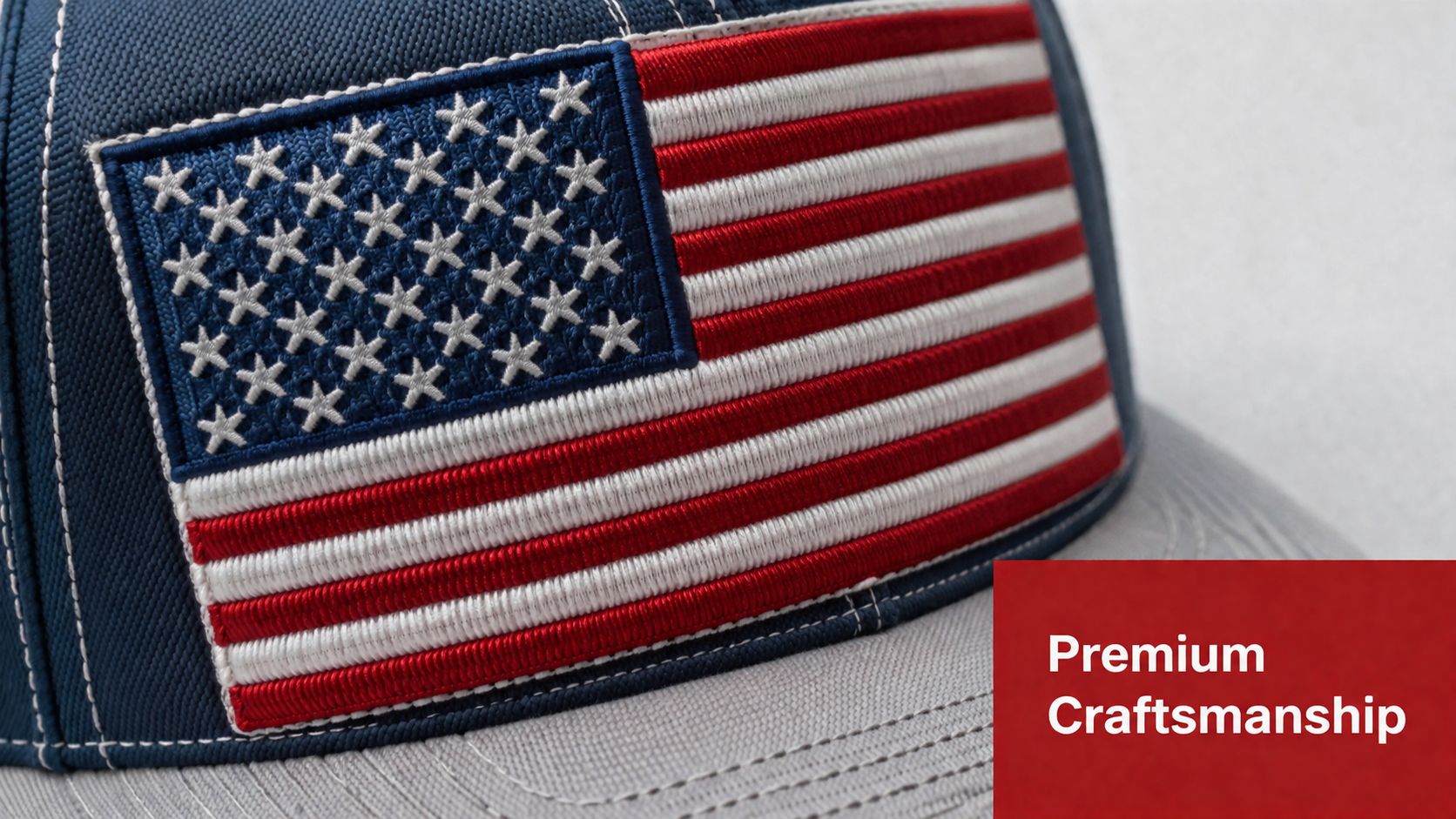
A key benchmark for USA-made patriotic headwear is the “cut-and-sewn from rolls of fabric” method by American workers, which helps maintain consistent fiber tension and avoids the dimensional instability common in assembled overseas blanks, according to The American Hat Co. product information.
Why cut-and-sewn matters
This is one of the clearest differences between a purpose-built domestic hat and a generic imported blank.
With cut-and-sewn production, the factory starts with fabric rolls and builds the cap through the full manufacturing sequence. That usually gives you tighter control over:
- Panel consistency
- Crown shape
- Seam alignment
- Closure placement
- Overall fit from batch to batch
Imported blanks can still be useful for budget projects, but they often vary more than buyers expect. One carton may feel fine. The next may have a softer front, a different curve, or uneven panel tension that affects embroidery.
What to inspect on a sample
When I review patriotic caps for sourcing, I don't start with the flag artwork. I start with the base hat.
Check these details first:
| Area | What good construction looks like | What causes problems |
|---|---|---|
| Front panels | Stable shape and smooth embroidery surface | Buckling or rippling under stitching |
| Sweatband | Even attachment and comfortable feel | Twisting, rough edges, or loose stitching |
| Closure | Secure, aligned, easy to adjust | Crooked placement or weak fastening |
| Seams | Clean and consistent | Skipped stitches or visible puckering |
A hat can have a sharp-looking flag patch and still be a poor product. If the crown collapses, the brim warps, or the fit varies too much, your decoration won't save it.
For a related lesson in material choice and performance, this breakdown of American Goose aluminum flags is worth reading. Different category, same sourcing principle. Material decisions shape durability more than slogans do.
Decoration only works if the base is stable
Here's a quick look at how quality embroidery behaves on a properly built cap:
The practical takeaway is simple. If the hat body is unstable, stitching exposes every weakness. You'll see tunneling, puckering, loose edges, or a distorted flag shape much sooner than you would on a better-made cap.
A patriotic design raises expectations. Buyers look closer at these hats than they do at a basic promo cap.
Customization Options for Your Flag Hats
Once you've found a base hat you trust, customization becomes the next major decision. Most businesses choose between direct embroidery and custom patches. Both can work well. The right choice depends on your artwork, your target price, and how you want the finished cap to feel.
Direct embroidery when you want permanence
Direct embroidery is the cleanest option when your design is simple enough to stitch well and you want a built-in look. On patriotic hats, this usually means flag motifs, text, military-style identifiers, or compact logos.
Premium USA-made hats often use 3D raised embroidery with a tactile depth of 0.5–0.8mm, and that construction has been validated to withstand over 500+ cycles of industrial washing without fraying, according to Medals of America's patriotic hat product details.
That matters if you want a logo with depth or a flag that stands off the crown.
Patches when the artwork needs flexibility
Patches make more sense when your design has fine borders, layered textures, or a style that benefits from contrast against the cap fabric.
Good use cases include:
- Embroidered patches for classic Americana styling
- Woven patches for finer detail in smaller spaces
- Leather-style patches when you want a rugged retail look
- Oversized shapes that wouldn't stitch cleanly as direct embroidery
Patches also help when you want to use the same emblem across several hat styles without reworking the stitching file every time.
How to choose between them
Here's the side-by-side view buyers usually need:
| Feature | Direct Embroidery | Custom Patches |
|---|---|---|
| Look | Built into the hat | Added as a separate design element |
| Best for | Clean logos, flags, text | Detailed emblems, layered styles, specialty looks |
| Surface feel | Smooth or raised, depending on stitch style | More dimensional edge and distinct texture |
| Flexibility across styles | Moderate | High |
| Common risk | Distortion on unstable crowns | Patch edge placement and attachment quality |
If you're shopping finished styles for inspiration, a collection of hats with flags can help you compare how different decoration approaches read on various cap profiles.
The ordering workflow that prevents mistakes
Most ordering problems don't start in production. They start in approval.
A clean workflow looks like this:
- Choose the hat style first.
- Match the decoration method to the artwork.
- Review a digital proof carefully.
- Confirm placement, size, thread colors, and closure style.
- Approve only when the proof reflects exactly what you want.
Don't approve a proof based on “close enough.” On hats, small placement changes are visible fast.
For small businesses, the smartest move is usually a manageable first run. Test the fit, stitching, and customer response before scaling into larger reorder volume. That approach protects cash flow and gives you real-world feedback on what buyers prefer.
The Price of Patriotism Understanding Real Cost and Value
Let's address the obvious issue. A genuine American-made patriotic hat usually costs more than a mass-imported alternative.
That price difference isn't mysterious. Domestic labor, domestic processing, smaller-scale production, and tighter origin standards all add cost. If the supplier is transparent about sourcing and manufacturing, that work has to be paid for somewhere. Cheap hats and fully domestic hats rarely occupy the same lane.
Why the higher price can still make sense
The mistake is treating this as a simple unit-cost debate. It's usually a positioning decision.
If your customer only wants the lowest-priced giveaway item, a verified U.S.-made hat may not be the right fit. But if you're building branded merchandise, premium event goods, patriotic retail, tourism product, or mission-driven apparel, the hat's origin can become part of the product value.
That value shows up in a few ways:
- Cleaner storytelling for retail and event marketing
- Stronger giftability because the hat feels intentional
- Lower friction in sales conversations when buyers ask where it was made
- Better alignment for organizations centered on patriotism, service, or domestic manufacturing
Veteran-owned supply can add another layer
One of the more interesting shifts in this space is the growing visibility of veteran-owned manufacturing. Recent data from the U.S. Department of Veterans Affairs, cited in Freedom Fatigues' discussion of patriotic hats, shows a 42% increase in veteran-owned apparel manufacturers in Q1 2026.
That doesn't automatically make every product better. But it can matter for brand fit.
If your audience includes veterans, first responders, military families, civic groups, or patriotic event buyers, a veteran-owned manufacturing relationship can strengthen the offer. It gives the product a story that goes beyond decoration and into ownership, labor, and business values.
What not to do on pricing
Don't try to win the sale by hiding the premium. Explain it plainly.
A buyer who wants a real American flag hat made in USA is usually not asking for the cheapest hat on the page. They're asking for authenticity they can trust. If you source well, that premium becomes easier to defend because the product has a reason for costing more.
Your Next Steps to Order American Flag Hats
At this point, the path should feel a lot clearer. The smart buying process isn't complicated, but it does require discipline. Most bad orders happen because one step gets skipped.
A clean buying sequence
Start with supplier screening. Ask where the hats are cut and sewn, where the fabric comes from, and whether the cap is a true domestic build or an imported blank with domestic decoration.
Then choose the style that fits your use case. A structured trucker feels different from a dad hat. A rope cap sends a different message than a low-profile twill cap. Before you think about artwork, decide what silhouette fits your customer or team.
Lock the decoration before production
After the base style is chosen, move into artwork review. Decide whether your logo or flag concept belongs in direct embroidery or patch form. Then check the digital proof carefully.
The safest approval process looks like this:
- Confirm placement on the front, side, or back
- Review colors against the hat fabric
- Check closure style so the final fit matches the audience
- Read every line item before giving approval
If you need a walkthrough of that process, this guide on how to order custom embroidered hats is a practical reference.
Keep the first run controlled
For a new program, start with a testable quantity and a clear goal. Maybe it's event merch. Maybe it's staff wear. Maybe it's a first retail drop tied to a holiday window.
That smaller first order tells you a lot. You'll learn whether the shape works, whether buyers prefer embroidery or patches, and whether the domestic sourcing story helps close the sale the way you expected. Once that feedback comes in, scaling the next order becomes much easier and much less risky.
Frequently Asked Questions
What are the rules for flag display on a hat
The U.S. Flag Code treats the flag as a national symbol that should be shown respectfully. On apparel, the common rule of thumb is that the flag should appear as if it is advancing. On the right side of a hat, that usually means the union, or blue field of stars, faces forward.
Can I get a sample before placing a large bulk order
Yes, and you should if the style is new to you. A sample helps you evaluate crown shape, stitching surface, closure feel, and overall construction before you commit to a larger quantity. For custom work, the proofing step matters just as much. Review the mockup carefully before production starts.
Is assembled in USA the same as made in USA
No. Those claims are not the same. “Assembled in USA” usually refers to final joining or finishing steps done domestically, while a full “Made in USA” claim carries a much higher bar for domestic components and processing.
Should I choose embroidery or a patch for a flag hat
Choose embroidery when the design is clean, compact, and meant to feel built into the cap. Choose a patch when your artwork needs more flexibility, edge definition, or a distinct retail look. The better option depends on the artwork and the hat structure, not just personal preference.
What's the biggest mistake buyers make
They rely on the product title instead of verifying the manufacturing details. In this category, vague patriotic language is common. Written proof beats branding copy every time.
If you're ready to source custom patriotic headwear without guessing, Dirt Cheap Headwear makes the process easier. You can shop wholesale blanks, request custom embroidery or patches, and place small test runs before scaling into larger orders. For businesses that need responsive communication, low minimums, and a straightforward path from proof to production, it's a solid place to start.