
Fast Embroidery Near Me: Your Guide to Quick Custom Hats
You're probably here because the deadline already got real.
Maybe the trade show is this week. Maybe your coach just remembered the tournament hats. Maybe your team approved the logo late, and now you're searching fast embroidery near me hoping someone can save the job without mangling the stitching.
That search makes sense. It's also where a lot of buyers make the wrong call.
The closest shop isn't always the fastest shop. And it definitely isn't always the shop that can turn hats around cleanly, communicate clearly, and keep pricing sane. In custom headwear, speed comes from workflow, machine capacity, proofing discipline, and inventory control. Geography helps sometimes. It doesn't solve production bottlenecks.
That matters more than ever because custom apparel isn't some tiny niche anymore. The global custom apparel market was valued at $57.55 billion in 2024 and is projected to reach between $100.8 billion and $145.94 billion by 2033, according to this custom apparel market analysis. More buyers are ordering branded gear, which means good embroidery shops are busy and weak ones get exposed fast.
If you need hats in a hurry, you don't need vague promises. You need to know what controls turnaround, what questions to ask, and when an online specialist will beat the local option.
That "Oh No I Need Custom Hats NOW" Moment
The panic usually starts the same way. Someone says, “We only need a few hats,” as if that makes it easier. Then the logo file is missing, the event date is locked, and every local shop suddenly has “a full production schedule.”
I've watched this happen with company outings, brewery merch drops, school events, and weekend tournaments. The buyer assumes they can drive to a local shop, point at a hat wall, and pick up finished caps a day later. Sometimes that works for a basic reorder. Most of the time, it doesn't.
Why the rush order gets messy fast
Hats are not the easiest item in the shop. They need the right cap frame, the right backing, the right machine settings, and a design that translates well to stitching on structured or unstructured headwear. A shirt printer that “also does embroidery” may be fine for polos. That doesn't mean they're the shop you want touching your trucker hats on a deadline.
A rush hat order usually stalls in one of these places:
- Artwork problems: Low-res logos, tiny details, bad file types, or last-minute edits.
- Blank inventory issues: The shop doesn't stock the style or color you need.
- Machine scheduling: They have embroidery capacity, but not enough open machine time.
- Approval delays: Nobody signs off on the proof until the next day.
Fast orders don't fail because embroidery is slow. They fail because buyers and vendors waste time before the machine even starts.
The better way to think about “near me”
Treat “near me” as one filter, not the deciding factor.
If a local shop has the blanks in stock, answers fast, sends proofs quickly, and has real hat embroidery experience, great. Use them. But if they're vague on turnaround, won't show sample quality, or seem annoyed by your deadline, stop romanticizing local pickup. A specialized provider with better systems can beat that shop even after shipping.
You're not buying proximity. You're buying reliable completion by your deadline.
What Fast Embroidery Really Means
“Fast” in embroidery has a hard production definition. It does not mean “we own a machine” or “we can probably squeeze it in.” It means the shop can move your order through approval, digitizing, setup, stitching, QC, and shipping without dead time or avoidable mistakes.
A clean workflow matters more than marketing copy.
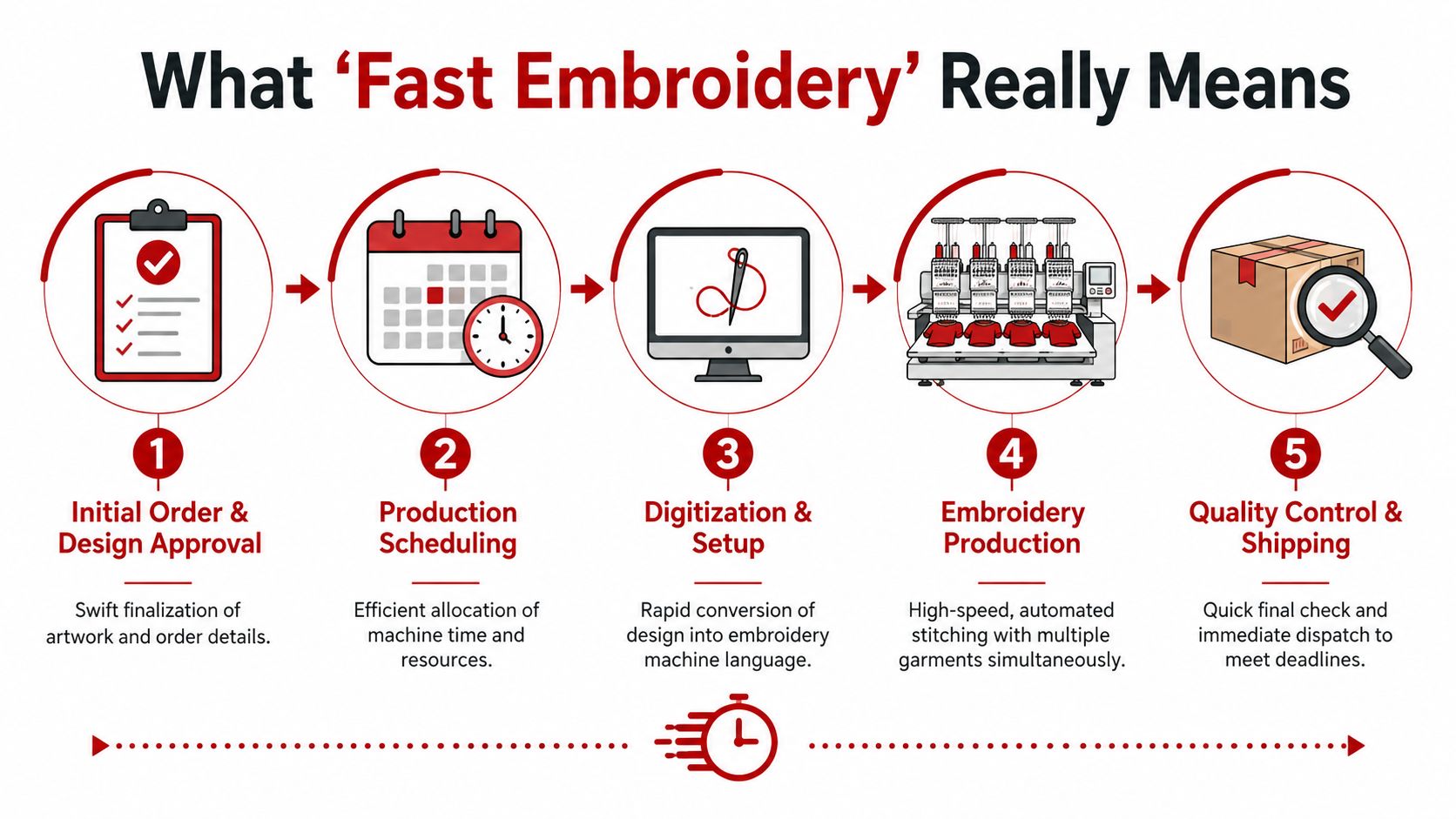
Machine speed is only part of the story
Yes, commercial embroidery machines can move fast. High-speed commercial embroidery machines can run at up to 1,500 stitches per minute, but hats usually look better at 600 to 700 stitches per minute because that lower speed reduces thread breaks and helps stitch quality stay consistent. A 5,000-stitch logo takes about 3.3 minutes at 1,500 spm and about 7.1 minutes at the quality-focused speed, based on Melco's embroidery-on-demand guidance.
That gap matters. It also explains why smart shops don't promise miracles.
If a vendor tells you they'll just “run it faster,” that's not reassuring. It's a warning sign. Hats have curves, seams, buckram, and tension changes. Running them flat-out is like trying to take every corner at full throttle. You might finish sooner. You also might end up with thread breaks, fuzzy fills, or a logo that looks sloppy from three feet away.
What actually speeds up the job
The shops that turn orders quickly usually do a few things well:
- They approve art fast. No chasing down vague email threads.
- They digitize for hats properly. Not every left-chest file works on a cap.
- They schedule production tightly. Good shops know which machines and operators should handle hats.
- They automate what should be automated. Color changes, trims, and production flow matter.
One useful benchmark comes from machine workflow. Production time follows a simple formula: number of stitches divided by machine speed equals stitching time, and advanced setups with automatic color change and thread trimming can increase capacity per operator by up to 40% in high-volume settings, according to this machine speed and workflow breakdown. That doesn't mean every order finishes instantly. It means the right equipment and process can remove labor bottlenecks.
What you should expect from a vendor
Don't ask, “Can you do this fast?” Ask these instead:
| Question | Why it matters |
|---|---|
| When does turnaround start? | It should start after proof approval, not after your first email. |
| Do you embroider hats in-house? | In-house control usually means fewer handoff delays. |
| Are my hat styles in stock now? | No stock means no rush job. |
| What happens if my logo needs simplification? | Good shops tell you early, not after production starts. |
If you want a good explanation of how production timing usually works on custom hats, this guide on hat embroidery turnaround time is worth reading.
Practical rule: Fast embroidery is mostly a scheduling and process problem. The stitching itself is only one part of the clock.
Your 5-Minute Vendor Vetting Checklist
When you call or email a shop, don't ask broad questions. Broad questions get broad answers. Ask pointed ones, and you'll know in a few minutes whether they're organized or just hopeful.
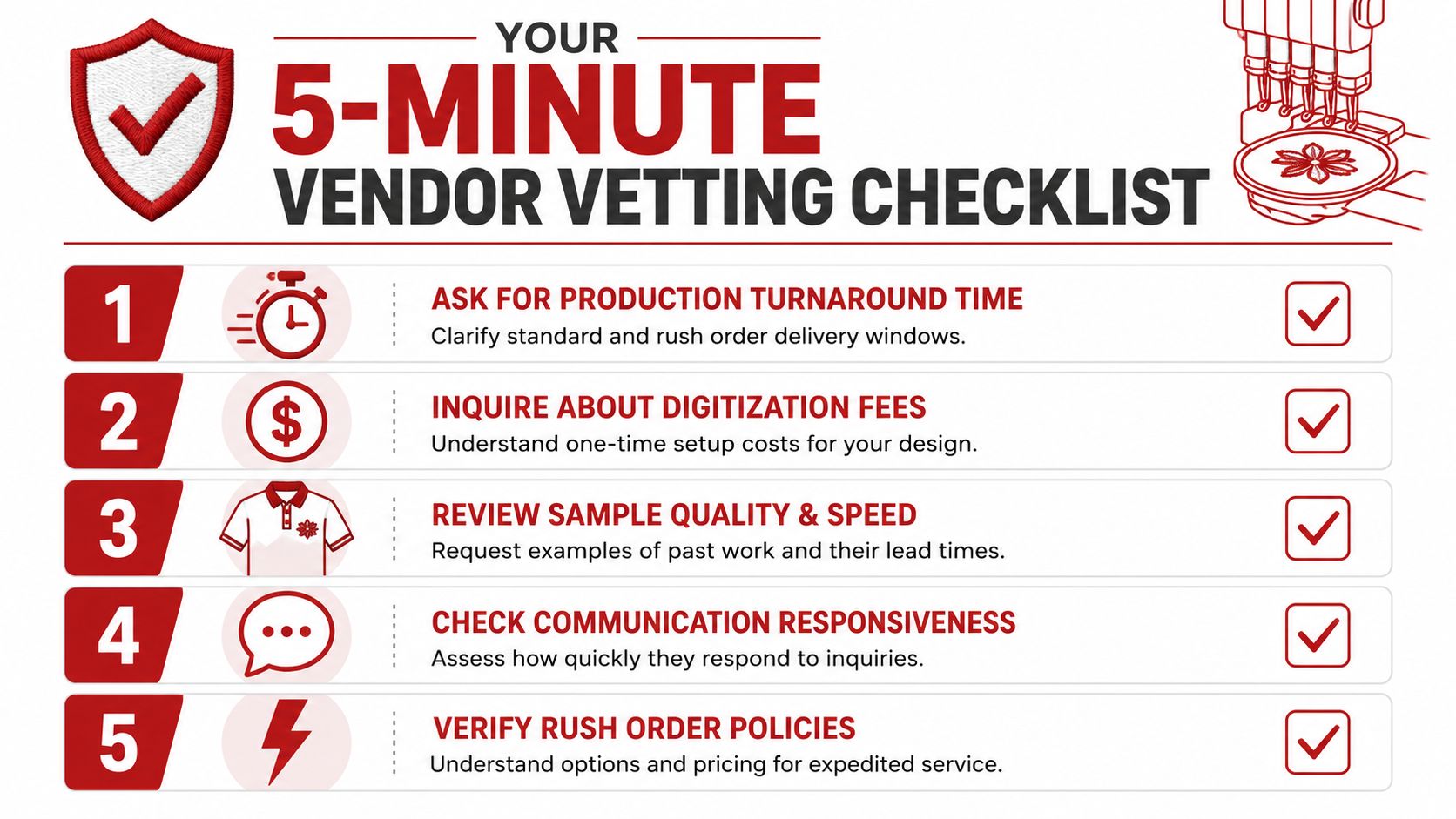
Ask these before you send any money
What's your production turnaround after proof approval?
If they can't define when the clock starts, expect confusion later.Do you have a rush option, and what changes when I use it?
A real rush process has rules. It might limit styles, thread choices, or decoration methods.Is there a digitizing fee?
Your logo has to be converted into an embroidery file. That setup work is normal. What matters is whether they explain it clearly.Can I see hat-specific samples?
Don't settle for polos or flat garments. Hats are their own category.What are your minimums?
Some shops want volume because small runs interrupt their schedule. Others are built for lower minimums.
Watch how they communicate
A vendor can have nice samples and still be a terrible choice if communication is sloppy.
Here's what I look for right away:
- Fast first response: If they take forever to answer a sales inquiry, they won't get sharper after you pay.
- Clear proof process: You should know who sends the proof, how you approve it, and what happens if you need revisions.
- Straight answers on limitations: A good shop will tell you if your tiny text, metallic thread, or side embroidery request creates risk on a rush order.
If a shop acts annoyed by basic production questions, move on. Good operators like informed buyers.
Don't skip style-specific questions
Many buyers encounter a common pitfall. They ask if the shop can embroider hats. They don't ask whether the shop can embroider their hats.
Ask about:
- Structured vs. unstructured caps
- Standard flat embroidery vs. 3D puff
- Front logo only or side/back locations
- Fine-detail logos on smaller panels
- Brand and style availability
If you're ordering headwear along with other team gear, this article on getting custom team hoodies right is a useful reminder that apparel orders go smoother when you lock in decoration method, garment type, and approval steps early.
A bad quote often sounds good at first
Cheap quotes can hide delays. Maybe the hats aren't in stock. Maybe the digitizing isn't included. Maybe the rush promise depends on “simple artwork” that nobody defined. Maybe they outsource the embroidery and never said so.
The best vendor conversations feel boring. That's a compliment. Boring means they have a process.
Local Shop vs Online Specialist Which Is Truly Faster
A local shop has one obvious advantage. You can walk in, talk face to face, and maybe pick up the order without waiting on a carrier. If your job is simple and they have open capacity, that convenience is real.
But convenience gets overrated when the shop isn't built for headwear volume.
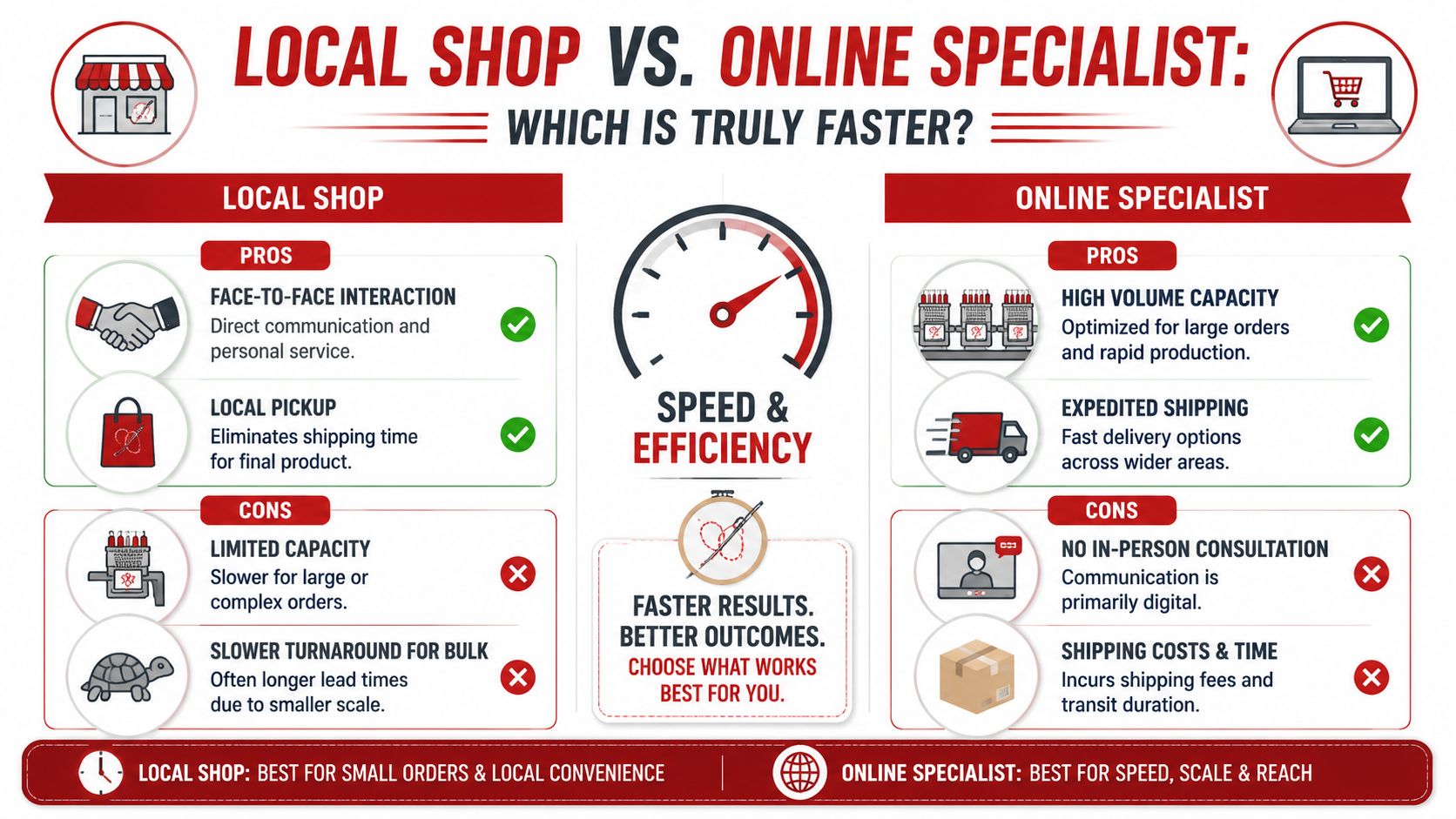
Where local shops usually win
Local can be the right choice if you need:
- In-person sample review
- A very small reorder of an existing design
- Same-area pickup
- A relationship with one person handling your account
That's especially useful for buyers who are still choosing thread colors, hat styles, or logo placement. Some people make decisions faster when they can hold the blank in their hand.
Where online specialists often beat them
A dedicated online headwear shop usually has stronger systems around the stuff that controls turnaround.
| Factor | Typical local shop | Online specialist |
|---|---|---|
| Hat inventory depth | Often limited | Usually broader |
| Hat-specific embroidery experience | Mixed | Usually stronger |
| Workflow for proofs and approvals | Sometimes manual | Often streamlined |
| Capacity for larger runs | Can bottleneck fast | Usually better built for volume |
| Pickup option | Yes | No |
| Shipping reach | Local | Broad |
The big question isn't “Can I drive there?” It's “Can they get my exact hats decorated and out the door faster than a specialist can produce and ship them?”
That's why I tell buyers to compare total time, not local time.
Add shipping to the equation the right way
People hear “online” and assume slow. That's lazy math.
If the local shop needs extra days to order blanks, fit your job into the queue, or fix production mistakes, shipping doesn't matter much. A specialist with hats in stock, tighter proofing, and a cleaner embroidery pipeline can still land the order faster. That's the whole point of checking process before location.
If you want a broader look at how local sourcing compares with specialist options, this resource on choosing a headwear shop near you lays out the tradeoffs pretty clearly.
Local pickup saves transit time. It does not fix bad scheduling, weak inventory, or mediocre hat embroidery.
My advice is simple. Start local if you already trust the shop. If you don't have a proven relationship, compare them against a specialist the same day. Get both answers. Then buy from the vendor who sounds like they've done this a hundred times before.
The Dirt Cheap Headwear Advantage Built for Speed
If you need a practical example of what to look for in a vendor, use Dirt Cheap Headwear as the checklist.
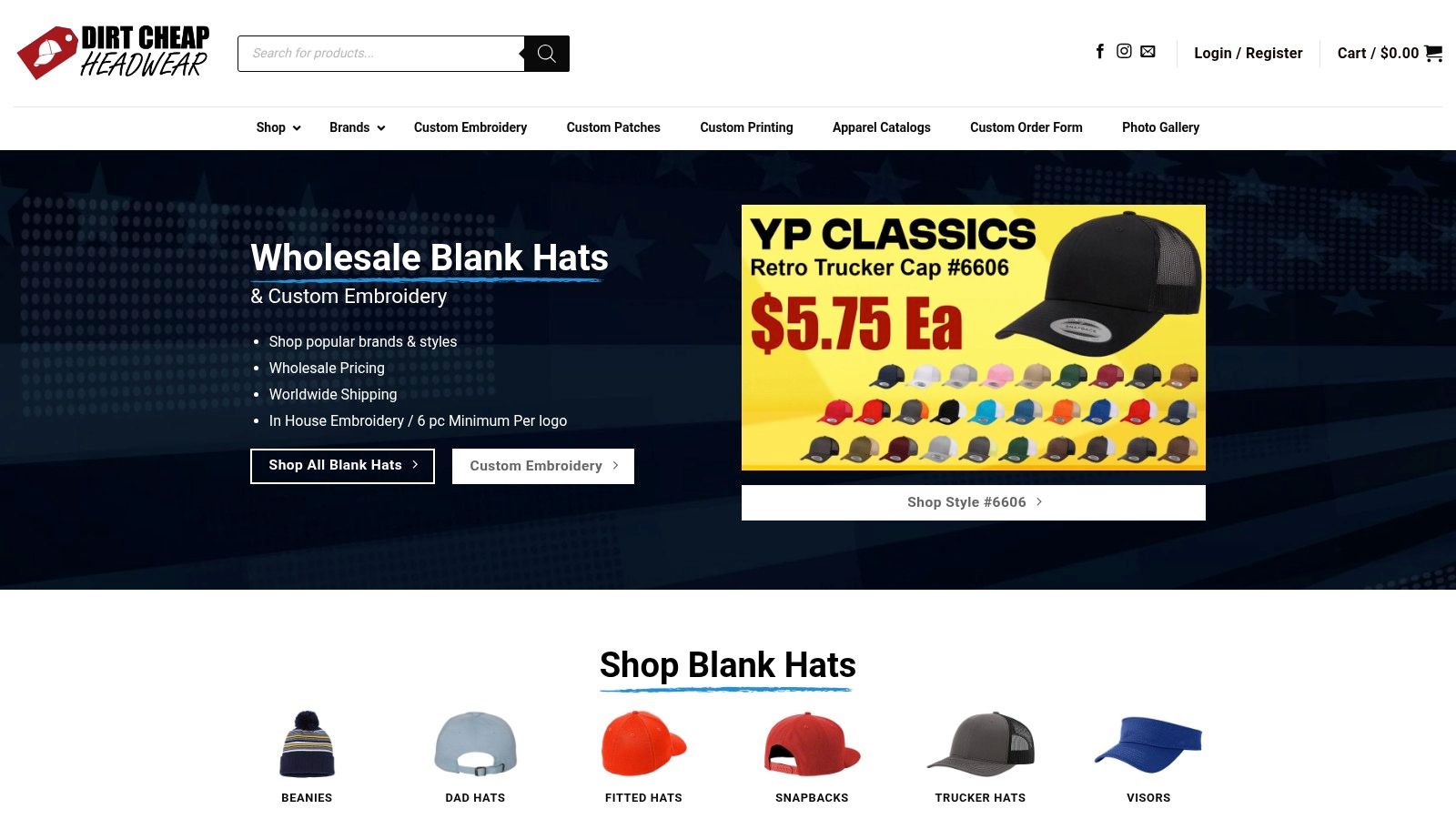
They're set up around headwear first, not hats as a side add-on. That matters. A shop that focuses on caps tends to have better style depth, cleaner embroidery expectations, and fewer surprises when you need trucker hats, dad hats, beanies, visors, or rope hats on a deadline.
What stands out operationally
A few things make a difference for buyers trying to move quickly:
- Low minimums: Orders can start at six pieces per logo, which is useful for startups, small teams, and test runs.
- In-house embroidery: That usually gives better control over timing and quality than handing jobs off elsewhere.
- Broad hat selection: Brands and styles are already part of the workflow, so you're not improvising product sourcing.
- Online proofing and ordering: Faster approvals mean less dead time between quote and production.
That's the kind of structure you want from any embroidery partner. Clear process. Relevant inventory. Real headwear focus.
Why this setup helps rush buyers
Rush buyers usually struggle with one of two problems. Either the order is too small for a large decorator to care about, or the order is large enough that a small local shop can't absorb it smoothly.
A headwear-focused provider can cover both ends better because the business is already built around decorated caps. You're not asking them to make room for an unusual product. You're asking them to do their normal work.
If you're comparing options right now, the page for wholesale custom hats with fast turnaround shows the kind of ordering model that tends to work well for urgent custom headwear projects.
The bigger lesson
Don't latch onto a brand name. Latch onto the operating model.
You want a vendor that can answer these without stumbling:
- What hat styles are available now?
- What's the minimum?
- How does proof approval work?
- Can they handle 3D puff and fine-detail embroidery?
- Is embroidery done in-house?
- Who owns communication if there's a stock or art issue?
If a provider can answer all that cleanly, they're worth your time. If they can't, keep looking.
Decoding Your Embroidery Quote What Am I Paying For
Embroidery quotes confuse people because they don't behave like print quotes.
With embroidery, the main cost drivers are usually the blank hat, the embroidery application, and the setup or digitizing work if the design is new. If a quote feels high, don't react to the total first. Ask what each part covers.
The three parts of most quotes
The blank cap
Brand, style, fabric, and construction all affect price. A basic dad hat and a premium Richardson trucker cap won't cost the same.The embroidery charge
This usually tracks with design complexity and stitch count, not with how many thread colors your logo uses. Small clean logos are easier than dense fills, tiny lettering, or layered effects.The setup fee
If your logo hasn't been digitized for embroidery yet, someone has to build that file. That's skilled prep work, not a fake fee.
What to question in a quote
Use this quick filter:
- Missing setup info: If there's no mention of digitizing, ask whether it's included.
- No proof process listed: That's a problem.
- Rush language without conditions: Ask what “rush” changes.
- No hat model named: Never approve a quote for “custom hats” without the exact blank.
A fair embroidery quote is detailed enough that you know what hat you're getting, what logo is being sewn, and what process gets you from proof to delivery.
If a vendor can't break the quote down in plain English, they're asking you to trust a process they haven't explained.
Frequently Asked Questions About Fast Embroidery
What logo file should I send?
Send the cleanest file you have. Vector art is usually the easiest starting point if available, but a sharp high-resolution logo file can also help. What you're trying to avoid is tiny screenshots, blurry web images, or files with effects that won't translate well into thread.
Can I bring my own hats?
Sometimes a shop will allow it. Many professional shops would rather not. That's not them being difficult.
Customer-supplied hats create problems with consistency, spoilage risk, and replacement liability. If a cap runs poorly, arrives damaged, or can't be replaced in time, the whole job gets messy. Shops prefer using blanks they source because they know the style, fit, panel structure, and stock path.
What's the difference between 3D puff and standard embroidery?
3D puff uses foam under the stitching to raise the design. It works well for bold shapes and larger lettering, especially on structured caps. It's not the right choice for tiny details.
Standard flat embroidery sits closer to the cap and handles finer detail better. If your logo has small text, thin outlines, or intricate shapes, flat embroidery is usually the safer pick.
If you're in a hurry, ask the shop which method fits your logo best on the exact hat style you want. That answer should come fast. If it doesn't, keep shopping.
If you need custom hats fast and want a cleaner process than the average “near me” search result, take a look at Dirt Cheap Headwear. You can review styles, request custom embroidery, and work from a setup built around headwear instead of generic apparel decoration.