
Cheap Winter Hats: A Buyer’s Guide for Branded Headwear
You're probably staring at a spreadsheet, a budget, and a deadline. You need winter hats for staff, a promo event, a school store, a merch drop, or a client program, and every search for cheap winter hats keeps dumping you into retail listings that don't answer the key questions. Can this hat take embroidery well? Will it keep people warm? Are you about to save money, or buy a pile of regret?
That's the gap most first-time bulk buyers run into.
A cheap winter hat can be a smart buy. It can also be the classic bad order: thin knit, tiny cuff, sloppy logo placement, weird fit, and boxes full of product nobody wants to wear twice. The difference usually isn't the word “cheap.” It's whether the buyer understands style, material, decoration, and ordering mechanics before approving the run.
Your Complete Wholesale Guide to Winter Hats
Most new buyers come in with the same rough target. They need a solid-looking branded beanie order without drifting into premium pricing. Usually the order has to do three jobs at once: keep people warm, carry a logo cleanly, and hit a budget that still leaves room for the rest of the campaign.
That's why retail shopping instincts get in the way. Retail teaches you to compare one hat at a time. Wholesale buying is different. You're not just picking a hat. You're choosing a platform for decoration, a unit cost structure, and an item that has to hold up across a whole batch.
The category is big for a reason. The global winter hats market was valued at USD 25.7 billion in 2021 and is projected to reach USD 36.4 billion by 2030, according to Grand View Research's winter hats market report. That matters because it tells you this isn't some niche seasonal afterthought. Businesses, teams, retailers, and organizers keep buying winter headwear at scale.
Practical rule: In bulk buying, “cheap” should mean controlled cost, not stripped-down function.
A good first order starts with a few blunt questions:
- Who is wearing it: Staff in cold weather need something different from a coffee shop merch customer.
- How visible is the logo: Tiny left-chest style artwork often fails on hats. Bold marks usually win.
- What matters more, feel or price: Some buyers need the lowest practical cost. Others need a hat that feels gift-worthy in hand.
- Will you reorder later: If this might become a standing item, keep the style simple enough to source again.
If you also sell online, the buying side and the selling side connect more than people expect. Once you standardize styles, colors, and decoration options, it gets much easier to manage SKUs and merchandising. That's the same reason smart brands spend time optimizing product catalogs for SEO instead of treating product data like an afterthought.
For buyers comparing real wholesale options, it helps to start with a focused category page like wholesale winter hats so you're looking at bulk-friendly styles instead of random one-off consumer listings.
Decoding Winter Hat Styles for Your Brand
The first mistake I see is choosing style last. Buyers get excited about thread color and logo size, then realize too late that the hat shape doesn't fit the brand or leaves almost no good decoration space.
The beanie works so well for branding because it started as utility gear, not precious fashion. Haak Wear traces the beanie's lineage back to the Monmouth cap of the 15th to 18th centuries, notes use in Scottish fishing communities as early as the 17th century, and says the U.S. Navy standardized the watch cap in the early 1900s, which helped normalize the style as practical workwear in mass use, as outlined in Haak Wear's history of the beanie.
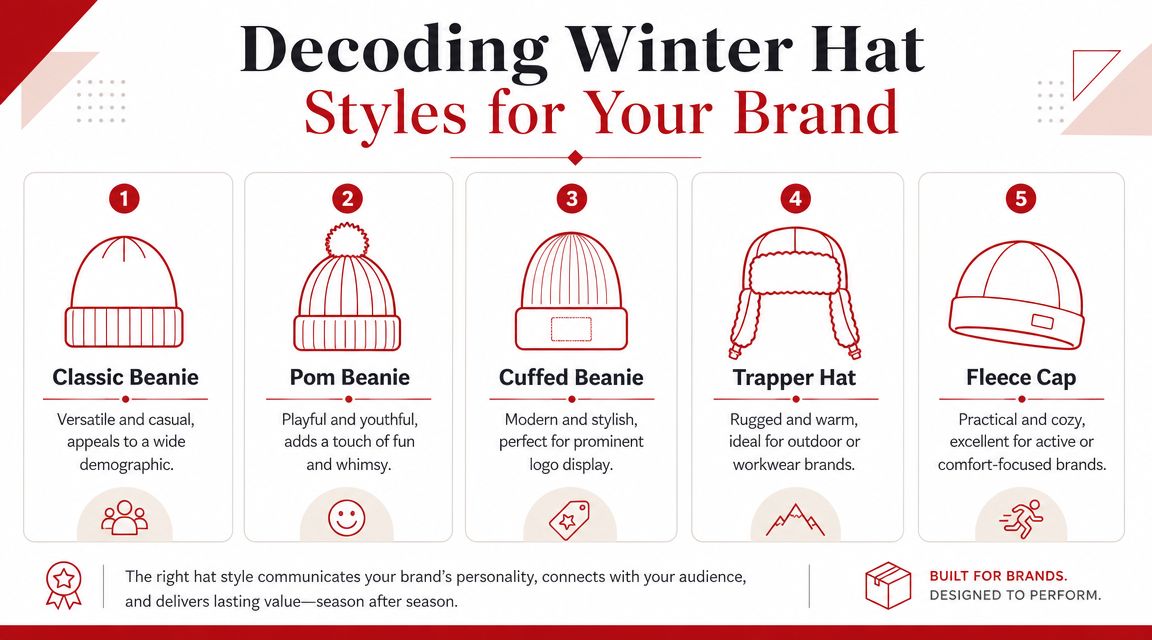
The styles that usually make sense
Cuffed beanie is the safest wholesale pick. The cuff gives you a clean front panel for embroidery or a patch, and it visually frames the logo. For staff gear, events, schools, and straightforward merch, this is usually the no-drama choice.
Slouchy beanie reads more lifestyle-driven. It can work for coffee brands, skate shops, artists, and casual apparel labels, but it's less predictable for uniform programs. Logos can look good on slouchy fits, though the extra fabric changes how the decoration sits when worn.
Cuffless skull cap has a cleaner, lower-profile look. It works when the brand wants less visual bulk. The trade-off is obvious once you've handled enough samples: less cuff area means less forgiving logo placement.
Pom-pom beanie is more personality-forward. It fits youth programs, winter events, team spirit items, and brands that don't mind looking a little less restrained. It can be excellent for retail sell-through if the audience wants fun instead of minimalism.
Knit texture changes your logo
A tight rib knit is easier to decorate than a chunky, heavily textured knit. Fine embroidery behaves better on smoother surfaces. Chunkier knits look cozy in photos, but they can fight small details and make logos distort slightly when the hat stretches.
If the logo has thin lines, tiny text, or lots of internal detail, the hat style matters almost as much as the digitizing.
Before you lock in a silhouette, it can help to visualize hats before buying so you can sense how different profiles read on a person rather than as flat product shots.
Fast style matching
- Corporate staff use: Cuffed beanie
- Outdoor crews or workwear tie-ins: Cuffed beanie or rugged utility style
- Streetwear or creator merch: Slouchy beanie
- Minimal logo programs: Skull cap
- School, team, or winter event energy: Pom-pom beanie
The style should make the logo easier to wear, not harder to sell.
Materials Matter Warmth Cost and Feel
Material choice is where a lot of budget gets won or wasted. Consider it like choosing an engine for a work truck. You don't buy based on romance. You buy based on what you need it to do every day.
Most cheap winter hats in bulk sit somewhere in the synthetic family, and that's not a flaw by itself. Synthetics dominate for practical reasons. They keep cost under control, take color well, dry quickly, and are easier to source consistently for repeat orders.
What actually helps warmth
If you want the most useful warmth upgrade without wandering into expensive territory, lined construction matters more than fancy marketing language. Stio notes that for affordable hats, a double-layer synthetic knit or a fleece lining is usually the most cost-effective warmth upgrade, and that fleece is a polyester fabric designed to mimic wool, is lightweight and breathable, and retains warmth even when wet in its guide to fleece-lined winter hats.
That last part matters in practice. Cold isn't always dry. A hat that still performs in damp weather is worth more than one that only feels good in a product photo.
The practical material trade-offs
Here's the simple version.
| Material | Relative Cost | Warmth Level | Best Use Case |
|---|---|---|---|
| Acrylic knit | Low | Moderate | Budget bulk orders, promo giveaways, standard embroidered beanies |
| Polyester fleece lining | Low to moderate | High | Cold-weather staff use, outdoor events, added warmth without a major price jump |
| Cotton knit | Moderate | Lower in cold conditions | Mild-weather lifestyle use, softer hand feel, less ideal for hard winter use |
| Blends | Moderate | Varies by blend | Buyers trying to balance feel, appearance, and cost |
What works and what doesn't
Acrylic works when you need a broad color range, predictable pricing, and a hat that can take embroidery without getting too precious. It's the workhorse of promotional headwear.
Fleece-lined synthetic hats work better when recipients will rely on the hat outside. If your team is loading trucks, running outdoor check-in, working a jobsite, or standing through a winter event, lining is where I'd put the extra spend.
Cotton can disappoint in deep-winter expectations. It may feel familiar in hand, but for a true winter use case, it's often not where the value is.
A cheap hat feels expensive when the fit is secure, the ears are covered, and the wearer stays warm. It feels cheap when it looks fine on a table and fails outside.
What to ask before you buy
Use these questions with any supplier:
- Is it single-layer or double-layer
- Is there fleece lining or just standard knit
- Does it fully cover the ears on most adults
- Is the knit tight enough for clean embroidery
- Will this exact style be easy to reorder later
A lot of buyers over-focus on thickness. That's not the best shortcut. Coverage, lining, and fit usually tell you more than a vague “heavyweight” description ever will.
Customization From a Simple Logo to a Statement Piece
Blank stock is only half the decision. Decoration is where a winter hat either becomes useful brand gear or turns into dead inventory.
Start with the logo itself, not the decoration method. If the logo is clean, bold, and built around readable shapes, you've got options. If it has thin outlines, small text, gradients, or too many little islands of detail, your options narrow fast.
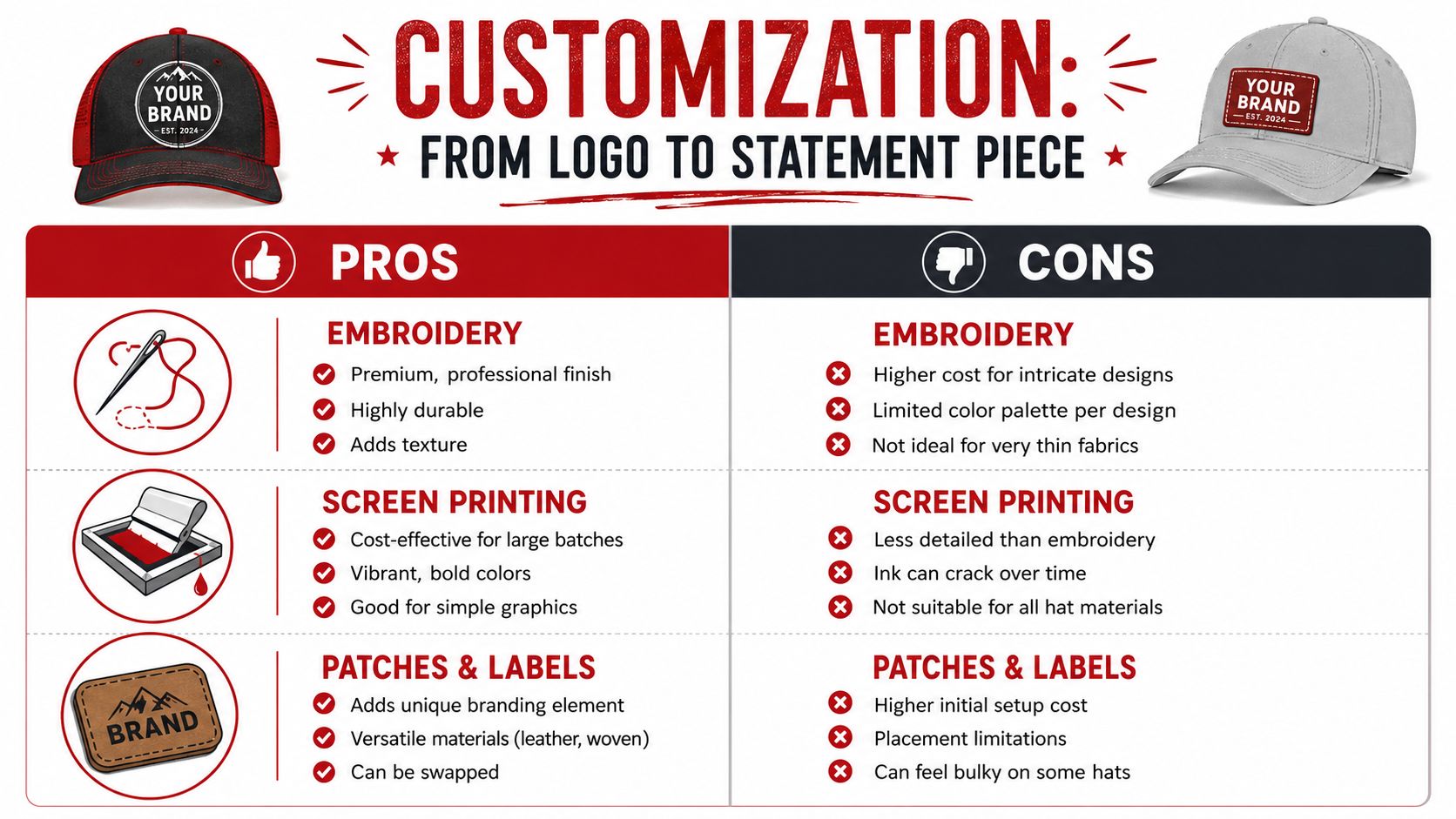
Embroidery when you want the safe bet
For winter hats, flat embroidery is usually the default. It's durable, familiar, and looks right on knit. If your logo has moderate detail and you want a straightforward branded result, flat embroidery is where most buyers should start.
3D puff embroidery is a stronger visual statement, but only for the right artwork. Big block letters, simple icons, and thick shapes can look great with puff. Thin scripts, small text, and intricate linework usually don't.
Patches when you want more personality
Patches solve a lot of branding problems. If the knit is textured, the logo is better framed inside a badge shape, or you want a slightly more retail-style look, patches can outperform direct embroidery.
Common choices include:
- Embroidered patches for a classic stitched look
- Woven patches for finer detail and cleaner small elements
- Leather-look patches when the brand wants a rugged or premium vibe
The trade-off is feel and bulk. On some softer beanies, a big patch can make the front panel stiffer than expected.
A quick visual walkthrough helps if this is your first decorated run:
The decisions that affect price fast
A few things move cost more than buyers expect.
Logo complexity
More detail usually means more stitching or a more specialized patch approach.Placement
Front cuff decoration is the cleanest and most standard. Odd placements can create more setup friction.Minimums
Some shops are flexible, some aren't. If you need low-quantity testing, ask before you build your whole plan around one style.Proof approval
Never skip it. A proof is where you catch scale, thread color, simplification, and placement issues before they become expensive.
If you're ordering decorated product and want a practical primer on process, buying custom embroidered hats in bulk covers the basic workflow well.
A simple way to choose
- Pick flat embroidery for most logos
- Pick 3D puff only for bold, simple marks
- Pick patches when you want a badge-style look or need better separation from the knit texture
The best customization is the one that makes the logo readable at arm's length and still looks good after real wear.
The Smart Buyer's Guide to Bulk Ordering
Bulk ordering is part pricing exercise, part project management. Buyers who treat it like a quick cart checkout usually create their own problems. Buyers who slow down at the right moments usually save money without lowering the standard.
Many affordable winter hats are light by design. Outdoor Life lists examples around 1.98 to 2.2 ounces, while budget options can still use simple double-layered synthetic construction, which matters because warmth comes more from air-trapping design, coverage, and insulation continuity than from raw bulk, as shown in Outdoor Life's winter hat roundup.
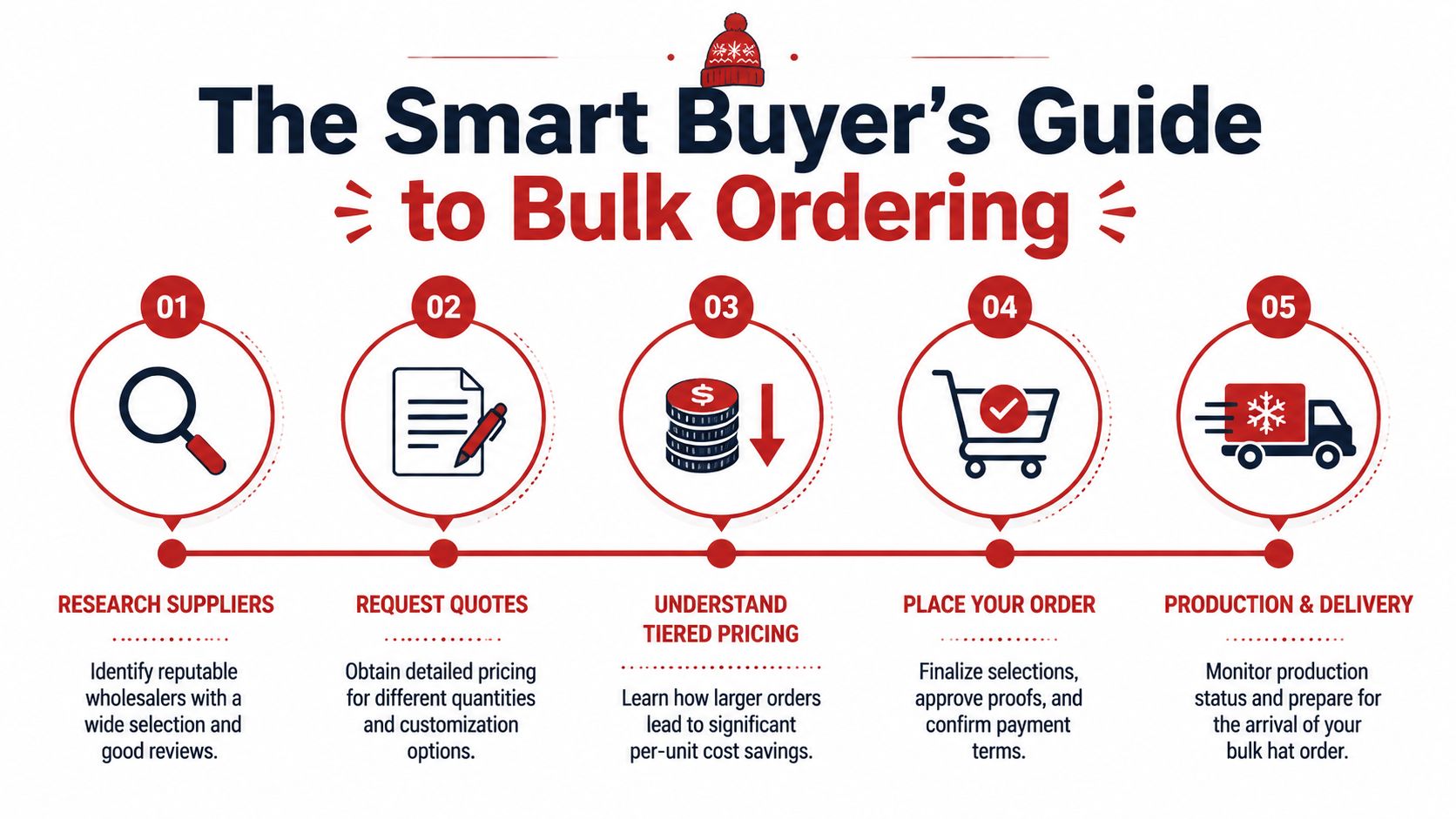
What smart buyers do before they place the order
They decide what problem the hat is solving.
If it's a giveaway, they optimize for acceptable quality at scale. If it's staff uniform gear, they protect warmth and consistency first. If it's resale merch, they focus on perceived value. Those are three different buying strategies, even if the hats look similar online.
They also ask for pricing at more than one quantity break. Wholesale often rewards slightly larger orders with a better per-unit outcome, and sometimes the jump to a higher quantity makes sense if the item will be used again later.
The proof is not a formality
New buyers lose money in this situation.
A digital proof helps confirm placement, logo size, thread color, and whether the artwork needs simplification. A physical sample can be even better when the logo is detailed, the knit is unusual, or the order is high stakes.
Approve the proof like you're trying to find a mistake, not like you're trying to get the order moving.
Check these points carefully:
- Logo scale: Too small is the most common failure
- Thread contrast: Good on screen doesn't always mean readable on knit
- Placement height: Especially important on cuffs
- Hat color accuracy: Black, charcoal, navy, and heather shades get mixed up all the time
Build in time for boring realities
Production doesn't just mean decoration. It means stock confirmation, artwork prep, proofing, stitching, boxing, and transit. If the order has to land before peak cold weather or before an event, pad the schedule.
Shipping is part of your budget too. For larger or repeated orders, it's worth reviewing practical methods for optimizing shipping expenses, especially if you're splitting deliveries or shipping to multiple locations.
If you're still comparing blank inventory strategies before adding decoration, wholesale blank hats in bulk buy smarter is useful because it frames the buy from the inventory side first.
Where perceived value comes from
The hat that feels better in hand often wins the whole project. Not because it's fancy, but because the recipient notices immediate, simple things:
- a deeper fit
- a softer lining
- cleaner embroidery
- better cuff structure
- a color that fits the brand
That's why the lowest unit price isn't always the cheapest decision. If the hat gets worn all season, it keeps doing its job. If it stays in a drawer, the discount never mattered.
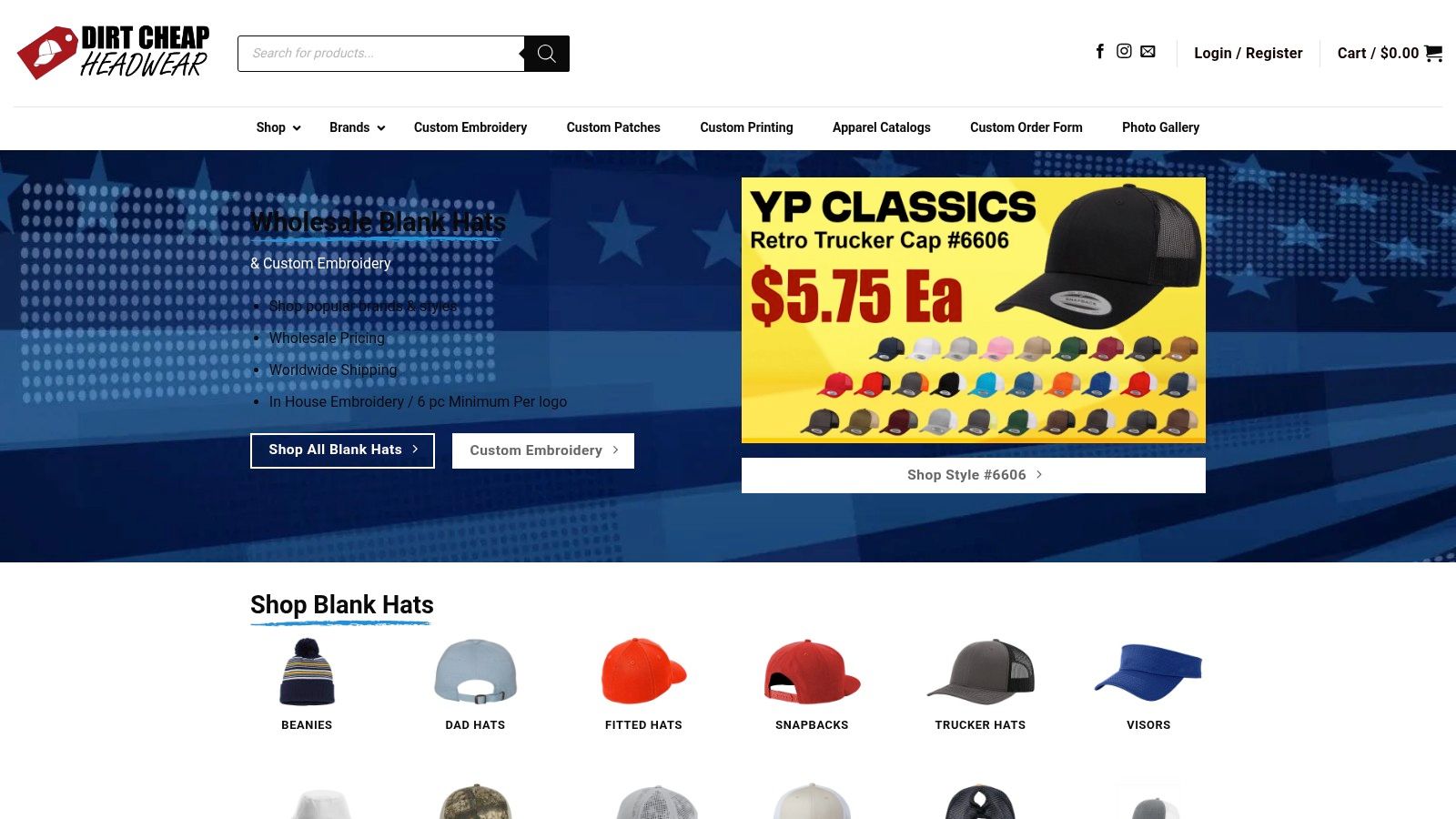
One practical option in this space is Dirt Cheap Headwear, which offers wholesale blank hats and in-house embroidery with low minimums for decorated orders. That kind of setup can be useful if you want blanks and customization handled through the same shop.
Protecting Your Investment Hat Care and Quality Checks
A winter hat order isn't finished when the boxes arrive. It's finished when the end user keeps wearing the hat and your logo still looks right.
That's why care instructions and incoming quality checks matter. Most buyers skip both. Then they find out later that a few hats had crooked embroidery, loose threads, or care issues that could've been prevented with a simple handoff note.
The care instructions to pass along
Keep this part basic. People won't read a long care card.
Tell them to wash cold, use a gentle cycle if needed, and lay flat to dry. That protects knit shape, helps decorated areas last longer, and reduces the odds of a beanie coming back stretched, twisted, or shrunken. If the hat has a patch or heavier embroidery, hand washing is the safer recommendation.
Your incoming QC checklist
Open cartons and inspect immediately. Don't leave boxes sealed until the day before distribution.
Use a short checklist:
- Decoration placement: Front logos should sit in the same position across the batch
- Thread quality: Look for loose threads, missed areas, or sloppy edges
- Color accuracy: Hat body and thread colors should match the approved proof
- Fit consistency: Spot-check a handful of hats for obvious size or shape variation
- Construction: Seams, cuff shape, and lining attachment should look uniform
The fastest way to lose trust in branded merch is handing out hats that look like they came from two different orders.
Why this step matters more than buyers think
A winter hat is a visible item. People wear it on the street, at events, in staff photos, and during repeated daily use. Small defects don't stay small when your logo is on the front.
Catching issues early gives you options. You can separate problem units, contact the supplier while the order is fresh, and avoid distributing inconsistent product. That's not nitpicking. It's protecting the money already spent on the hats, the decoration, and the brand impression tied to them.
The buyers who get the most out of cheap winter hats aren't just good at buying. They're good at finishing the job.
Your Next Great Winter Hat Order Starts Here
By this point, the category should look a lot simpler.
Cheap winter hats aren't hard to buy because there are too few choices. They're hard to buy because there are too many bad shortcuts. The smart move is to line up the hat style with the audience, choose materials based on actual use, decorate with the logo's limits in mind, and manage the order like a real production job instead of a quick impulse buy.
That's how a budget order starts looking intentional.
A cuffed acrylic beanie with clean embroidery can be exactly right. A fleece-lined style can be the better call when warmth matters more. A patch can beat direct stitching when the artwork needs a better frame. None of those are universal answers. They're good answers when they match the job.
The good news is that once you've made one solid order, the next one gets easier. You know what fit worked, what decoration looked right, what recipients wore, and where the budget created real value. That turns cheap winter hats from a guessing game into a repeatable part of your brand program.
If you're ready to turn this into an actual order, Dirt Cheap Headwear is a practical place to start. You can source blank winter hats, compare bulk-friendly styles, and submit a custom embroidery project without overcomplicating the process.