
Design Your Own Baseball Caps: A Pro’s Guide
You’re probably in one of three spots right now.
You need hats for a staff team that has to look consistent without blowing the budget. You’re a coach trying to get a season’s worth of caps that won’t fall apart by midyear. Or you’re building merch for a brand, event, or fundraiser and trying to figure out how to design your own baseball caps without getting buried in bad proofs, confusing minimums, and disappointing quality.
That’s where most first orders go sideways. Not because the logo is bad, but because the buyer doesn’t get enough real production guidance before approving the job. Cap style, fabric, front panel shape, decoration method, and order size all affect the final result. A great design on the wrong hat still turns into a weak product.
Custom caps can absolutely be a smart business buy. A 2023 PPAI summary on custom sports caps reports that customizable hat programs deliver 227% higher ROI than standard promotional items, and 81% of recipients keep and use them for over a year. That only helps you, though, if the hat is wearable, the logo reads clearly, and the order process is handled right.
If you’re still sorting your broader product or merch workflow, a tool like the lunabloomai Starter App can help organize early brand and launch decisions before you lock in apparel details.
Your First Step to Amazing Custom Caps
The first good decision isn’t color. It’s purpose.
A coffee shop ordering staff hats has different needs than a travel baseball program. Staff hats need a clean logo, easy reordering, and a style that fits a lot of head shapes. Team hats need durability, consistent embroidery, and enough structure up front so the logo doesn’t cave in after wear. Brand merch needs shelf appeal first, then margin, then repeatability.

Start with the use case
Before you pick a hat, answer these four questions:
- Who will wear it: Staff, customers, athletes, donors, or retail buyers all expect different fits and looks.
- How hard will it be used: Daily wear, game-day use, and one-time event giveaways should not be built the same way.
- What matters most: Brand image, budget control, durability, or speed.
- Will you reorder: If yes, choose something you can source again without reinventing the whole job.
That sounds basic, but it saves people from the most common first-order mistake. They shop like consumers and buy like decorators later. The smart move is the reverse. Buy for production first, then for looks.
What a practical first order looks like
For a small business, the best first run is usually a limited group of proven styles with one strong front logo. Not three logo placements. Not six thread colors because the brand guide allows it. One clean execution beats a crowded cap every time.
Practical rule: If the hat has to work for a group, choose the style that wears best across the most people, not the one that looks coolest on one person.
For teams and resellers, the first order should also answer one bigger question. Is this a short test, or the beginning of a repeat program? That changes everything from fabric choice to decoration method to how strict you need to be with proofs.
Choosing the Right Hat Style and Material
A buyer approves a cap on screen, then the cartons land and half the team says it sits too high, feels too hot, or looks cheaper than expected. That problem usually starts with the blank, not the logo.
Hat style and material decide three business outcomes fast. Unit cost. Wear rate. Reorder consistency. If the cap is for staff, a school program, a fundraiser, or retail resale, those factors matter more than chasing the trendiest silhouette in the catalog.
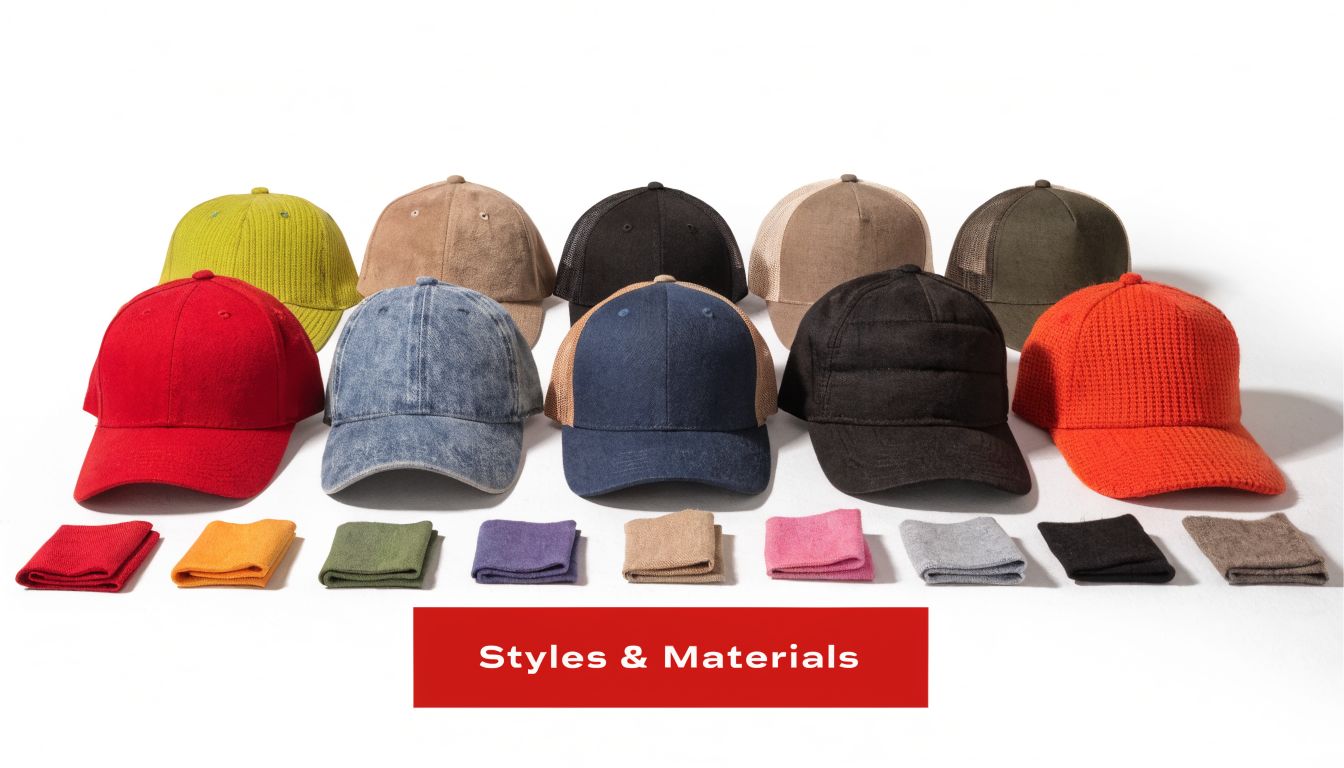
If you are comparing options across vendors, a broad assortment of wholesale blank baseball caps helps you sort profiles, closures, fabrics, and price tiers before you start decorating.
Start with the cap profile, not the color
Structured caps are the safer bulk-order choice for company programs, team gear, and any front logo that needs to read cleanly from a distance. The crown keeps its shape, the front panel gives embroidery better support, and sizing looks more consistent across a group.
Unstructured caps feel softer and usually cost less in perceived risk for lifestyle brands because buyers expect a relaxed fit. They can be a smart choice for coffee shops, breweries, and casual merch lines. The trade-off is front graphics have less backing, so small details and tall logos lose some presence.
Profile matters too. A high-profile trucker can look great at retail and get ignored in a corporate handout. A mid-profile 6-panel usually gets better adoption across mixed age groups because it fits more people without looking too fashion-specific.
5-panel or 6-panel changes production options
A 6-panel cap is still the default for bulk custom work because it is familiar, easy to reorder, and available at more price points. The center seam is the main limitation. If your logo has fine symmetry, narrow text stacked in the middle, or a clean circle badge, that seam can force adjustments.
A 5-panel gives you a broader front canvas with no center seam running through the art. That makes patches, wide graphics, and simple retail-style branding easier to place. It can also raise your blank cost and limit replacement options later, depending on the vendor and color.
For repeat programs, I usually advise buyers to ask a simple question first. Will this exact cap need to be reordered six months from now? If yes, pick a style with stable availability before getting attached to a niche silhouette.
Fabric affects cost, comfort, and defect rates
Material choice is where a lot of first orders go sideways. Buyers often focus on appearance, but fabric changes how the hat wears, how it decorates, and how many complaints show up after delivery.
- Cotton twill is dependable and easy to decorate. It works well for school stores, nonprofits, local businesses, and general staff use.
- Polyester and performance blends handle sweat, heat, and outdoor use better. They are a stronger fit for sports, golf events, summer crews, and active brands.
- Mesh-back truckers move well in merch programs because they feel casual and breathable, but not every workplace or donor audience wants that look.
- Nylon and other slick synthetics can look sharp for modern retail drops, though they show puckering and poor digitizing faster if the design is not set up carefully.
The image file matters here too, especially if you are using printed patches, transfers, or mockups to sell preorders. A clean source file saves time, and this guide to upscaling images for print with 300 DPI is a useful reference if your starting artwork is too small for production review.
Match the hat to the order type
For uniforms and staff use, stay conservative. Structured 6-panel caps in cotton twill or performance blends are easier to approve, easier to reorder, and less likely to create fit complaints.
For team orders, prioritize durability and sweat management over fashion. Players and coaches will notice comfort long before they compliment the logo.
For resale, the margin math changes the decision. A slightly higher blank cost can make sense if the style has better perceived value and stronger sell-through. A cheap cap that sits on the shelf is expensive inventory.
For giveaways, keep the fit broad and the decoration simple. The goal is actual wear, not just low unit cost on the invoice.
A quick visual walkthrough helps if you’re deciding between profiles and crown shapes:
One practical rule holds up on almost every bulk job. Buy the cap people will wear again, not the one that only looks good in the proof.
Getting Your Artwork Ready for Production
Most custom cap problems start in the artwork, not on the machine.
Buyers usually think the decorator will “clean it up” later. Sometimes that happens. Sometimes it doesn’t. And sometimes the art can be cleaned up, but only by simplifying it enough that it no longer looks like what you approved in your head.
Artwork for caps has to be built for the decoration method. Embroidery and print don’t read the same file the same way, and they don’t tolerate the same kinds of detail.
Embroidery needs clean, simplified art
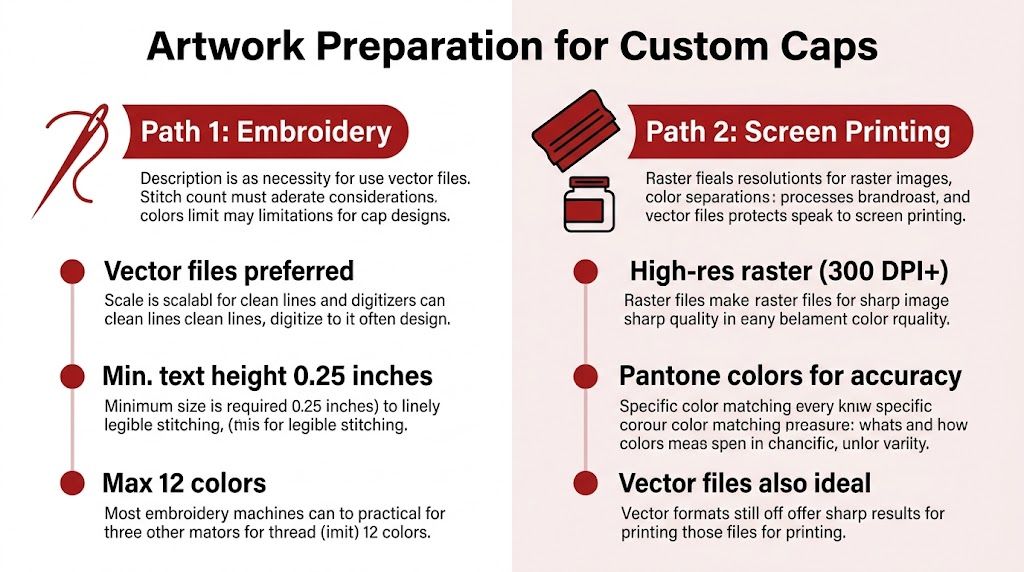
Embroidery turns your logo into stitches, underlay, density, and machine pathing. That means tiny details, thin outlines, and cramped lettering can break down fast on curved cap panels.
The embroidery methodology reference from MaggieFrame gives a useful production benchmark: professional cap embroidery relies on a 6-step process, including proper hooping, the right stabilizer, and slowing machine speed to 600 to 800 SPM for intricate designs. That process can improve success rates from 70% to 92%, and the same source notes durability for 50+ washes when the job is executed correctly.
It also gives one of the most useful hard rules for buyers. Minimum text height should be ¼ inch if you want legibility after wear and washing.
That means embroidery works best when your logo has:
- Bold shapes: Thick enough to stitch cleanly
- Open spacing: So letters and elements don’t fill in
- Limited complexity: Fine gradients and micro-detail don’t translate well
- A strong silhouette: The cap is seen from a distance, not under a microscope
If your logo is already vector artwork, you’re in good shape. AI and EPS files are ideal because they scale cleanly and give the digitizer clear shape data. If you only have a small raster file, expect more back-and-forth.
For anyone new to the technical side, this walkthrough on how to digitize a logo for embroidery is useful because it explains why a logo that looks good on screen may still need edits before it can stitch cleanly.
Printing gives you more detail, but different trade-offs
Print methods on caps can preserve finer artwork, softer transitions, and more graphic-heavy designs that embroidery can’t handle well. But print depends heavily on file quality. If the image starts soft, pixelated, or compressed, production won’t rescue it.
For print files, high-resolution artwork is the safe path. If you’re fixing customer-supplied graphics before production, this guide to upscaling images for print with 300 DPI is a useful reference for understanding what print-ready means.
Printing is usually a better fit when the design includes illustration, texture, or image detail that embroidery would simplify too aggressively. The trade-off is feel and perceived value. A stitched logo usually reads as more premium on a cap.
Embroidery vs printing
The better method depends on what the cap is supposed to do.
| Feature | Embroidery | Printing (Screen Print / Heat Transfer) |
|---|---|---|
| Best for | Logos, initials, short text, badge-style artwork | Detailed graphics, illustrations, image-heavy art |
| Durability | Strong choice for repeat wear when digitized and stitched correctly | Varies by method and use case |
| Detail handling | Limited by stitch size, spacing, and cap curve | Better for fine visual detail |
| Perceived value | Usually feels more premium on headwear | Often more cost-conscious for graphic designs |
| Surface behavior | Works best on suitable crown shapes and stable panels | Can suit art that embroidery would simplify too much |
| Artwork needs | Vector art strongly preferred, simplified shapes, text at least ¼ inch | High-resolution files, clean edges, color-managed art |
| Best buyer fit | Teams, staff programs, resale merch, long-term branding | Event graphics, one-off visual concepts, art-driven promos |
If the design is your star, print may be the better path. If the hat itself is the brand statement, embroidery usually carries more weight.
What works in real orders
Good cap art is rarely the exact same file used on a website, business card, and shirt. It’s usually a cap-specific version.
That might mean removing a tagline, thickening a line, switching to one-color art, or separating a mark from a wordmark. Buyers sometimes resist that at first. Then they see the sew-out, and it clicks. Caps have less room and more physical constraints than flat garments.
The cleanest custom cap programs build a front-logo version on purpose, not as an afterthought.
Smart Design Placement and Color Choices
A bulk cap order can go sideways fast at this stage. The logo is approved, the hat style is chosen, and the buyer assumes the hard part is over. Then the front hit sews too high on a low-profile cap, the side logo gets lost in the seam, or the thread color that looked refined on screen turns muddy on actual fabric. Those mistakes cost money because they usually show up after setup, sampling, or production has already started.
The main placement zones
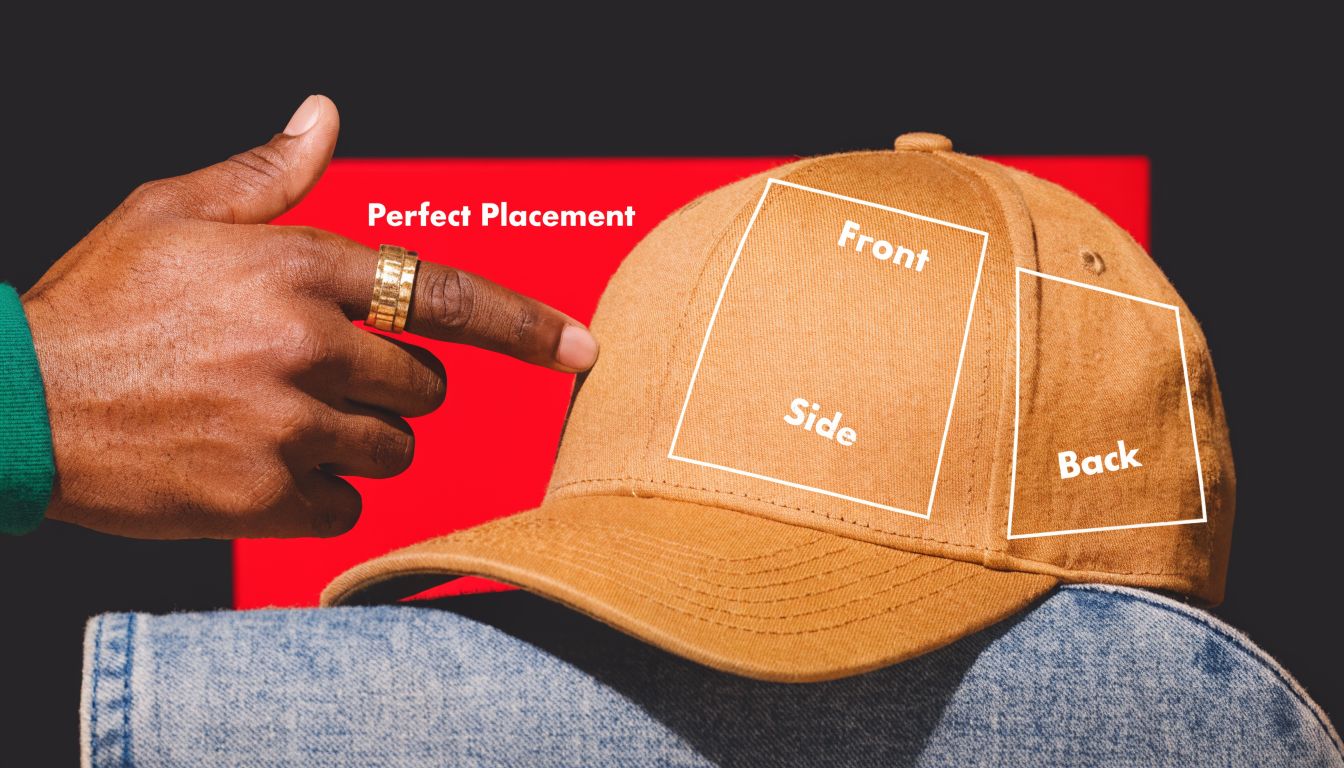
Front-center earns most orders because it gives the cleanest read and the strongest branding value per stitch. For staff uniforms, school programs, resale merch, and sponsor-driven team caps, that usually makes it the safest use of the decoration budget.
The other zones still matter, but each one has a job:
- Front panel: Best for the primary logo, especially if the cap is meant to identify a brand or organization at a distance.
- Side panel: Works for small secondary marks, sponsor logos, flags, or anniversary details.
- Back arch: Good for short text, player names, team names, or a web address if the buyer accepts smaller readability.
- Closure area or strap zone: Better for subtle branding than sales messaging. It can look sharp, but it is not a high-visibility location.
Placement should follow the cap’s construction, not just the art. A six-panel structured cap gives the front logo more support. A softer unstructured cap can distort taller embroidery. Center seams, crown height, button position, and panel taper all affect what will look balanced once the hat is worn, not just when it is laid flat on a table.
That is why a production-minded spec matters. A good proof should show location, width, height, and orientation, and buyers placing larger programs should review how custom embroidered hat orders are typically set up and approved before releasing the job.
Placement mistakes that hit the budget
Bad placement is not only a design problem. It is an operations problem.
If the front logo is too wide, the shop may need to resize the art, simplify the stitch file, or move the design to a different cap style. If the side hit lands too close to a seam or eyelet, the result can look crooked even when the machine runs the file correctly. If a back arch line is too long, the text may wrap awkwardly and lose legibility.
On a small run, those are frustrating errors. On a 288-piece order, they become expensive errors because every correction touches labor, setup time, and delivery dates.
Color choices that hold up in real use
Thread color has to work in daylight, under gym lights, and from several feet away. A subtle tone-on-tone concept can look great in a brand deck and underperform badly on actual headwear.
A few rules save buyers from that outcome:
- Use contrast on purpose: Light thread on dark caps and dark thread on light caps usually reads better and sells better.
- Trim extra colors if they do not add recognition: More thread changes can raise cost and slow production without improving the logo.
- Allow for practical brand matching: Exact Pantone-style thinking matters less if the mark disappears on the hat.
- Review physical thread options whenever possible: Monitors are poor judges of sheen, depth, and visibility.
I usually tell buyers to judge cap color like signage, not like packaging. The logo has to read fast. If the viewer needs good lighting and three extra seconds to figure it out, the design is too quiet for most bulk programs.
One strong thread color often beats a complicated adaptation of a print logo. That is especially true for team orders, workwear caps, and resale runs where consistency, speed, and repeatability matter as much as aesthetics.
Navigating the Ordering and Approval Process
At this juncture, business buyers stop thinking like designers and start thinking like operators.
The order process for custom caps is really a chain of decisions. Blank selection, decoration method, artwork prep, proof approval, quantity, and timing all connect. If one part is rushed, the whole order gets shakier.
The small-order cost problem
One of the biggest frustrations for first-time buyers is that many sellers talk about flexibility but stay vague about what a small order really costs. The custom hat collection page from Underground Printing points to this exact issue: buyers often struggle with cost transparency for small batches, especially when trying to understand the actual difference between ordering 6 pieces versus 50 pieces.
That confusion is normal. Small orders usually carry more setup weight per unit. Larger orders spread that setup out better. So yes, per-piece economics usually improve with volume, but the right order size still depends on your risk tolerance.
For a startup or a booster club, a smaller first run can still be the smart move if it prevents getting stuck with the wrong hat, wrong color, or wrong logo scale.
What you’re usually approving
A proper cap order should not jump straight from “looks good” to full production.
Most buyers should expect some version of this workflow:
- Submit the logo and job details
- Choose the blank cap
- Receive a digital proof or mockup
- Review placement, size, colors, and spelling
- Approve for production
- Receive the finished order and inspect it immediately
For embroidery, there’s often an extra layer behind the scenes. The logo has to be digitized into a stitch file. That’s not busywork. It’s the production blueprint. If the art is complex or not cap-friendly, this stage is where the shop decides what needs simplifying.
If you want a clear look at that workflow before placing an order, this guide on how to order custom embroidered hats lays out the practical steps buyers usually move through.
Approval mistakes that create avoidable problems
The biggest approval mistake is focusing only on the logo itself and ignoring everything around it.
Check these every time:
- Cap model: Make sure the proof matches the actual blank you chose.
- Logo size: A design can be technically correct and still feel too small once worn.
- Placement: Watch for seam interference, crown height, and balance.
- Thread or print colors: Ask what the closest production match will be if exact matching matters.
- Back and side add-ons: Extra placements are where spelling and alignment errors often hide.
A fast approval saves time only if it’s accurate. A rushed proof creates the slowest kind of job, the one that has to be redone.
Lead times and expectations
Lead times vary by stock, decoration load, and proof turnaround. Buyers can help themselves a lot here by replying quickly, approving carefully, and consolidating changes into one message instead of five.
If you’re ordering for an event, season opener, or launch date, build in room for revisions. Caps are not the place to make your deadline depend on a same-day decision chain.
Final Quality Checks and What Comes Next
When the boxes land, don’t hand them out immediately. Open them and inspect them first.
Cap quality control is simple, but it needs to be deliberate. You’re checking both the decoration and the blank itself. A good-looking logo on a flawed cap still creates a bad impression.
What to inspect right away
Use the approved proof as your reference and go piece by piece through a sample of the order first.
- Logo cleanliness: Look for tight stitching, smooth fills, and no loose threads.
- Placement consistency: Check whether the logo sits in the same spot across caps.
- Color accuracy: Confirm the thread or print is what you approved.
- Cap condition: Inspect crowns, brims, closures, and seams for visible defects.
- Overall feel: Put one on. A cap can pass a visual check and still feel wrong in wear.
For embroidered caps, pay attention to puckering on the front panel and distortion around seams. Those are the kinds of issues buyers notice fast once the hats are worn in public.
Think beyond the first batch
A good first order should make the second one easier.
Save your approved proof. Save the exact cap style, color, closure type, and decoration notes. If your team grows, your staff changes, or your event repeats, that documentation keeps the next run consistent instead of turning it into a fresh guessing game.
This is also the point where smart buyers start separating test styles from program styles. You may try a few silhouettes early, then standardize once people start wearing one model more than the others.
The goal isn’t just getting hats made. It’s building a cap program you can reorder without drama.
Custom headwear gets much easier after the first clean run. Once the blank, logo treatment, and approval process are dialed in, you’re not guessing anymore. You’re managing a repeatable product.
If you’re ready to build a clean first run or scale an existing program, Dirt Cheap Headwear is a practical place to start. They handle wholesale blanks and in-house decoration with low minimums, fast turnaround, and the kind of responsive proofing that makes repeat orders easier for businesses, teams, and merch brands.
Pingback: Silk Screen Technique for Custom Headwear: A How-To Guide | Dirt Cheap Headwear
Pingback: Choosing the Best Method of Screen Printing in 2026 | Dirt Cheap Headwear
Pingback: Printing and Embroidery for Hats: A 2026 Comparison | Dirt Cheap Headwear