
6 Panel Baseball Hats: A Practical Buyer’s Guide
You're comparing two caps that look almost identical in a wholesale catalog. Both are six-panel baseball hats, both carry the same basic logo, and both appear suitable for your team, brand, or event. Yet one costs more, one holds its shape better, and the cheaper option may produce a noticeably weaker embroidered result.
The difference usually isn't the panel count alone. Crown structure, fabric, visor construction, sweatband, closure, and decoration method all affect how a cap fits, wears, ships, and represents your organization. This guide breaks down those decisions so you can compare specifications instead of judging a hat only by its product photo.
What Makes a Six Panel Baseball Hat
A six-panel baseball hat has a crown assembled from six fabric sections sewn together. The panels meet at seams that create the rounded top, while the front center seam divides the visible branding area into two balanced front sections. The bill projects forward from the crown, and the sweatband sits inside against the wearer's forehead.
That center seam is the detail buyers often notice only after decoration begins. It gives the hat its familiar baseball-cap appearance, but it also becomes a boundary that an embroidered logo must respect. A design centered over the seam can look balanced when digitized yet appear crowded or distorted if the decorator doesn't account for the seam thickness and crown curvature.
Historical accounts describe a transition from an eight-panel crown to the six-panel configuration recognizable today. Six fabric panels create a rounded, continuous, symmetrical structure, which helped establish the format as a practical piece of athletic headwear rather than a purely decorative accessory (baseball cap history and construction).

Why six panels matter to a buyer
A five-panel cap commonly uses one uninterrupted front panel, creating a cleaner field for large artwork, patches, or printed graphics. A six-panel cap divides that front with a seam, but it offers the traditional rounded baseball silhouette that many teams, schools, companies, and promotional programs expect. For a more detailed comparison, this guide to five-panel versus six-panel hats explains how the layouts affect appearance and decoration.
The six-panel design also gives manufacturers clear front and side areas for logos, lettering, and decorative stitching. That makes it adaptable for a small embroidered mark above the bill, a team emblem across the front, or secondary branding on a side panel.
When you compare wholesale listings, ask for more than “six panel” in the specification. Confirm the profile, whether the crown is structured, the fabric weight, the bill shape, the closure, and the intended decoration method. A concise guide to tech packs can help new buyers organize those details before requesting samples or production quotes.
Practical rule: Treat “six panel” as the starting point, not the complete product description.
How the Crown and Bill Are Built
A cap's comfort and decoration performance come from several parts working together. The crown sections create the upper shape, the bill shades the eyes, the sweatband manages contact with the skin, and the closure controls adjustability. Small changes in any of these components can make two visually similar hats feel very different.
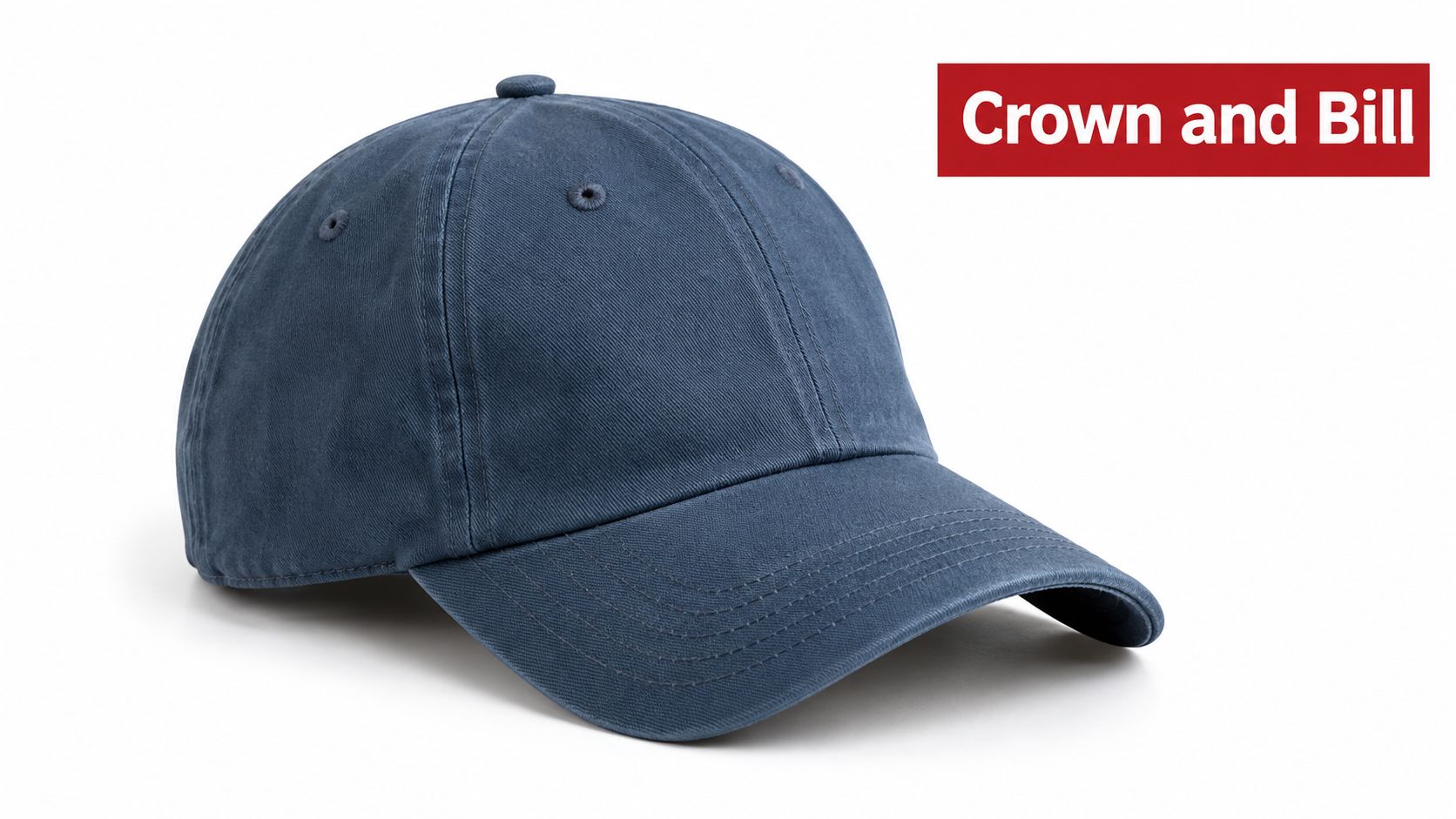
A typical six-panel pattern includes crown sections, a visor, back-hole facing, and sweatband. Internal buckram often stabilizes the front panels, while buckram or a plastic insert reinforces the visor and helps it resist bending (baseball cap manufacturing components).
Crown panels and front stabilization
The front panels determine the hat's visual presence. A structured cap uses an internal stiffener, commonly buckram, to keep those panels upright and create a defined front. This gives an embroidered logo a more stable surface, especially when the design has substantial thread coverage.
The trade-off is feel. A firm front can look crisp on a retail display or team sideline, but it may feel less forgiving for wearers who prefer a soft cap. A flexible fabric can feel more natural, yet it needs careful stabilization during embroidery so the logo doesn't pull the front out of shape.
Seam construction matters as well. If the center seam is bulky, uneven, or poorly pressed, a logo placed too close to it can lose registration. Ask for seam placement and front-panel dimensions in the sample rather than assuming every six-panel pattern offers the same decoration field.
Visor, facing, and sweatband
The visor core controls how the bill holds its curve or flat profile. A stiffer insert supports shape retention, while a softer construction creates a more relaxed feel but may change shape during wear and packing. The bill length and curve also affect eye shading and the amount of usable space below the logo.
Back-hole facing reinforces the openings and helps finish the rear of the crown. The sweatband affects comfort, moisture handling, and the internal fit. For active wear, a soft, moisture-managing sweatband can be more useful than a decorative closure. For casual promotional use, a comfortable cotton-feel band may matter more than technical performance.
Use a production specification that records panel count, crown profile, fabric composition and weight, visor-core material, closure position, seam construction, and sweatband dimensions. A step-by-step baseball cap sewing guide is useful when you need to translate factory terminology into the physical parts you can inspect in a sample.
The following video gives a visual reference for how these components come together:
A tech pack should also state the intended bill length and curve. Those geometry choices change perceived fit, sun coverage, and the available embroidery field. If a supplier can't explain those specifications clearly, request a physical sample before approving a larger order.
Structured vs Unstructured and Other Build Choices
The right six-panel hat depends on who will wear it and what the decoration needs to accomplish. A structured crown usually presents a cleaner logo surface and keeps its silhouette away from the head. An unstructured crown folds and conforms more easily, which can make it feel casual and comfortable, but it offers less support for dense embroidery.
Cotton and polyester create a different set of trade-offs. Cotton often feels familiar and natural for everyday branded merchandise. Polyester can suit outdoor work, sport, and warm conditions where moisture management matters, although some wearers prefer the hand feel of cotton. Neither fabric wins in every application.
| Build Choice | Main Options | Best For |
|---|---|---|
| Crown structure | Structured or unstructured | Structured for crisp branding, unstructured for relaxed comfort |
| Fabric | Cotton, polyester, blends | Cotton for casual use, polyester for active or outdoor programs |
| Closure | Snapback, strapback, fitted, stretch fit | Adjustable closures for varied groups, fitted styles for consistent sizing |
| Bill | Curved or flat | Curved for traditional athletic wear, flat for a sharper streetwear look |
| Front support | Buckram or softer front | Buckram for shape and embroidery stability, softer fronts for flexibility |
Match the build to the program
A small business giving hats to staff and customers usually benefits from an adjustable closure and a familiar curved bill. That combination reduces fit problems and works across casual settings. A coach ordering team headwear may prefer a structured front when the logo needs to look uniform across photographs, uniforms, and sideline wear.
A retail brand has more room to make a deliberate style choice. An unstructured cotton cap can support a washed, relaxed identity, while a structured snapback can create a more prominent logo silhouette. Fitted hats offer a clean rear profile, but they require accurate size planning and may create more complexity for a mixed group.
Snapbacks provide quick adjustment, though the plastic closure can feel less refined for some retail concepts. Strapbacks offer a softer visual finish and can suit heritage-inspired products. Stretch-fit closures remove the visible adjustment hardware, but they still need a thoughtful size strategy because stretch doesn't eliminate differences in crown depth or wearer preference.
Buyer's test: Put the sample on an actual wearer, then inspect the logo from the front, side, and seated position. A cap that looks good on a flat table may not present the same way on a head.
Don't compare price without comparing the components behind it. A lower-priced blank may use a lighter fabric, weaker visor core, simpler sweatband, or less stable front. Those savings can be sensible for a short promotional event, but they're harder to justify for a retail product expected to survive repeated wear.
For a more detailed explanation of front support and crown feel, use this comparison of structured and unstructured hats when building your shortlist.
Embroidery and Decoration on a Curved Surface
Embroidery is where a six-panel order earns or loses its value. The decorator isn't stitching onto a flat rectangle. The front panels curve around the head, the center seam introduces a physical obstruction, and the fabric can move under thread tension.
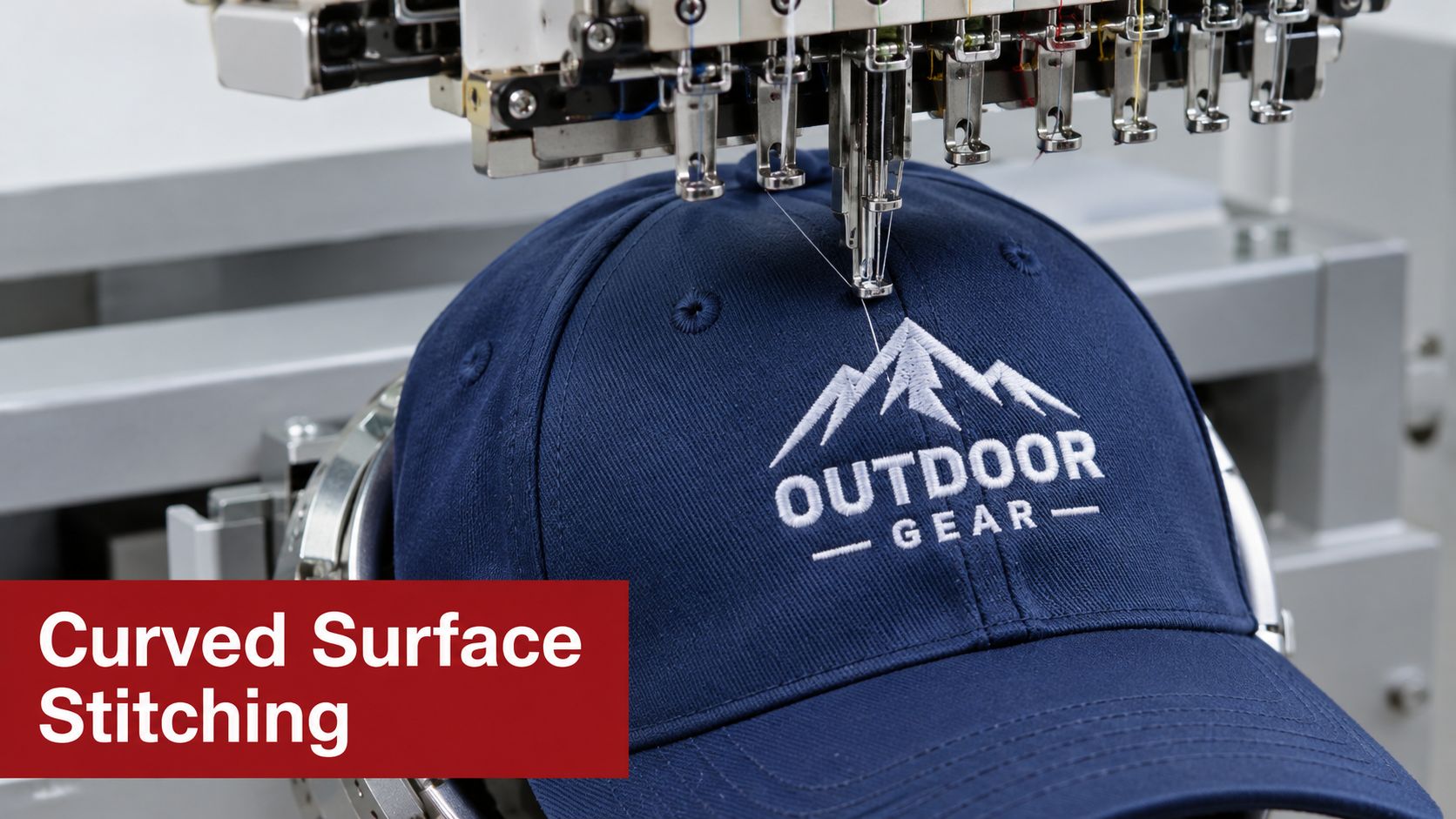
Start with artwork that respects the blank. Bold lettering and simplified shapes usually survive curvature better than tiny type, narrow strokes, or intricate interior details. A logo that works perfectly on a shirt may need a separate hat version with heavier strokes, fewer small elements, or a different size.
Control movement before adding stitches
Underlay anchors the fabric before the visible stitches build the logo. Backing supports the material from inside the cap, while push-pull compensation adjusts the digitized design for the way thread can draw fabric inward or shift it outward. The right combination depends on the fabric, backing, stitch type, and design.
Research on machine embroidery identifies stitch density, filling method, thread type, and textile characteristics as important determinants of dimensional accuracy. Changes to those variables can cause the finished image to differ geometrically from the original digitized artwork (embroidery quality and dimensional accuracy).
Excessive density is a common mistake. More stitches don't automatically create a better logo. Dense thread coverage can produce puckering, seam stress, a stiff hand, or distortion on a lightweight front. A skilled decorator adjusts density to the blank instead of forcing one file across every cap style.
Choose the decoration method honestly
Flat embroidery is the dependable starting point for most logos. It works well for readable lettering, solid marks, and designs that need a clean profile. Fine-detail stitching can succeed when the file, thread, fabric, and size are carefully matched, but tiny text is unforgiving.
Three-dimensional puff embroidery adds height and presence, particularly on a stable structured crown. It needs bold shapes, adequate space, and a front panel that can support the dimensional material. Thin lettering, tight counters, and lightweight unstructured fabric are poor candidates because the raised effect can collapse or distort.
Approve a physical sew-out on the actual six-panel blank before bulk decoration. Check the logo's relationship to the center seam, thread coverage, registration, lower-edge distortion, and overall scale. A digital proof shows placement, but only a sewn sample reveals how the crown and thread behave together.
Production safeguard: Never approve a dense or dimensional hat logo from a screen proof alone.
Fit Sizing and Climate Performance
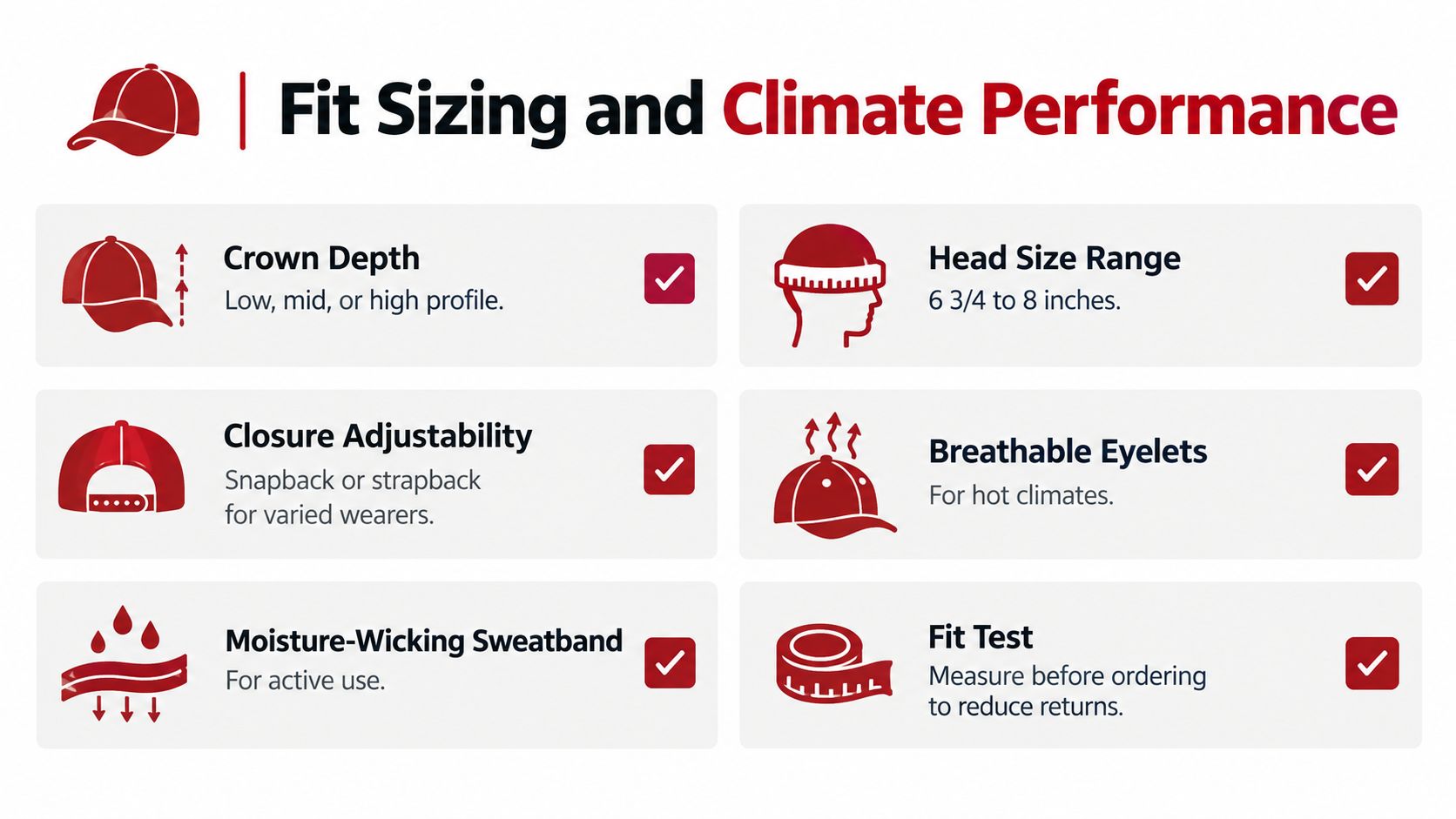
A decorated cap can look excellent and still fail if the wearer can't comfortably keep it on. Fit starts with crown depth and head circumference, then extends to the closure, sweatband, ventilation, and bill shape. Buyers should test the cap on people with different hair volume, head sizes, and pressure preferences rather than relying on a single sample wearer.
A low-profile crown may suit casual, close-fitting wear, while a mid or high profile creates more room and a stronger front silhouette. Structured fronts can support decoration, but the added firmness may feel restrictive to someone who prefers a soft crown. A closure with useful adjustment gives a mixed group more flexibility than a fitted style ordered without careful sizing.
Build a use-case match
For an indoor event, everyday cotton and a comfortable sweatband may be enough. Outdoor crews and athletes may need moisture management, ventilation, a brim that shades the eyes, and a fabric that remains comfortable during activity. Market reporting identifies moisture management, UV protection, lightweight construction, and recycled materials as key headwear attributes, while caps held the largest headwear category share in 2025 (headwear market reporting).
Those features need careful interpretation. Moisture-wicking material may help during sport or outdoor work, but it may not feel as natural for casual wear. UV protection depends on fabric construction and coverage, not just a label. Eyelets can improve airflow, but they don't solve a poor crown fit or an uncomfortable sweatband.
Use this checklist before ordering:
- Crown depth: Decide whether a low, mid, or high profile suits the wearer group.
- Adjustment range: Choose snapback or strapback when one order must accommodate varied heads.
- Hair and pressure: Test the cap on people with thick hair and on wearers sensitive to tight bands or rigid fronts.
- Climate: Prioritize ventilation and moisture management for heat and activity, but don't over-specify performance features for indoor programs.
- Bill shape: Match a curved or flatter bill to the desired eye shading and visual identity.
For fitted styles, a practical hat sizing guide can help buyers measure before committing to a size assortment. For adjustable caps, inspect the smallest and largest useful settings, not only the middle position.
Materials Sustainability and End of Life
Sustainability language around six-panel hats needs more detail than “made with recycled polyester.” That phrase may describe recycled content, but it doesn't prove the cap is part of a closed material loop or easy to recover after use.
Polyester accounted for about 59% of global fiber production in 2024, while approximately 7.6% of all fibers were recycled. Around 98% of recycled polyester feedstock came from PET bottles, and true textile-to-textile recycling represented less than a broad share of global fiber output, according to industry analysis of recycled inputs.
That distinction matters for wholesale buyers. A cap can contain recycled polyester and still combine several materials that complicate recovery, including embroidery thread, adhesive backing, buckram, sweatbands, plastic closures, and mixed-fiber panels. Decoration can improve the product's usefulness and lifespan while making separation more difficult at disposal.
Ask better sustainability questions
Request the recycled-content percentage and the fiber composition. Ask whether the supplier is describing post-consumer material, production waste, or a bottle-derived feedstock. Confirm care instructions, expected service life, and whether the decoration package introduces materials that affect end-of-life handling.
Cotton and polyester both involve trade-offs. Cotton may offer a familiar feel, while polyester can deliver performance and durability suited to demanding use. A durable cap worn repeatedly can make more practical sense than a lower-impact claim attached to a product that loses its shape quickly and gets discarded.
A responsible buying framework weighs four things together:
- Material evidence: What fibers are present, and what recycled content can the supplier document?
- Service life: Will the structure, bill, seams, and decoration withstand the intended use?
- Decoration complexity: Do backing, puff materials, patches, or mixed threads complicate recovery?
- End-of-life reality: Can the cap be repaired, reused, donated, or processed through a known route?
Don't label one fabric universally sustainable. Specify what you're buying, how long it should last, and what users should do with it afterward.
Brands Wholesale Orders and Buying With Confidence
Wholesale catalogs often include Richardson, YP Classics and Flexfit, New Era, Nike, Valucap, and Legacy six-panel styles. Treat the brand name as a starting point, not a substitute for reviewing the exact model. Within one brand, fit, profile, fabric, closure, front support, and bill construction can vary widely.
Richardson is commonly considered for team, outdoor, and promotional programs. YP Classics and Flexfit offer structured, adjustable, and stretch-oriented options for branded merchandise. New Era and Nike can suit buyers who need a more recognizable athletic or retail association, while Valucap and Legacy can help fill different price and style positions. Confirm current availability and decoration compatibility for the specific blank rather than relying on a general brand reputation.
The cap's history explains why the format remains so recognizable. Smithsonian reporting describes specialized stitching supporting a higher, comfortable six-panel crown, while the bill originally served to block sunlight from players' eyes (Smithsonian history of the baseball cap). Those practical roots still matter when you choose a bill, crown, and sweatband for real wear.
Check the order before approval
Ask the distributor to confirm:
- Exact style: Record the model, profile, structure, fabric, closure, and bill shape.
- Stock position: Verify available colors and sizes before finalizing artwork.
- Decoration plan: Confirm flat embroidery, fine detail, puff, patches, or printing and request a physical sew-out when needed.
- Fit sample: Test the blank on representative wearers, including people with larger heads, thick hair, and pressure sensitivities.
- Delivery details: Confirm blank availability, decoration lead time, shipping destination, and reorder process.
- Proofing: Make sure the approved proof identifies placement relative to the center seam.
If you're also evaluating resale inventory or broader apparel sourcing, a practical resource on sourcing second-hand clothing can help you think through product condition, assortment consistency, and resale requirements.
Dirt Cheap Headwear is one wholesale option for this process, offering blank six-panel styles and custom embroidery, patches, and printing for businesses, teams, brands, and events. Its in-house decoration service includes low-minimum custom work, while buyers can also order blanks when they already have a decorator.
Dirt Cheap Headwear can help you source blank six-panel baseball hats, compare structured and unstructured options, and prepare embroidery or patch decoration for your program. Visit Dirt Cheap Headwear with your logo, wearer profile, target use, and preferred cap style ready, then request a sample or quote before placing the full order.