You're probably here because mesh hats seem like an easy win. You need staff merch, team hats, retail stock, or a giveaway item that won't get tossed in a closet. Then you open a few wholesale catalogs and run into a wall of lookalike trucker caps, confusing fit terms, and brand names that all claim quality.
That's where most first bulk orders go sideways.
A mesh hat can be cheap and wearable, or cheap and disposable. It can stitch cleanly, or pucker around your logo. It can hold its shape for months, or collapse after a few hot days in the truck. The difference usually isn't the marketing. It's the build, the panel shape, the mesh quality, and whether the style fits the job you need it to do.
Mesh hat brands matter because hats are no longer just utility items. The broader headwear market is projected to grow from USD 39.37 billion in 2026 to USD 62.83 billion by 2033, according to Grand View Research's headwear market outlook. For a buyer, that matters less as trivia and more as context. Brands keep investing in blanks, customization, and replenishable programs because there's real demand behind this category.
Your Guide to Choosing the Right Mesh Hat
A lot of new buyers start with the same assumption. “It's just a trucker hat. Pick a color, add a logo, done.”
That works right up until samples arrive.
One cap feels stiff in a good way and takes embroidery cleanly. Another looks fine online but has a front panel that ripples after stitching. One fits broad head sizes well enough for an event table. Another has a shape that works for retail but not for crews wearing it all day. On paper they're both mesh hats. In practice they're different products.
The first thing to get straight is what you're buying. You're not buying “a hat.” You're buying a combination of fit, decoration surface, airflow, and repeatability. If you need reorders later, that last part matters more than most first-time buyers realize.
What new buyers usually get wrong
Most ordering mistakes come from focusing on color and price before construction.
- They shop by photo first: A clean product image doesn't tell you whether the front panel is stable enough for detailed embroidery.
- They assume all trucker caps fit the same: They don't. Crown height, panel count, and structure change the look on the head.
- They ignore the end use: A hat for a brewery merch wall isn't the same hat you'd choose for field crews or tournament volunteers.
- They decide on decoration too late: Some logos look better as direct embroidery. Others need a patch because the hat shape or artwork won't cooperate.
Practical rule: If you're ordering bulk mesh hats for the first time, choose the blank based on decoration and wear conditions first. Choose color second.
That approach saves money because it reduces avoidable redraws, bad proofs, and disappointing first samples.
What actually matters on a first order
If you're trying to narrow the field quickly, start with four questions:
- Who's wearing the hat?
- How often will they wear it?
- Will the logo be embroidered directly or applied as a patch?
- Do you need easy reorders from the same brand and style?
Buyers who answer those four questions early usually make better choices than buyers who start by asking which mesh hat brands are “best.” There isn't one best brand. There's a best fit for the job.
What Exactly Defines a Mesh Hat
A mesh hat is simple once you stop looking at the buzzwords. Solid front. Ventilated back. Built to give you a clean branding area without turning the whole cap into a heat trap.
That's why mesh-backed styles have stayed relevant for so long. According to Mordor Intelligence's headwear market report, caps and hats accounted for 59.10% of headwear market share in 2025. Mesh-backed styles sit right inside that dominant category because they work for both promotion and everyday wear.
The basic anatomy
The easiest way to think about a mesh hat is this: business in the front, airflow in the back.
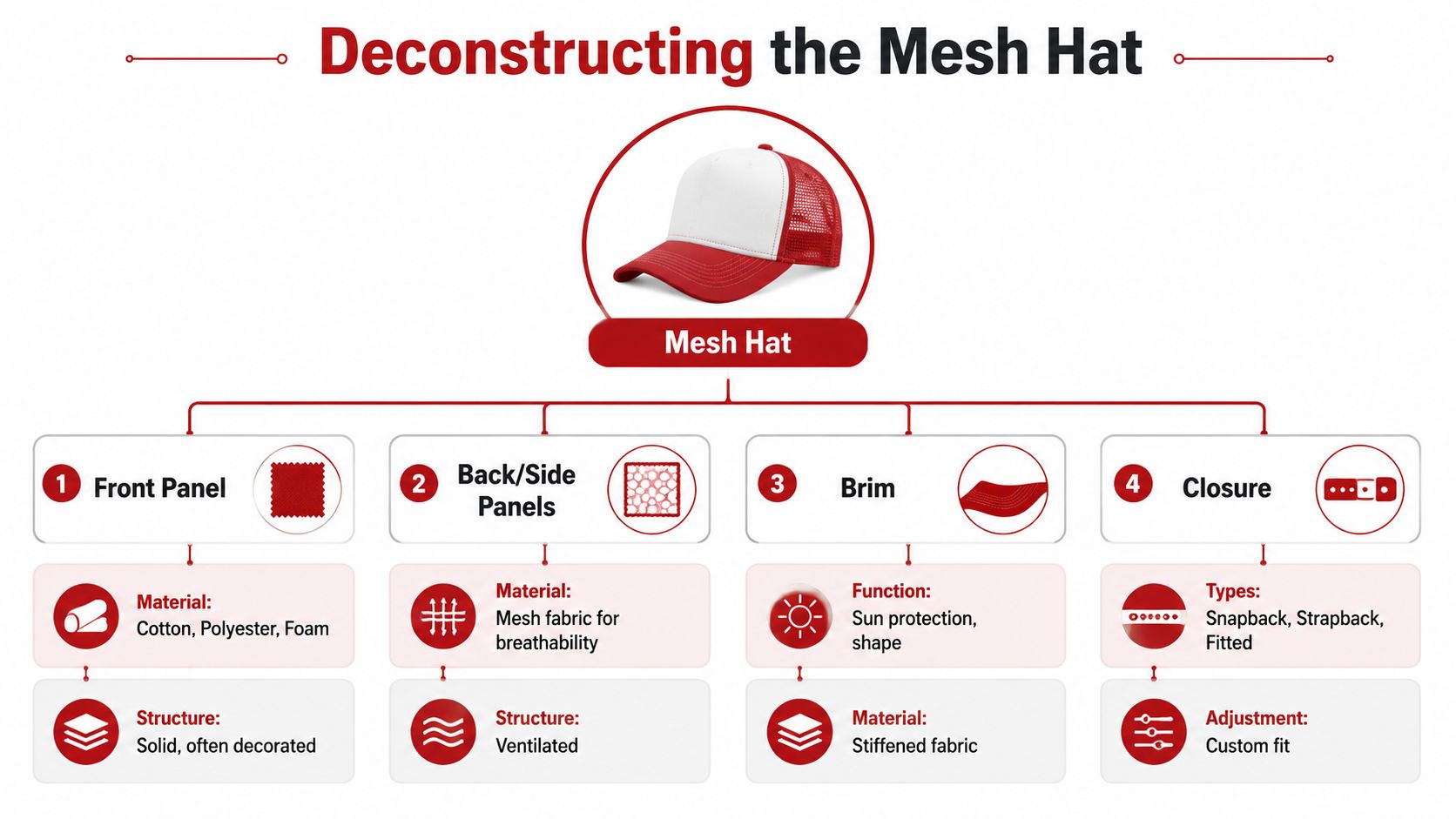
The main parts are straightforward:
- Front panel: Usually cotton, polyester, foam, or a blend. This is the part that carries your logo.
- Back and side panels: Mesh. That's where the ventilation comes from.
- Brim or bill: Provides shape and sun shielding for the face.
- Closure: Usually snapback on trucker styles, though some brands offer fitted or strap options.
If you're buying for decoration, the front panel does most of the heavy lifting. If you're buying for comfort, the mesh and sweatband matter more than people expect.
Why trucker styles dominate the category
Most mesh hat brands are really competing inside the trucker-cap world. That design became popular for a reason. It solves two problems at once: it gives brands a visible front panel and gives wearers more airflow than a fully fabric cap.
A common trucker build uses a five-panel crown. One larger structured front panel creates a cleaner decorating surface, while the rear mesh panels keep the cap lighter and cooler. That basic setup is why trucker caps keep showing up in workwear, sports-adjacent merch, farm supply branding, outdoor retail, and casual lifestyle collections.
A mesh back helps with airflow, but it also changes what you can do with side decoration and how much fabric coverage the hat gives the wearer.
That trade-off gets ignored in a lot of consumer-style buying guides.
Terms worth knowing before you order
Here's the language that comes up most often when buyers compare mesh hat brands:
| Term | What it means | Why it matters |
|---|---|---|
| Structured | Front panel holds shape | Better for embroidery and logo presence |
| Unstructured | Softer, more relaxed crown | Better for laid-back retail looks, less ideal for bold front logos |
| 5-panel | One larger front panel | Cleaner canvas for patches and embroidery |
| 6-panel | Split front seam | Can affect centered logo placement |
| Snapback | Adjustable plastic closure | Easy for events and mixed head sizes |
| Low profile / mid profile / high profile | Crown height and silhouette | Changes fit, style, and how large the logo appears |
If you understand those terms, you'll read product pages much more accurately and avoid ordering by guesswork.
Decoding the Features That Differentiate Brands
Two mesh hats can look nearly identical in a thumbnail and perform very differently once you decorate them. That usually comes down to construction.
A key technical difference is the five-panel crown. In that setup, a structured front panel gives you an uninterrupted decoration area, while four rear mesh panels improve airflow and help reduce heat buildup in active or outdoor settings, as described in this trucker cap construction explainer.
Front panel material changes the whole result
The front panel is where good custom hats are won or lost.
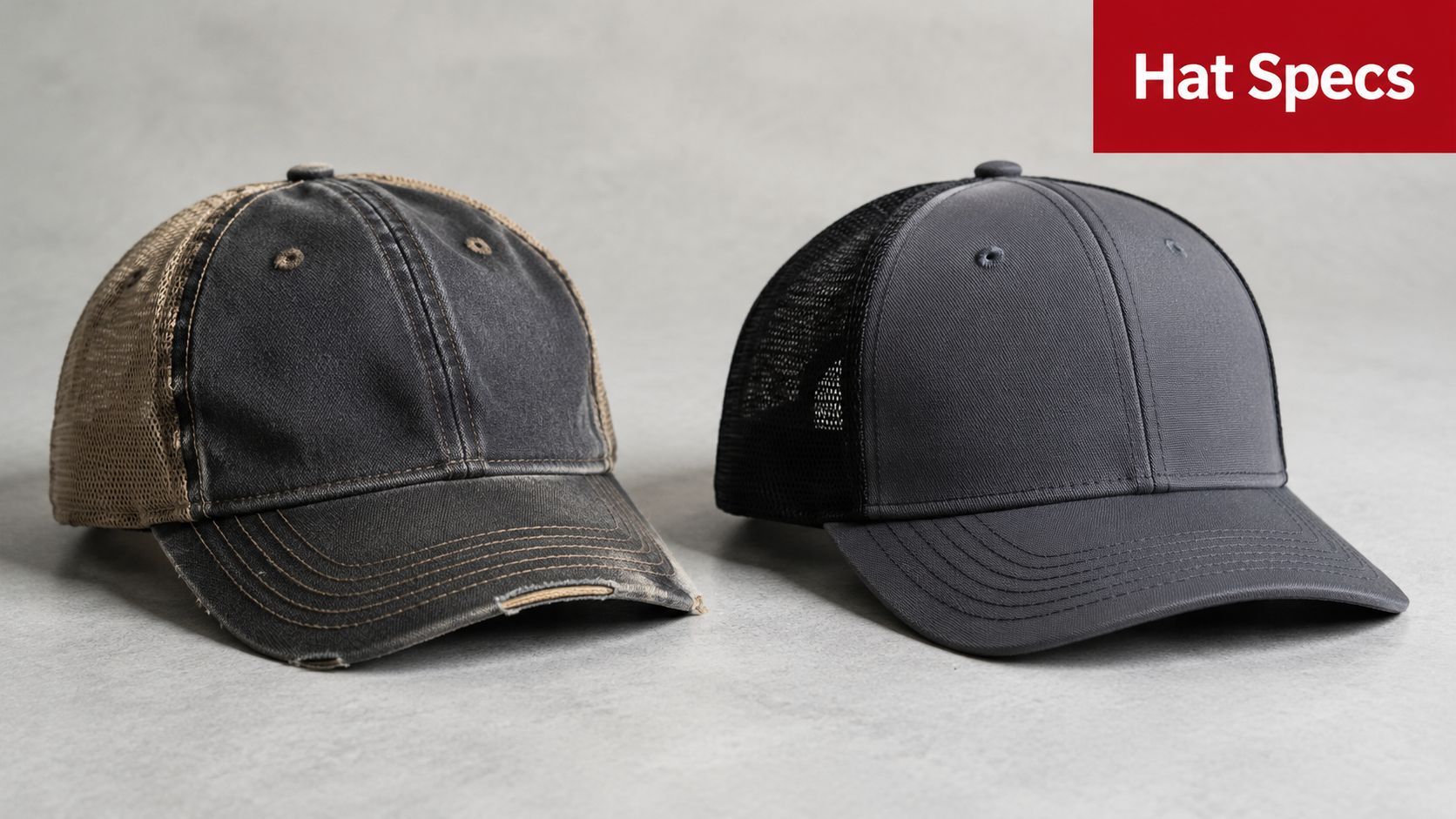
Commercial trucker caps often use builds like 100% polyester front panels with mesh backs, while some premium-feeling options use 60% cotton / 40% polyester fronts paired with 100% polyester mesh backs, as shown in CapBargain's trucker cap buying guide. In practical terms, polyester-heavy fronts usually hold shape better and resist moisture well. Cotton-poly fronts often feel softer but can be less forgiving if the stitching, hooping, or logo density isn't dialed in.
If your design has fine text or compact detail, stable front panels matter more than softness.
Mesh quality is not a minor detail
A lot of buyers focus on crown shape and ignore the mesh. That's a mistake.
Cheap mesh tends to show problems fast. It can feel scratchy, lose tension, or make the whole cap look tired after regular wear. Better mesh keeps its shape, supports the crown visually, and stays more comfortable when the hat gets used for real work instead of occasional casual wear.
Three quick checks help separate stronger blanks from weaker ones:
- Look at the mesh pattern: Dense, even mesh usually wears better than loose, inconsistent openings.
- Check attachment points: Where the mesh meets the front panel, sloppy sewing often predicts long-term failure.
- Flex the cap lightly by hand: If the back collapses too easily, the hat may not recover shape well after packing and wear.
The mesh isn't just there for ventilation. It affects how premium the whole cap feels once it's on someone's head.
Five-panel versus six-panel
This is one of the few spec debates that matters.
A five-panel mesh hat gives you a broad uninterrupted front. That's helpful for bold logos, patches, and centered artwork. A six-panel hat has a seam running down the front, which can interfere with detailed embroidery or make larger patch placement more awkward.
That doesn't mean six-panel hats are bad. Some buyers prefer the fit and contour. But if decoration is the priority, five-panel styles usually make life easier.
Build details buyers should inspect
Some quality markers don't show up in the sales copy. You have to look for them.
| Feature | What to inspect | Why it matters |
|---|---|---|
| Stitching | Even lines, clean edge finishing | Better durability and cleaner decoration appearance |
| Shape retention | Whether crown springs back after handling | Important for shipping, storage, and daily wear |
| Sweatband feel | Scratchy versus smooth contact | Affects whether people actually keep wearing it |
| Closure strength | Snapback tabs and holes | Weak closures fail early on promo hats |
| Bill consistency | Uniform curve and stiffness | Helps hats look consistent across bulk orders |
Those details don't make exciting marketing copy. They do decide whether a hat feels like real merch or a throwaway item.
Comparing Top Mesh Hat Brands for Wholesale
The right way to compare mesh hat brands isn't by popularity. It's by how each brand behaves once you decorate it, box it, reorder it, and hand it to actual wearers.
Brand quality is best judged by stitching consistency, mesh durability, and shape retention after repeated use, which is the standard highlighted in Flexfit's trucker cap guide. That's a much more useful filter than lifestyle positioning.
Richardson for consistency and broad appeal
Richardson is the name many buyers run into first, and for good reason. Their trucker styles are known in the custom world because they tend to give decorators what they need: predictable fit, stable front panels, and a shape people already recognize.
For teams, trades, and general branded merch, Richardson usually makes sense when you want a safe pick that won't surprise you in production. Their better-known profiles also help with reorders because customers often come back asking for “the same hat again.”
YP Classics and Flexfit for modern fit options
YP Classics and Flexfit sit in a useful lane for buyers who want a more fashion-aware or premium-leaning look. Their trucker and mesh-back options often appeal to apparel brands, streetwear projects, and retail-minded buyers who care as much about silhouette as they do about decoration.
They're also worth considering when fit is part of the product story. Some buyers want that cleaner, more current profile rather than a purely workwear-style trucker shape.
If you're comparing options in that lane, this roundup of trucker cap brands and their wholesale differences is a practical place to sort through profiles and use cases.
New Era for sports-adjacent premium positioning
New Era carries weight with buyers who want sports credibility in the finished product. Not every customer needs that, but some absolutely do. If you're building merch around leagues, fanwear, or a more polished athletic look, brand recognition can help the finished hat feel more intentional.
The trade-off is simple. Once branding on the blank matters, budget flexibility usually matters too.
Valucap for price-sensitive promotions
Valucap usually enters the conversation when quantity matters and the budget is tight. For events, outreach, volunteer gear, or simple logo programs, value-focused brands can make sense if the decoration is straightforward and expectations are realistic.
That said, a lower price point only works if the front panel still decorates cleanly and the cap doesn't feel flimsy in hand. The cheapest mesh hat is expensive if people won't wear it.
If you're buying promotional mesh hats, ask a tougher question than “Is this affordable?” Ask “Will this still look acceptable after it gets worn for a week?”
A simple brand-fit view
| Brand lane | Strong fit for | Watch for |
|---|---|---|
| Richardson | Teams, trades, all-purpose branded merch | Some buyers may want a more fashion-forward silhouette |
| YP Classics / Flexfit | Apparel brands, premium casual merch, modern fits | Match the style carefully to your decoration method |
| New Era | Sports-oriented retail, branded fanwear | Higher brand-driven cost expectations |
| Valucap | Large promo runs, events, outreach | Verify panel stability and hand feel before going big |
That's usually the cleanest way to evaluate mesh hat brands. Not by hype. By job fit.
A Buyer's Guide for Teams Retailers and Events
The best mesh hat for one buyer can be the wrong one for another. That's why broad “top 10” lists usually aren't enough. End use changes everything.
One under-discussed trade-off is that a mesh back improves airflow but can reduce sun protection and limit fabric area for certain logo placements, a point raised in this discussion of mesh-back hats and practical wear trade-offs. That matters a lot when you're choosing between outdoor workwear, retail merch, and event giveaways.
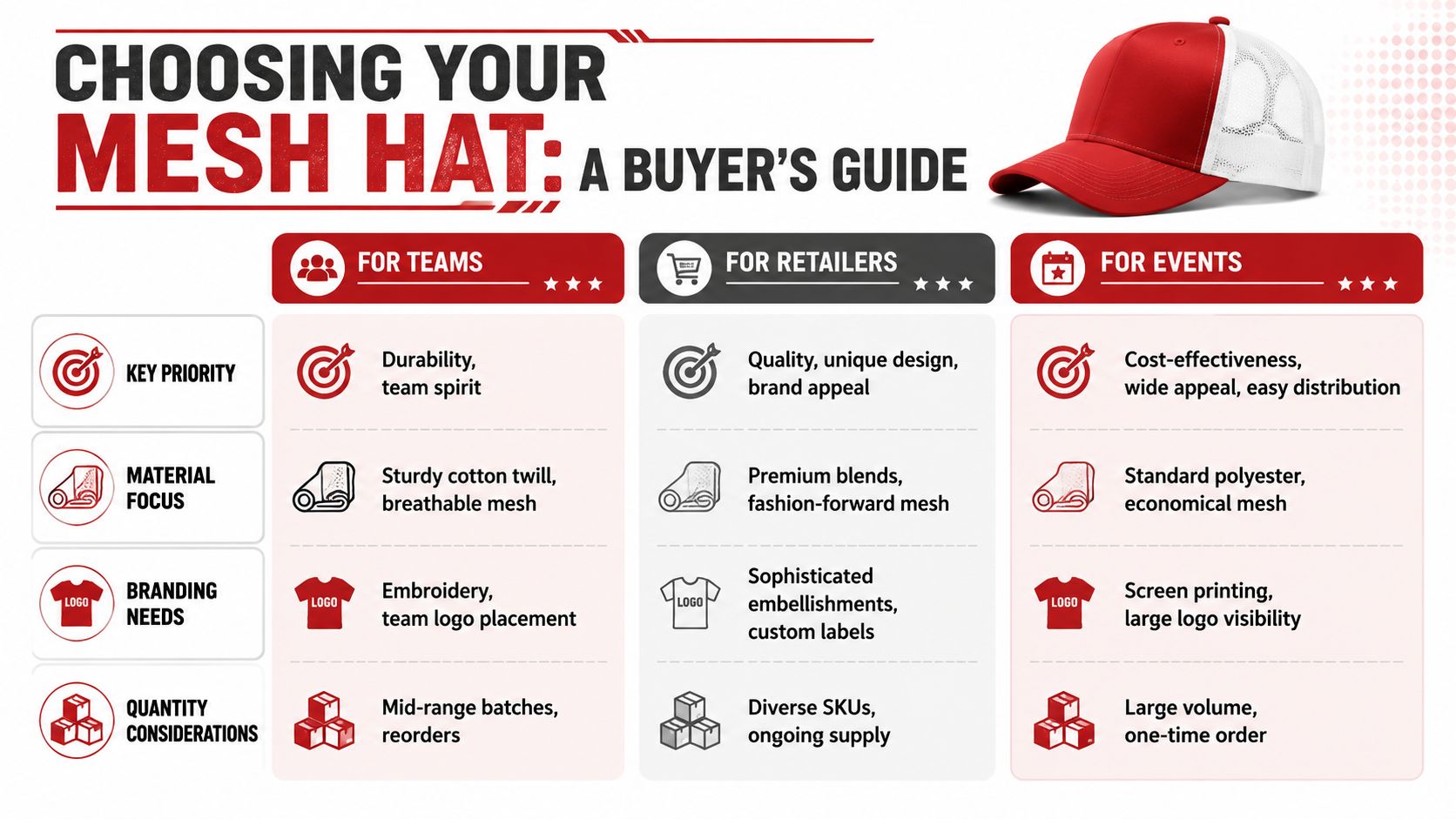
For teams and leagues
Teams usually need hats that survive repeat wear, travel, and rough handling in gear bags. They also need colors that stay close to uniforms and logos that remain readable at a distance.
That pushes most team buyers toward structured fronts, dependable snapbacks, and shapes that work across a range of head sizes.
Good team-buying priorities look like this:
- Choose shape over novelty: A classic structured trucker profile is easier to reorder and easier for players, coaches, and parents to wear.
- Prioritize embroidery stability: Team marks often include outlined letters and compact detail. The hat has to hold that stitching well.
- Keep reorders in mind: If you run programs season after season, stock consistency matters almost as much as the first order.
For clubs also building out a broader merch package, SoccerWares' guide on custom apparel is useful because it shows how headwear fits into a wider teamwear system instead of living as a one-off item.
For retailers and apparel brands
Retail buyers should be pickier than promo buyers. The hat has to sell off a shelf or online product page. That means fit, crown height, color selection, and feel all matter.
A cap that's technically durable but visually clunky won't move well in a retail setting, making YP Classics, Flexfit, and select higher-finish trucker styles often a more sensible choice than basic giveaway blanks.
Retail-focused buyers should lean into:
| Retail priority | Better choice | Why |
|---|---|---|
| Silhouette | Cleaner profile, often structured | Sells better when shape looks intentional |
| Decoration style | Patch or refined embroidery | Creates a more branded, less promotional feel |
| Color strategy | Curated neutrals or brand-matched tones | Easier to merchandise across collections |
If your store plans to test several blanks before committing, this guide to buying bulk blank trucker hats that stitch well can help narrow which styles are easier to decorate cleanly.
For events and promotional programs
Event buyers usually need simplicity. One hat has to fit a mixed crowd, carry a visible logo, and stay inside budget.
That doesn't mean you should automatically buy the cheapest mesh hat available. For events, comfort and immediate visual appeal matter because recipients make a keep-or-trash decision fast.
A promo hat succeeds when someone puts it on the same day they receive it.
For that reason, event orders usually do best with structured fronts, easy snapback sizing, and uncomplicated logo placement. Avoid fussy side placements or overbuilt decoration unless the program is intentionally premium.
Tips for Customization and Long-Term Care
Once you've picked the blank, decoration becomes the next make-or-break decision. Most mesh hats perform best when you keep the artwork focused on the front panel and match the method to the hat's structure.
Choose the right decoration method
Direct embroidery works well when the front panel is structured and the logo isn't overloaded with tiny detail. It gives the hat an integrated look and usually holds up well with daily wear.
Patches work better when you want more texture, a badge look, or a design that doesn't translate cleanly into stitched fill. They're also useful when the logo needs visual separation from the fabric beneath it.
A few practical rules help:
- Use direct embroidery for simple marks: Clean logos, bold lettering, and team initials usually translate well.
- Use patches for tougher artwork: Vintage graphics, badge-style logos, and layered brand marks often look stronger as patches.
- Respect the panel shape: Don't force oversized decoration onto a crown that can't support it neatly.
If you're testing louder colorways for summer promos or retail drops, these neon mesh hats are a useful reference point for how bold blanks can change the feel of the finished design.
Keep the hats looking good
A mesh hat doesn't need complicated care, but bad cleaning habits ruin shape fast.
Do this instead:
- Spot clean first: Use mild soap, a soft cloth, and light pressure on sweat marks or dirt.
- Avoid full machine washing when possible: Aggressive cycles can warp the bill and stress the crown.
- Air dry only: Heat is rough on structure, mesh, and decorative elements.
- Store them with support: Don't crush finished hats under heavier boxes if you want the front panels to stay crisp.
Wash for shape, not just cleanliness. A perfectly clean hat that lost its crown shape is still a bad-looking hat.
How to Place Your Custom Order Today
A lot of first orders go off track in the same place. The buyer has a logo ready, a deadline on the calendar, and a rough budget, but the hat style is still undecided. That is how you end up approving art on a blank that cannot hold the decoration well or paying for a revision after samples have already been discussed.
The cleanest ordering process starts with the blank and works forward from there. Choose the mesh hat brand, profile, color, and closure first. Then confirm the decoration method, review the proof, and release the order for production.
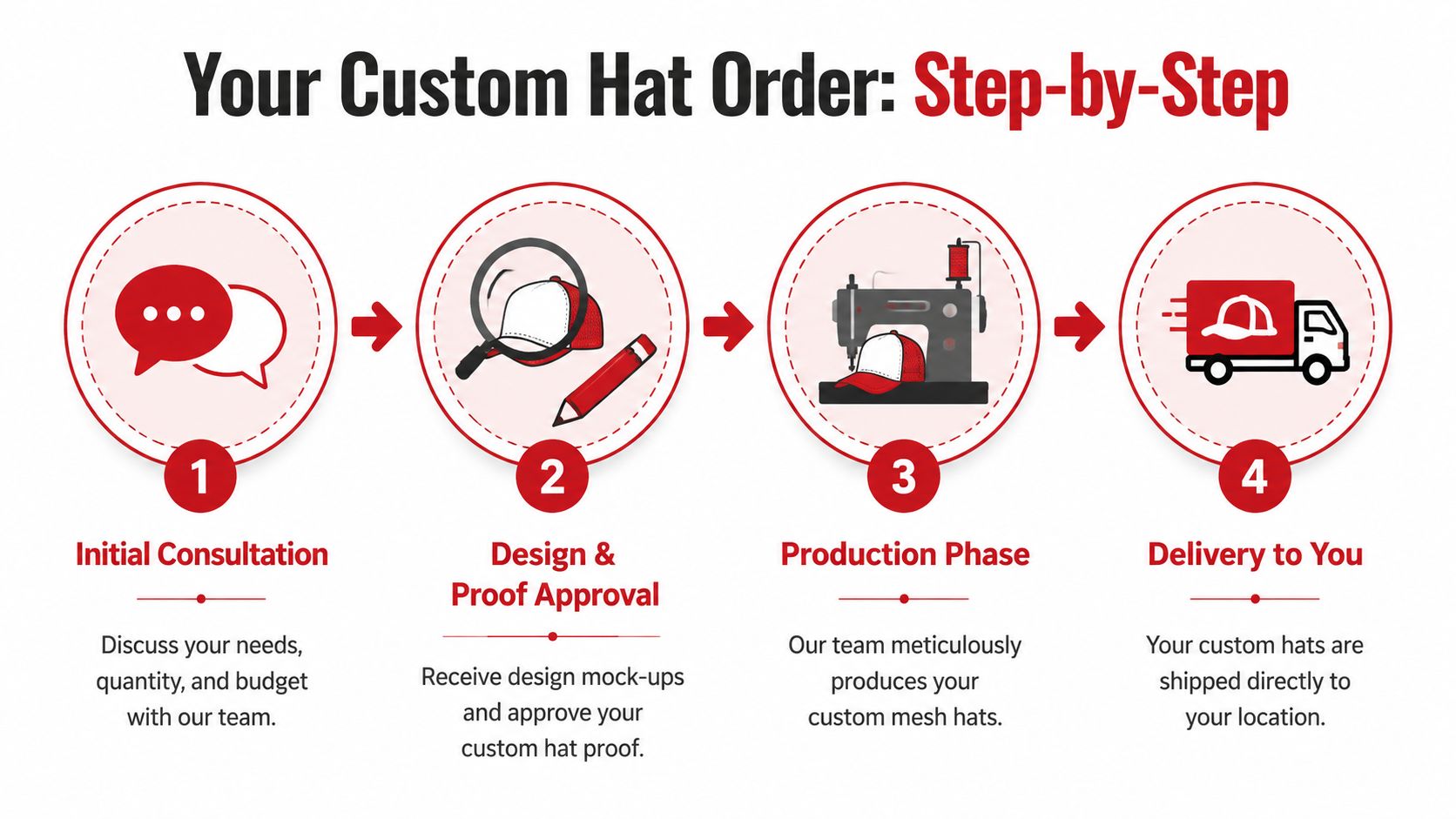
The order flow that keeps problems down
Start with product fit. A structured trucker with a tall front panel gives embroidery more room than a lower-profile mesh cap, and that affects what your logo will look like before a single stitch is sewn.
Use this sequence to keep quoting and production tight:
- Choose the blank first: Set the brand, profile, colorway, and closure before discussing final decoration details.
- Send usable artwork: Vector files or clean high-resolution art reduce redraw time and proof corrections.
- Check the proof like a buyer, not just a designer: Look at logo width, stitch density, placement, and whether the design fits the crown shape cleanly.
- Approve against the actual use case: Event giveaways, retail shelves, and employee uniforms often need different sizing, materials, or price targets.
This short video gives a useful visual reference for the process and helps set expectations before production starts.
What to have ready before you request pricing
Clean quote requests get better answers. If a supplier has to guess on quantity, decoration type, or deadline, the first quote is often only a placeholder.
Have these details ready before you ask for pricing:
| What to prepare | Why it helps |
|---|---|
| Preferred hat brand or style | Keeps the quote tied to the right profile and panel shape |
| Estimated quantity | Affects both blank sourcing and decoration setup |
| Logo file | Shows whether embroidery, a patch, or another method fits the artwork |
| Target use | Helps match the hat to staff wear, resale, team orders, or event distribution |
| Deadline | Sets realistic production and shipping options |
If you want one source that handles both blank wholesale headwear and decoration, a specialized supplier can quote mesh and trucker hat styles, confirm decoration options, and send a proof before production. That usually saves time on a first order, especially if you are still comparing brands and trying to keep minimums under control.
If you're ready to test a few mesh hat brands without overbuying, Dirt Cheap Headwear is a practical place to start. You can compare wholesale blanks, submit a logo for embroidery, and build a small run before committing to a larger reorder.
Pingback: Bulk Hats With Printed Logos That Actually Work | Dirt Cheap Headwear